Category: Cost Guides

  • Air Dome ROI Calculator for Sports Facilities

    Air Dome ROI Calculator for Sports Facilities

    You can expect a complete return on your air dome investment within 2-5 years, with proven facilities generating $560,000 in revenue during just eight months of operation. Construction costs range from $1-4.6 million depending on your sport, while annual operating expenses stay low at $3-6 per square foot. You’ll benefit from 30% membership growth through year-round programming, plus additional income of $150K-$300K annually. The specifics of financing options and break-even calculations will help you maximize your facility’s profit potential.

    Air Dome ROI Basics: Investment Returns for Sports Facilities

    When you’re evaluating air dome investments for your sports facility, the financial returns consistently demonstrate compelling value across multiple revenue streams.

    Your air dome ROI calculations should factor in the proven $560,000 revenue generation achieved by single facilities in just eight months, alongside 30% membership growth from shifting seasonal operations to year-round programming.

    You’ll find comparable facilities consistently double their total revenue through expanded programming capabilities.

    The investment threshold sits in the mid-six-figure range, but you’re looking at construction costs 50-75% lower than permanent structures. The quick installation process of 2-14 days means your facility can begin generating revenue almost immediately after project approval.

    With $93,600 annualized profit potential and payback periods of 2-3 years for clubs, your facility gains 1,800 additional operational hours annually while eliminating weather-related cancellations that previously impacted revenue.

    Construction Costs by Sport: Tennis, Baseball, Soccer, and More

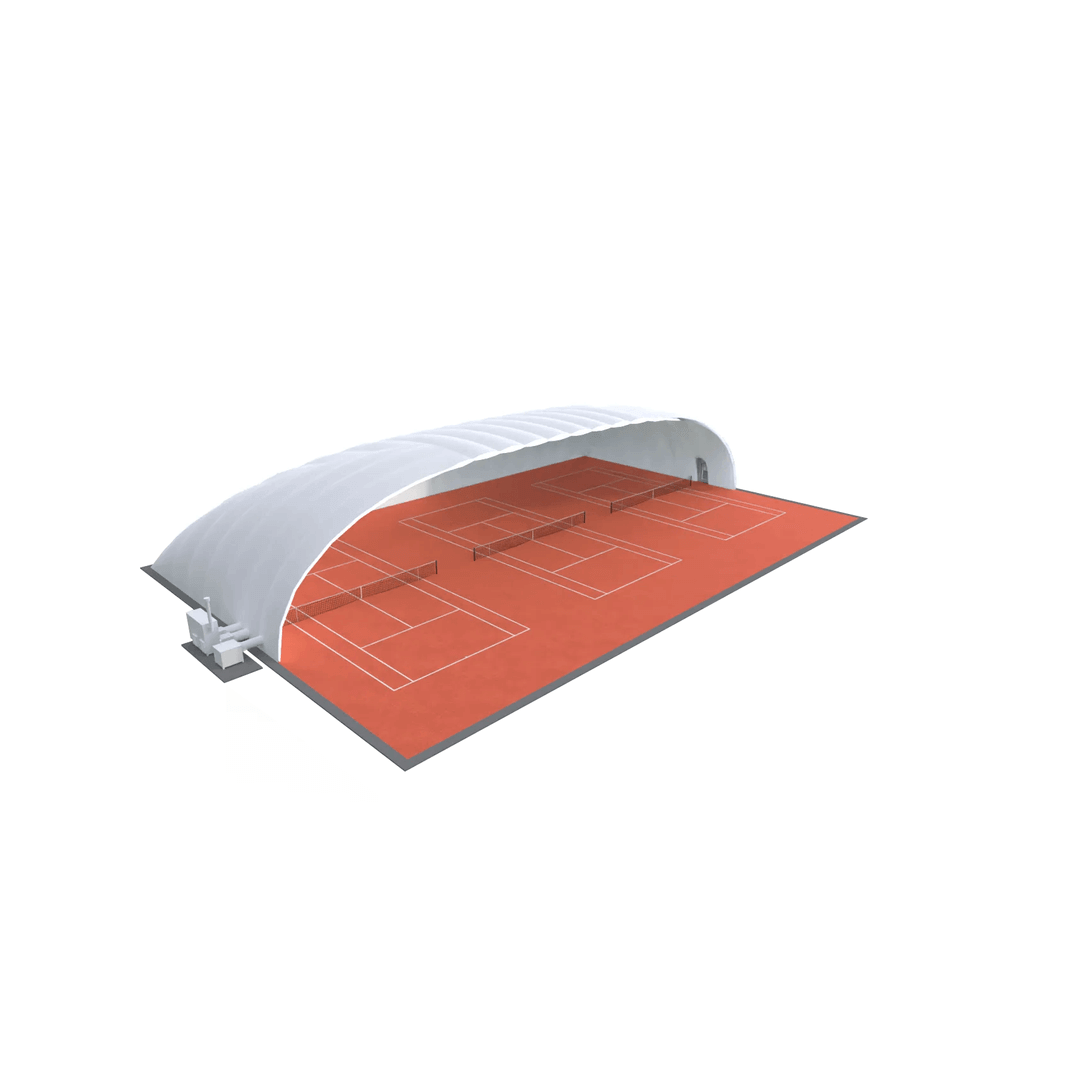
    Construction costs vary dramatically across sports, with your investment ranging from $1,000,000 for basic pickleball facilities to $4,600,000 for premium football domes. Understanding these variations helps you calculate accurate sports dome return on investment projections for your specific facility needs.

    Sport Construction Cost Range
    Pickleball $1,000,000 – $2,600,000
    Tennis $1,400,000 – $2,900,000
    Soccer $2,100,000 – $4,200,000
    Baseball $1,600,000 – $4,200,000
    Football $2,200,000 – $4,600,000

    Tennis and pickleball represent the most cost-effective entry points, while football commands premium pricing due to field size requirements. All costs include foundations, flooring, air-supported structures, lighting, and amenities. You’ll save 50-75% compared to traditional permanent structures while achieving faster installation timelines. Short lead times allow for functional buildings to be completed within months, significantly accelerating your facility’s revenue generation timeline.

    Financing and Revenue Strategies for Year-Round Facilities

    Smart financing transforms your air dome project from concept to profitable reality. You’ll access indoor facility revenue potential through diverse funding approaches that match your specific situation and goals.

    Traditional financing options include:

    1. Bank loans and specialized lenders – Grenke Leasing and LED.Finance offer tailored solutions for business facility projects.
    2. Government grant programs – UPARR assessments, CDBG funding, and NRPA grants provide public funding opportunities.
    3. Revenue-sharing partnerships – Private investors fund construction in exchange for revenue splits during contract periods.
    4. Community-based funding – Professional fundraising campaigns, crowdfunding platforms, and donor networks with naming rights incentives.

    For individuals pursuing smaller-scale projects, personal financing options are available up to $100,000 through specialized providers.

    You can also generate immediate revenue through multi-year team agreements, corporate sponsorships, advertising sales, and general community rentals to accelerate your payback timeline.

    Operating Expenses: Electricity, Maintenance, and Hidden Costs

    Understanding your air dome’s true operating costs prevents budget surprises and guarantees long-term profitability.

    You’ll face annual operating expenses of $3-$6 per square foot, with electricity comprising the largest component. A two-court dome consumes 83.2kW daily, costing approximately £12.48 for blowers and lighting combined.

    Your three-court facility operating four months annually averages $60,000-$80,000 in expenses. Air dome structures deliver electricity consumption that is 10%-25% of traditional structures, creating substantial savings compared to conventional buildings.

    Beyond electricity, you’ll encounter maintenance costs for air blower systems, LED lighting assemblies, HVAC equipment, and sports flooring replacement.

    Regional electricity rates and seasonal usage patterns greatly impact your bottom line. Winter heating demands increase energy consumption, while summer cooling affects HVAC costs.

    Sports dome profitability improves through motion-sensing lighting systems and intelligent climate controls that adjust operations based on weather conditions.

    Break-Even Timeline: When Air Domes Start Paying Off

    With operating expenses mapped out, you’ll want to know exactly when your air dome investment starts generating profit. The tennis bubble payback period typically ranges from 2-3 years for private clubs and 3-5 years for schools, depending on your facility’s utilization rates and local market conditions.

    Your break-even timeline depends on four critical factors:

    1. Initial investment size – Mid-six-figure investments require higher annual revenues to achieve quicker payback.
    2. Seasonal revenue boost – Year-round programming generates $150K-$300K additional annual income.
    3. Hourly rental rates – Tennis courts earning $60-$120/hour notably impact recovery speed.
    4. Operational efficiency – Lower operating costs at $3-$6 per square foot accelerate profitability.

    Most facilities reach profitability faster than traditional permanent structures due to lower construction costs and immediate revenue generation capabilities. Air domes offer quick setup advantages that allow facilities to start earning revenue almost immediately after installation.

    Frequently Asked Questions

    What Insurance Coverage Is Required for Air-Supported Dome Facilities?

    You’ll need liability, property, and casualty insurance for your air dome facility.

    Specialized coverage should include damage assessment for structural and mechanical equipment failure, plus weather-related protection against wind, snow, and storms.

    Your facility must comply with IBC Type II-B construction standards and A-4 occupancy classification.

    You’re required to conduct annual NFPA 102 inspections and biennial professional assessments to maintain insurance eligibility and favorable premium rates.

    How Do Extreme Weather Conditions Affect Dome Structural Integrity and Operations?

    You’ll find extreme weather considerably impacts your dome’s operations.

    High winds up to 120 mph are manageable with proper engineering, but you’ll need emergency deflation protocols for severe conditions.

    Snow loads can cause catastrophic collapse if your cable systems aren’t adequate.

    Temperature extremes require robust climate control – you’ll spend more on heating/cooling during harsh weather.

    Regular maintenance becomes critical, and you’ll need backup pressure systems to prevent complete deflation from membrane tears.

    Can Existing Outdoor Courts Be Converted to Air Dome Facilities?

    Yes, you can convert your existing outdoor courts to air dome facilities within just 5 days from foundation completion.

    You’ll need proper anchoring systems based on soil conditions and local wind codes, plus professional engineering assessment.

    The installation’s labor-intensive, requiring 20-30 workers, but you’ll transform your outdoor space into a weatherproof, all-season venue without extended delays.

    Your courts become climate-controlled with unobstructed interior space through continuous overpressure.

    What Permits and Zoning Approvals Are Needed for Dome Installation?

    You’ll need building permits with structural engineer-stamped designs as the primary requirement.

    Contact your building department first to confirm their specific requirements beyond engineer approval.

    You’ll also need zoning compliance verification, plus water and septic permits in most counties.

    Soil testing and site plans are mandatory.

    Your structural design must address local seismic zones, wind resistance, and snow loads based on your region’s extreme weather factors.

    How Does Dome Collapse Risk Impact Liability and Safety Protocols?

    You’ll face significant liability exposure during deflation events, requiring thorough safety protocols.

    Power loss creates immediate collapse risk, so you must install backup systems and real-time pressure monitoring.

    You’ll need emergency evacuation procedures since deflation, while gradual, can injure occupants.

    Insurance costs increase due to weather vulnerability and equipment damage risks.

    You must establish weather monitoring protocols, staff training programs, and structured assembly/disassembly procedures to minimize liability exposure.
  • Sports Dome Cost vs Permanent Building

    Sports Dome Cost vs Permanent Building

    You’ll save 50-75% on upfront costs choosing a sports dome over a permanent building—a 20,000 sq ft air dome costs around $200,000 versus $800,000 for traditional construction. However, permanent buildings last 35+ years compared to domes’ 15-20 year lifespan. Annual operating costs are similar at $3-6 per square foot, though domes install in just 2-6 weeks versus 12-18 months for permanent structures. Understanding these trade-offs will help you make the smartest investment decision.

    Sports Dome vs Permanent Building: Upfront Investment Breakdown

    When you’re weighing the financial commitment between sports domes and permanent buildings, the upfront investment difference is striking.

    Air dome vs building cost analysis shows you’ll spend $10-$25 per square foot for dome structures, while permanent buildings require two to three times more capital expenditure. For a 20,000 square foot (1,858 square meter) facility, you’re looking at $200,000 for an air dome versus $800,000 for a traditional building—that’s 50-75% in savings.

    Temporary vs permanent facility cost comparisons reveal dome packages starting as low as $12 per square foot, with costs decreasing as size increases. Sports domes also offer faster installation times compared to permanent structures, reducing labor costs and allowing you to start generating revenue sooner.

    The inflatable vs traditional building price gap widens further when you factor in material requirements, as air domes use economical synthetic textiles while permanent structures demand substantial investments in concrete, steel, and glass.

    Operating Costs: What You’ll Pay Each Year

    Beyond the initial investment, your annual operating expenses will determine the true cost of facility ownership. For a 20,000 sq ft (1,858 sq m) facility, you’ll face several key expense categories that impact the sports dome vs permanent structure decision.

    Maintenance costs range from $3–$6 per square foot annually, with inflation systems adding $0.10–$0.20 per square foot yearly for air domes.

    Utility expenses typically run $0.50–$1.50 per square foot, though permanent buildings often achieve better energy efficiency long-term.

    Staffing represents your largest expense at approximately $500,000 annually for full operations.

    Insurance averages $36,000 yearly, while security costs around $30,000.

    Total operating budgets range from $336,000 for basic facilities to $1.6 million for extensive complexes. Rental hours constitute over 57% of most facilities’ total revenue, making scheduling optimization critical for covering these substantial operating expenses.

    How Long Does Each Structure Actually Last?

    While upfront costs grab immediate attention, the lifespan of your facility determines its true long-term value. You’ll typically get 15-20 years from a well-constructed air dome, though high-end models can reach 30 years under ideal conditions.

    PVC fabric offers superior durability with 25-year warranties, while lighter PE materials last 15-20 years.

    Permanent buildings greatly outlast air domes. You’re looking at 35+ years for standard stadiums, with historic concrete structures operating for over 100 years.

    The Cinerama Dome has functioned for 61+ years, while Wrigley Field hit its 100-year milestone.

    Your maintenance commitment directly impacts longevity. Proper installation, regular inspections, and following manufacturer guidelines can maximize your structure’s operational life, regardless of the type you choose. Modern air pressure technology continuously maintains inflation to minimize structural stress and preserve dome integrity.

    Construction Speed: Sports Domes vs Traditional Buildings

    Your facility’s construction timeline can make or break your project’s success, especially when you’re working with tight deadlines or seasonal demands. Sports domes offer dramatically faster installation compared to traditional buildings, allowing you to start operations in weeks rather than months.

    Aspect Sports Domes Traditional Buildings
    Installation Time 2-6 weeks 12-18 months
    Setup Process Inflation in days Multiple construction phases
    Labor Requirements 20-30 workers Extensive workforce teams

    You’ll find that dome construction eliminates complex foundation work and structural framing that permanent buildings require. While traditional facilities need site preparation, governmental permits, and extensive planning phases, air-supported structures use simplified air pressure systems for rapid assembly. This speed advantage means you can capture revenue opportunities immediately rather than waiting through lengthy construction delays.

    The flexible usage capabilities of sports domes also allow for quick adaptation to different sports and events without the extensive renovations that traditional structures would require.

    Which Option Delivers Better ROI?

    When comparing return on investment, the numbers tell a compelling story that favors air domes for most scenarios.

    You’ll save $600,000 upfront with a $200K air dome versus an $800K permanent building for the same 20,000 sq ft (1,858 sq m) space. That’s 50-75% less initial capital investment.

    Your operational costs remain competitive at $3-6 per square foot annually, while permanent buildings carry higher year-round expenses.

    If you’re operating seasonally for 5-6 months, you’ll reduce costs further compared to 12-month traditional facility operations. Air domes offer additional savings through direct-cooling ice systems that can reduce energy consumption by 60%.

    The faster 2-6 week installation versus 12-18 months means you’ll generate revenue sooner.

    With proper maintenance, your air dome can last 15-50 years, delivering strong returns on that lower initial investment.

    Frequently Asked Questions

    Can Air Domes Withstand Extreme Weather Like Hurricanes and Heavy Snow Loads?

    Yes, you’ll find air domes exceptionally resilient against extreme weather.

    They’ll withstand hurricane-force winds up to 252 km/h (157 mph) and even meet Nuclear Regulatory Commission standards for 482+ kph winds. You can rely on them supporting snow loads exceeding 250 kg/m² without failure.

    Their curved design actually reduces wind resistance compared to traditional buildings, while the reinforced membrane maintains structural integrity from -30°C to +70°C temperatures.

    What Permits and Zoning Approvals Are Needed for Sports Dome Installation?

    You’ll need local government permits before construction begins, with requirements varying by jurisdiction.

    Your site must comply with zoning classifications, building codes like IBC and ASCE 55-16, plus setback and height restrictions.

    Licensed engineers must create stamped permit drawings (costing around $20,000).

    Multiple city departments review applications including Planning, Building Code Enforcement, and Fire Department.

    Plan approval typically takes 2-6 weeks, followed by final inspections before receiving your Certificate of Occupancy.

    How Much Does It Cost to Relocate an Air Dome Facility?

    Relocation costs depend on your dome’s size.

    You’ll pay $10,000-$30,000 for small domes under 100 feet (30.5 meters) in diameter, $30,000-$100,000 for medium domes 100-300 feet (30.5-91.4 meters), and over $1 million for large domes exceeding 300 feet (91.4 meters).

    These costs include disassembly, transport, and reinstallation.

    You can reduce expenses by having your staff help with construction and maintenance during the relocation process.

    Are There Financing Options Available Specifically for Sports Dome Construction Projects?

    Yes, you’ll find several financing options specifically for sports dome construction.

    You can access public funding through UPARR programs, Land and Water Conservation Fund, and EPA Brown/Greenfield grants.

    You’ll also benefit from leasing agreements that spread costs over time with lower upfront requirements.

    Additionally, you can pursue bank loans, private investors, bonds financing, and community fundraising through sponsorships and donations to fund your project.

    What Happens if the Air Pressure System Fails During Events?

    If your air pressure system fails during events, you’ll need to evacuate everyone immediately as the dome deflates like a flag.

    The fabric develops wave-like movements and whip-like motions, but you won’t face structural collapse onto occupants – cables maintain 30+ feet (9+ meters) clearance above.

    However, you’ll lose complete facility protection and face significant re-inflation costs, making your 20,000 sq ft (1,858 sq m) space unusable until pressure’s restored.

  • Used Air Dome Prices USA 2026

    Used Air Dome Prices USA 2026

    You’ll find used air domes across the USA priced between $10-50 per square foot in 2026, offering substantial savings of 50-75% compared to new construction. A 16,000 sq ft dome recently sold for $200,000, while larger facilities range from $191,000-$1,277,740 depending on size and condition. You can purchase through manufacturer liquidations, wholesale platforms, and commercial resale brokers. However, you’ll need to budget for hidden costs like shipping, installation, and foundations that can greatly impact your total investment.

    Used Air Dome Savings: 50-75% Off New Construction Costs

    When you’re considering a used air dome purchase, you’ll discover savings that notably outpace even new construction’s cost advantages.

    Used air domes typically sell for 40-60% of their original prices, meaning you’re getting structures that already cost 50-75% less than traditional buildings at even steeper discounts.

    A 5-year-old dome retains 60% of its new value, while 10-year-old units range from 40-50%. For example, a single court dome covering 7,200 square feet costs $48,000-$108,000 used versus $80,000-$180,000 new.

    This used tennis bubble cost represents exceptional value when you consider the 20-30 year durability ratings these structures maintain. The prefabricated components also reduce labor costs during installation, making your total investment even more attractive.

    You’ll still benefit from energy savings exceeding 50% and minimal maintenance requirements while paying considerably less upfront.

    Real Used Dome Prices: 12,000 To 250,000 Square Foot Examples

    Real market data reveals significant variations in used air dome pricing across different facility sizes. You’ll find the used air dome price depends heavily on square footage and condition. A 16,000 sq ft Miami dome sold for $200,000 after only 10 days of use, representing a 52% discount from its $418,500 original cost.

    Size Range New Price Used Price Range
    12,000-25,000 sq ft $297,700-$418,500 $200,000-$297,700
    25,000-75,000 sq ft $297,700-$762,948 $191,000-$381,500
    75,000-250,000 sq ft $762,948-$2,555,480 $382,000-$1,277,740

    You’ll typically pay $10-50 per square foot in today’s market, with like-new condition domes commanding premium prices within the 50-75% savings range. Most domes can be erected in one day with a crew of 10 men, making them significantly faster to deploy than traditional construction methods.

    Best Places To Buy Used Air Domes And Bulk Discounts

    Finding the right marketplace can save you thousands on your used air dome purchase, especially when buying multiple units.

    You’ll find the best deals through manufacturer liquidation channels like Broadwell Air Domes, which offers demo units at 50% off retail prices. Their pink 42m × 42m dome dropped from $418,500 to $200,000.

    For bulk orders, consider these proven sources:

    • Wholesale platforms – Made-in-China.com and Alibaba offer $40-$115 per square meter for 500+ square meter orders.
    • Direct manufacturer sales – Broadwell’s corporate program serves Microsoft and Apple with $12/square foot pricing.
    • Commercial resale brokers – Repurposed Materials Inc. delivers 50-75% savings on second hand sports dome inventory.
    • Event facility liquidations – End-of-season opportunities from sports complexes and ski resorts. These facilities often sell domes engineered to withstand 150 mph winds, making them ideal for permanent installations.

    Hidden Costs Beyond Purchase Price: Shipping And Installation

    Beyond the sticker price of your used air dome, you’ll face substantial additional expenses that can double your total project cost.

    Shipping costs vary greatly by location and must be calculated individually, with you covering all freight expenses through common carrier companies. Your logistics associate will arrange worldwide shipping for international installations, though local government fees may apply for units shipped outside the USA.

    Installation represents your largest hidden expense. You’ll need 4 days to several weeks depending on size, requiring approximately 50 manual laborers for fabric deployment.

    A seven-day installation costs $74,000 for the complete team, including electricians and HVAC technicians. Equipment rental adds more expense, as you’ll need a minimum 10,000-pound forklift.

    Your pre-owned air dome also requires engineering documentation ($20,000), permits, and foundation work.

    Foundation costs alone can reach $350,000 for larger installations, depending on soil conditions and local requirements.

    Used Vs New Air Domes: When To Buy Secondary Market

    While new air domes offer warranties and customization options, you’ll save 50-75% by choosing the secondary market for your facility needs. A 16,000 sq ft used dome at $200,000 represents just 48% of its original retail price, making refurbished sports dome pricing extremely attractive for budget-conscious buyers.

    Consider secondary market purchases when:

    • Your budget demands maximum savings – Cut costs dramatically while achieving the same facility goals.
    • You need temporary or seasonal coverage – Why pay full price for uncertain long-term usage?
    • Quick deployment matters more than customization – Get operational faster with existing inventory.
    • You’re willing to accept limited warranty protection – Trade security for substantial financial savings.

    Additionally, factor in ongoing utility costs ranging from $0.50 to $1.50 per square foot annually when evaluating your total ownership expenses for used dome facilities.

    However, choose new domes when customization requirements are non-negotiable or warranty coverage remains essential for your project’s success.

    Frequently Asked Questions

    How Long Do Used Air Dome Fabric Membranes Typically Last Before Replacement?

    You can expect used air dome fabric membranes to last 10-15 years typically, though well-maintained domes often reach 15-20 years.

    Premium-grade membranes may perform for 15-25 years, with some exceptional cases lasting up to 30 years.

    Your membrane’s lifespan depends heavily on material quality, environmental conditions, and maintenance practices.

    Regular inspections, proper cleaning, and prompt repairs will greatly extend your dome’s operational life beyond standard expectations.

    What Financing Options Are Available for Purchasing Used Commercial Air Domes?

    You can finance used commercial air domes through equipment financing companies like Grenke Leasing or LED.Finance, offering 2-6 year terms with rates as low as 5.99% and potentially no down payment.

    Collateral-free personal loans up to $100,000 are available through Feeasy® and other lenders.

    You’ll also find lease-back arrangements with investor groups, community funding partnerships, and Buy Now Pay Later solutions that preserve your working capital while making dome ownership accessible.

    Can Used Air Domes Be Relocated to Different Sites After Purchase?

    Yes, you can relocate used air domes to different sites after purchase.

    They’re designed with fabric membranes and modular components for easy disassembly and reassembly without permanent foundations.

    You’ll need a supervisory team, laborers, heavy equipment, and professionals for the move.

    Small domes relocate in four days minimum, while larger ones take weeks.

    Expect around $20,000 in engineering costs plus permits and site preparation at your new location.

    What Warranty Coverage Exists When Buying Pre-Owned Inflatable Dome Structures?

    You’ll typically find no manufacturer warranty coverage when buying pre-owned inflatable dome structures.

    Original warranties rarely transfer to second owners, leaving you without factory protection.

    However, you can hire independent inspectors to evaluate the fabric membrane, blowers, and zippers before purchase.

    Some dealers offer limited short-term warranties on used domes they’ve refurbished.

    You’ll need to negotiate warranty terms directly with sellers or consider third-party inspection services for peace of mind.

    Are Building Permits Required Differently for Used Versus New Air Domes?

    Building permits aren’t typically required differently for used versus new air domes – you’ll need the same permits regardless of the dome’s age.

    What matters to building officials is the structure’s current condition, safety compliance, and installation specs, not whether it’s previously owned. You’ll still need to meet local building codes, zoning requirements, and structural standards.

    However, used domes may require additional inspections to verify they meet current safety regulations before approval.

  • Fabric Structure Operating Costs Comparison

    Fabric Structure Operating Costs Comparison

    You’ll save 40-60% on total building costs when you choose fabric structures over conventional steel or wood construction, with upfront savings of $20-30 per square foot compared to $34-35 for traditional materials. Monthly operating expenses run $800-2,000 for fabric buildings versus $1,500-3,500 for air domes, while repair costs stay considerably lower at $2 per square foot compared to $7 for steel sheeting. Understanding these cost components will help you identify the most financially advantageous building solution.

    Upfront Building Costs: Fabric vs Steel vs Wood Pricing

    When comparing upfront construction costs, fabric structures deliver the most economical option at $20-30 per square foot, undercutting both steel and wood alternatives.

    You’ll find pre-engineered steel components averaging $34 per square foot installed, while wood framing costs approximately $35 per square foot. Cold-formed steel framing runs about $26.50 per square foot for materials alone.

    Fabric structure operating costs start with these lower initial investments, giving you immediate savings upon completion. Fabric roofs eliminate expensive roofing materials that traditional steel buildings require, contributing to the overall cost reduction.

    Unlike rigid frame structure monthly costs that include higher material expenses, fabric buildings substantially reduce your overall construction budget.

    The clear span building operating expenses begin favorably since you’re investing less upfront compared to traditional steel or wood construction methods, making fabric structures the most cost-effective choice for your building project.

    Installation Costs and Timeline: Why Fabric Wins on Labor

    Beyond the initial material savings, fabric structures deliver substantial labor cost advantages that further reduce your total project investment. You’ll use 50% fewer labor hours compared to steel alternatives, requiring only 0.02 to 0.04 man-hours per square foot versus steel’s 0.04 to 0.07. This efficiency saves hundreds of labor hours on facilities exceeding 20,000 square feet.

    Your installation timeline accelerates dramatically. Steel frames erect within hours to days, while fabric covering completes just as quickly using seamless tensioning methods. The Regis University Berce Athletic Center demonstrates this speed, finishing in four months rather than years. Fabric buildings achieve remarkable construction speeds of approximately 2,500 square feet per day, allowing rapid project completion even on large-scale facilities.

    These tension fabric building expenses remain 20%-30% lower when manufacturers handle installation. You’ll achieve faster operational deployment, improved ROI timelines, and thousands in labor savings on large facilities through simplified construction processes.

    Monthly Operating Expenses: Energy and Utility Comparisons

    While installation costs grab immediate attention, your fabric structure’s monthly operating expenses deliver the most compelling long-term savings.

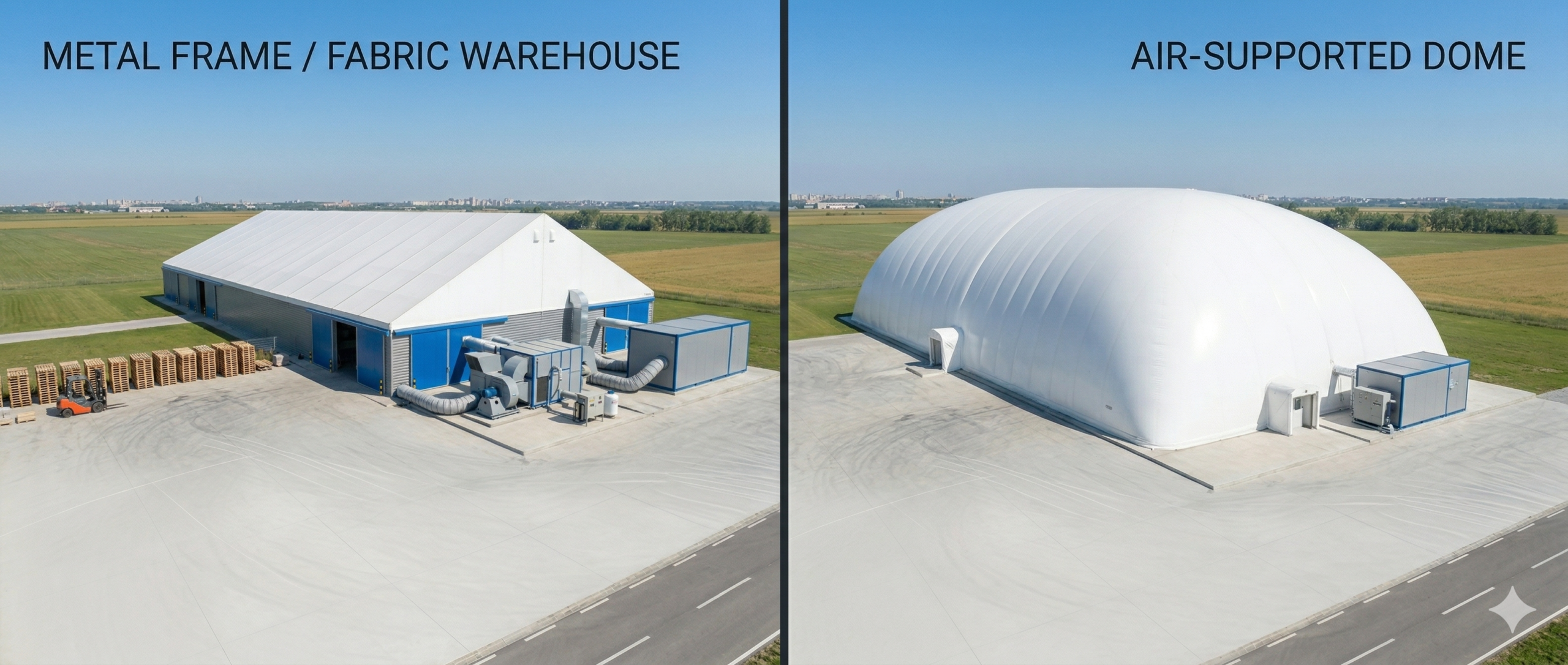
    Frame-supported fabric buildings operate at $800-2,000 monthly versus air domes requiring $1,500-3,500 monthly. You’ll eliminate constant blower operation costs that plague pressurized structures.

    Natural light penetration through translucent fabric reduces your electricity consumption considerably. You’ll only need HVAC when walls are closed, unlike traditional buildings requiring year-round climate control.

    These structures span up to 300 feet clear without interior supports, maximizing usable space while minimizing heating and cooling zones.

    Your energy savings compound monthly through reduced lighting needs during daylight hours and strategic HVAC usage. Manufacturing facilities should maintain a minimum cash buffer of at least $437,000 to ensure operational stability during peak production periods.

    Limited maintenance requirements further decrease operational expenses compared to steel or concrete alternatives requiring regular upkeep and repairs.

    Long-Term Maintenance: Repair Costs Over 20 Years

    Your fabric structure’s true financial advantage emerges through decades of reduced maintenance requirements and repair costs.

    You’ll spend considerably less on repairs, with fabric averaging $2 per square foot compared to traditional steel sheeting at $7 per square foot. Your maintenance schedule becomes simpler—periodic fabric inspections, routine tension checks, and occasional cleaning with mild soap suffice.

    You’ll see extended component lifespans with high-performance membranes lasting 20-30 years and galvanized steel frames exceeding 20 years.

    Your structure avoids corrosion, water leakage, and moisture damage that plague traditional buildings with screws and nails. Unlike rigid materials that crack under environmental pressure, fabric structures maintain their integrity through flexible absorption of wind and snow loads. Over two decades, you’ll realize substantial savings through reduced maintenance frequency, lower labor costs, and minimal upkeep requirements that extend your fabric cover’s replacement timeline.

    Fabric Replacement Costs: Planning for Material Lifecycles

    You’ll need to plan for fabric replacement as the most significant long-term expense in your structure’s operating budget.

    Your material choice directly impacts replacement frequency—premium fabrics cost more upfront but can extend your structure’s lifespan by 20-40% compared to basic options.

    You should calculate lifecycle costs rather than focusing solely on initial material prices, since quality fabrics often break even within 3-5 years through reduced replacement needs. Factor in maintenance costs when evaluating different fabric options, as these recurring expenses can significantly impact your total cost of ownership over the structure’s operational life.

    Material Durability Expectations

    When planning fabric structure investments, understanding material lifecycles becomes essential for accurate long-term budgeting.

    You’ll find outdoor upholstery fabrics lasting 5–15 years depending on quality and maintenance, while sailcloth tents consistently deliver 10–15 years with proper care. Canvas structures typically provide 7–10 years of service life.

    Your fabric’s durability depends heavily on environmental factors. UV exposure accelerates deterioration and fades colors, while extreme temperature fluctuations create additional stress.

    However, high-performance fabrics with UV resistance maintain structural integrity longer than standard alternatives.

    Maintenance practices greatly impact longevity. You’ll extend fabric life by protecting structures from direct sunlight during storage and following proper cleaning protocols.

    Quality construction with tight weaves and superior materials justifies higher upfront costs through extended replacement cycles, reducing your long-term operating expenses.

    Replacement Cost Planning

    Understanding material durability provides the foundation for developing accurate replacement cost strategies that protect your long-term investment.

    You’ll need to calculate cost per use by dividing purchase price by expected lifespan, factoring in your actual usage frequency. This analysis reveals whether higher-quality fabrics deliver better value despite elevated initial costs.

    Track your fabric’s performance in operational environments to refine future purchasing decisions.

    Monitor breakdown patterns and consumption data to establish monthly and annual replacement expenses. You should maintain detailed records of individual textile failures and spare part consumption for effective inventory planning.

    Implement proper maintenance protocols to prevent premature degradation.

    Harsh washing cycles, overheating, and unbalanced loads accelerate replacement needs.

    Professional laundering services extend fabric lifespan through correct temperatures, chemistry, and handling practices, reducing unplanned replacement costs.

    Total Ownership Analysis: Which Building Type Saves Most?

    When you’re evaluating building options, you’ll need to examine three critical cost components that determine your long-term financial commitment.

    Your initial investment represents just the starting point, as ongoing maintenance expenses and daily operational costs will greatly impact your total ownership experience over decades.

    Understanding how fabric structures compare against traditional metal, wood, and concrete buildings across these cost categories helps you identify which option delivers the greatest savings throughout your facility’s lifespan.

    Initial Investment Breakdown

    Three primary factors determine your fabric structure’s initial investment: foundation requirements, frame specifications, and fabric membrane quality.

    Foundation costs vary dramatically based on your soil conditions and local building codes, ranging from simple concrete footings to extensive pier systems. Your frame selection—whether steel, aluminum, or hybrid materials—directly impacts both upfront costs and long-term durability.

    The fabric membrane represents 20-30% of total investment, with architectural-grade materials offering superior weather resistance and longevity.

    You’ll also need to budget for engineering, permits, and installation labor. Unlike traditional construction, fabric structures require specialized contractors familiar with tensile systems.

    Consider that your initial investment typically runs 40-60% less than comparable conventional buildings, while the streamlined installation process reduces construction financing costs and gets you operational faster.

    Long-Term Maintenance Expenses

    Maintenance schedules for fabric structures reveal dramatic cost advantages over conventional buildings throughout their operational lifespan.

    You’ll spend $800-2,000 monthly operating frame-supported fabric buildings compared to $1,500-3,500 for air domes. This difference compounds markedly over decades of ownership.

    Your maintenance costs stay lower because there’s no constant blower operation requiring repairs and replacements. The fabric’s natural light transmission cuts your electricity expenses substantially, while HVAC systems only operate when wall sections are closed.

    You’ll also benefit from simpler structural components spanning up to 300 feet without interior supports.

    Over a 20-year period, you’re looking at potential savings of $168,000-360,000 compared to air-supported alternatives.

    These structures require periodic fabric replacement every 15-25 years, but even factoring in this major expense, your total ownership costs remain considerably lower than traditional construction methods.

    Operational Cost Savings

    Your total ownership analysis reveals that frame-supported fabric structures deliver the most substantial operational savings across all building categories.

    You’ll spend $800-2,000 monthly on operating costs compared to air domes’ $1,500-3,500 range. You’ll eliminate constant blower operation expenses that inflate air dome utility bills year-round.

    Your energy savings compound through natural light transmission, reducing electricity costs by minimizing artificial lighting needs.

    You’ll only run HVAC systems when walls are closed, unlike conventional buildings requiring continuous climate control. This selective operation dramatically cuts your monthly utilities.

    You can construct clear spans up to 300 feet without internal support columns, maximizing usable space per dollar invested.

    Your maintenance requirements stay minimal since you’re not dealing with complex mechanical systems or concrete deterioration.

    These combined factors position fabric structures as the most cost-effective building solution for long-term ownership.

    Frequently Asked Questions

    How Do Weather Conditions Affect Fabric Structure Operating Costs Year-Round?

    Weather conditions greatly impact your fabric structure’s operating costs throughout the year.

    You’ll save money during mild seasons when natural ventilation reduces HVAC needs, but expect higher heating costs in winter.

    Your frame-supported structures give you flexibility – you can open walls during favorable weather to minimize energy use.

    Snow loads and extreme temperatures don’t damage the fabric like traditional materials, keeping your maintenance costs predictably low year-round.

    What Insurance Costs Differences Exist Between Fabric and Traditional Building Structures?

    You’ll typically pay lower insurance premiums for fabric buildings compared to traditional structures.

    Insurers recognize engineered fabric buildings meet safety codes while offering superior weather resistance and fewer failure points.

    You’ll benefit from reduced claims risk since fabric structures eliminate moisture entry points, resist mold and pests, and don’t require complex HVAC systems.

    The simpler design means fewer maintenance issues and more predictable coverage costs over time.

    Can Fabric Buildings Be Relocated and What Are the Costs?

    Yes, you can relocate most fabric buildings, though structures built before 2014 need case-by-case assessment.

    You’ll spend 5-12% on engineering and permits, while moving operations cost 30-50% of your total budget.

    Relocation typically costs considerably less than building new. You can modify and upgrade during dismantling, making it cost-effective for business moves, mergers, or changing space requirements while reducing construction timelines.

    How Do Fabric Structures Perform in Extreme Climates Like Hurricanes?

    Your fabric structures perform exceptionally well in hurricanes when properly engineered.

    You’ll find PTFE-coated fiberglass membranes withstand 140 mph impacts and debris strikes without tearing. Real examples prove this – Port of Miami’s terminals survived Hurricane Wilma with minimal damage, while San Juan’s 900-foot canopy maintained stability in 125+ mph winds.

    You’re getting hurricane-force protection through aerodynamic designs, reinforced frames, advanced tensioning systems, and Miami-Dade certified materials that resist wind and debris.

    What Permits and Inspections Are Required for Fabric Building Operations?

    You’ll need building permits under Chapter 31 of the International Building Code for steel-framed tension fabric structures.

    Start by consulting your local building authority since requirements vary by municipality, site size, and intended use. You’ll submit detailed site plans showing location, dimensions, and purpose.

    Structures over 200 square feet require operational permits under fire codes.

    After construction, you’ll undergo final inspection to verify compliance with approved plans and safety codes.

  • Air Dome Operating Costs Winter Analysis

    Air Dome Operating Costs Winter Analysis

    You’ll face winter operating costs between $4,000-6,000 monthly for air domes in northern climates, with heating expenses representing the largest portion at $2,500-3,500 per month. Southern facilities benefit from lower costs of $1,500-2,000 monthly due to milder conditions. Double-layer insulated domes can slash your heating expenses by 30-40% compared to single-layer structures. Emergency repairs during severe weather events can cost $15,000-25,000, making proper preparation essential for managing your winter budget effectively.

    Air Dome Heating Costs: What To Expect

    How much will heating your air dome actually cost? Your air dome heating cost depends heavily on your climate zone and facility setup.

    If you’re operating in northern regions (Zone 6-7), you’ll spend $2,500-3,500 monthly on heating and blowers during winter months. Southern facilities (Zone 2-3) see lower costs of $1,500-2,000 per month.

    You can notably reduce these expenses by investing in double-layer insulated domes, which cut heating costs by 30-40%. The advanced membrane technology provides thermal resistance value of R=2, dramatically outperforming ordinary cement walls at R=0.2.

    Your overall energy consumption will be 10%-25% of traditional concrete structures, potentially saving you up to 75% compared to conventional buildings while maintaining comfortable interior temperatures year-round. Beyond heating costs, inflation unit costs typically range from $0.10 to $0.20 per square foot annually for maintaining proper dome pressure.

    Monthly Electricity Bills By Climate Zone

    When you’re budgeting for air dome operations, your monthly electricity bills will vary dramatically based on your climate zone and local utility rates.

    Northern facilities in zones 6-7 face the highest air dome energy costs, spending $2,500-3,500 monthly on heating and blowers during winter months when temperatures drop below 32°F (0°C).

    Southern facilities in zones 2-3 enjoy noticeably lower costs at $1,500-2,000 monthly, benefiting from milder winter conditions above 50°F (10°C).

    You can reduce these expenses by 30-40% with double-layer insulated domes.

    Your inflation system alone consumes approximately 1,200 kWh monthly, while lighting adds another layer of cost. Installing solar-plus-battery systems can provide backup power during outages and reduce your overall electricity expenses.

    Regional electricity rates ranging from $0.50-1.50 per square foot annually will directly impact your bottom line calculations.

    Weather Emergency And Maintenance Expenses

    Beyond regular electricity bills, weather emergencies and maintenance issues can devastate your air dome budget with unexpected costs. You’ll face significant sports dome winter expenses when severe snowfall and high winds damage your structure. Minor tears or mechanical failures during storms can cause complete collapse, creating safety risks and massive financial liabilities.

    Weather Risk Impact Cost
    Emergency repairs $15,000-$25,000
    Snow reinforcement $5,000-$8,000
    Collapse damage $100,000+
    Insurance premium increase 15-25% annually
    Backup power systems $3,000-$5,000

    Insurance premiums remain 15-25% higher than conventional buildings due to perceived vulnerability. Hurricane-prone areas often require additional reinforcements not included in original designs, adding unexpected expenses that strain your operational budget throughout winter months. The typical 15 to 20 years lifespan of air domes means that older structures become increasingly susceptible to weather-related failures as materials degrade over time.

    Ways To Reduce Air Dome Heating Costs

    Since winter heating represents your largest operational expense, implementing strategic cost-reduction measures can slash your monthly bills by 30-80% depending on your climate zone.

    Double-layer insulated domes with R20 thermal resistance dramatically reduce air dome heating costs compared to conventional R8 walls. You’ll achieve 30-40% cost reductions in northern facilities (zones 6-7), dropping monthly expenses from $2,500-3,500 to potentially $1,750-2,100.

    Install heat pump systems with 1.50-3.00 COP ratings instead of electric resistance heating. Choose natural gas units where available—1 cubic meter provides 10 kWh heat output efficiently. Consider connecting to external district heating networks where municipal heat transfer systems are accessible.

    Eliminate thermal bridges through three-stage welding processes and airtight door systems. These modifications prevent heat loss while maintaining consistent interior temperatures between 65-75°F (18-24°C), reducing seasonal energy consumption by 30-40%.

    Air Dome Vs Permanent Building Heating Costs

    Air domes deliver substantial heating cost advantages over permanent buildings through superior thermal efficiency and reduced operational demands.

    When comparing air dome vs permanent building heating costs, you’ll find air domes consume 30-40% less heating energy per season than conventional structures. Traditional reinforced concrete buildings contain thermal bridges through beams, columns, and joints that increase heat loss, while air dome membrane construction eliminates these structural weak points.

    Your air dome achieves R20 thermal resistance compared to conventional building walls at R8 – a 60% performance difference.

    Double-layer insulated domes create 100-250mm insulating air layers, improving heat retention by approximately 20%. The lightweight, flexible materials used in air dome construction provide enhanced thermal performance compared to traditional building materials.

    Additionally, you’ll benefit from seasonal operation spanning 5-6 months versus permanent facilities facing continuous 12-month operational expenses regardless of utilization patterns.

    Frequently Asked Questions

    How Much Does Backup Power Equipment Cost for Winter Emergencies?

    You’ll spend approximately $36,080 for main and backup blower units with dual fuel configuration providing 15,000 CFM capacity.

    This includes electric and natural gas engine options for grid-independent operation during emergencies.

    You’ll need additional costs for standby generators (typically handled by your contractor), natural gas hookup installation, and licensed electrician setup.

    Total emergency system costs vary based on your dome size, site requirements, and local building codes.

    What Insurance Considerations Apply to Air Domes During Harsh Winter Weather?

    You’ll need specialized coverage for winter weather risks since standard policies often exclude air dome collapses from snow loading.

    Insurance companies typically require NFPA 102 compliance, biennial professional inspections, and documented maintenance protocols. You must demonstrate proper cable anchorage systems and backup power capabilities.

    Premiums increase 25-40% in northern climates (Zones 6-7) where temperatures drop below 20°F (-7°C), reflecting higher collapse risks during blizzard conditions.

    Are There Tax Incentives for Energy-Efficient Air Dome Installations?

    You won’t find specific federal tax incentives for air dome installations in current programs.

    However, you might qualify for energy efficiency credits if your dome uses qualifying heating/cooling systems or insulation upgrades.

    Check with your state—some offer commercial energy incentives that could apply.

    Given that double-layer insulated domes reduce heating costs by 30-40% (saving $750-1,400 monthly in northern zones), you’ll want to consult a tax professional about potential deductions.

    How Do Snow Removal Services Impact Total Winter Operating Budgets?

    Snow removal services don’t directly impact your air dome’s operating budget since the structure’s sloped design naturally sheds snow.

    However, you’ll still need access path clearing, which adds $500-1,200 monthly in northern climates.

    Your main winter costs remain heating and increased blower operation.

    In Zone 6-7 regions, you’re looking at $2,500-3,500/month (versus $1,500-2,000 in southern zones).

    Double-layer insulation cuts these expenses by 30-40%.

    What Financing Options Exist for Air Dome Winter Upgrade Projects?

    You can access multiple financing options for winter dome upgrades.

    Grenke Leasing and LED.Finance offer business-focused solutions with flexible terms.

    For personal projects, Feeasy® and DomeSpaces provide up to $100,000 without collateral requirements.

    You’ll also find Buy Now, Pay Later programs enabling immediate project starts.

    Consider investor partnerships with lease-back arrangements or community funding through donor networks and local business partnerships for extensive winter improvement financing.

  • Sports Dome Installation Cost by Size

    Sports Dome Installation Cost by Size

    You’ll pay $30,000-$50,000 for basic personal domes under 100 feet, while single-court tennis facilities cost $80,000-$180,000 for 7,200 square feet. Mid-size multi-sport facilities range from $150,000-$400,000, with per-square-foot costs dropping to $10-$15 for larger installations. Large tournament complexes require $500,000 to several million dollars but offer the best value at $12-$50 per square foot. Foundation work, installation, and ongoing climate control add significant expenses that vary dramatically by location and soil conditions.

    What Drives Sports Dome Costs: Materials, Installation, and Ongoing Expenses?

    Understanding sports dome installation costs requires examining five key expense categories that determine your total investment.

    Materials and fabric systems range from $12 to $50 per square foot, including membrane, blowers, and hardware. You’ll face installation expenses around $74,000 for complete setup with professional teams, electricians, and HVAC technicians over seven days.

    Foundation and site preparation start at $10 per square foot, though costs vary dramatically based on soil conditions and terrain.

    Climate control systems create considerable ongoing operational expenses through continuous heating, cooling, and air pressure maintenance. Regular maintenance prevents minor issues from becoming costly repairs.

    Finally, you’ll need engineering services at approximately $20,000, plus permits and regulatory compliance costs.

    Each category greatly impacts your sports dome installation cost, requiring careful budget planning for both initial investment and long-term operational sustainability.

    Small Sports Dome Costs: Single Courts and Specialty Facilities

    When you’re considering a small sports dome for single-court applications, you’ll find costs ranging from $30,000 to $200,000 depending on your specific requirements and facility size.

    Small sports dome costs vary considerably based on diameter and features. Basic domes under 100 feet in diameter cost $30,000 to $50,000 for personal use, while more sophisticated installations reach $200,000.

    Single-court tennis facilities require substantially more investment, ranging from $80,000 to $180,000 for a 7,200 sq ft / 669 sq m structure.

    Specialty courts like pickleball installations cost between $1,000,000 and $2,600,000 when you include complete amenities and infrastructure. These facilities offer year-round operation that eliminates weather-related cancellations and scheduling disruptions.

    Your per-square-foot pricing starts at $12 for basic packages, with membrane structures costing $25 to $50 per square foot depending on specifications.

    Multi-Sport Dome Costs: Mid-Size Facilities for Schools and Clubs

    Mid-size sports domes serving schools and clubs typically require investments between $150,000 and $400,000 for multi-court facilities spanning 24,000 sq ft / 2,230 sq m.

    Your multi court dome cost benefits from economies of scale, with per-square-foot pricing dropping to $10–$15 for larger installations compared to smaller single-court facilities.

    You’ll need to budget for foundation work, which can reach $350,000 for extensive ground preparation depending on your soil conditions.

    Installation costs average $74,000 over seven days, including professional teams and equipment rental.

    Annual operational expenses run $3–$6 per square foot, covering utilities and maintenance. These facilities offer proven ROI through extended seasons that allow year-round programming and additional revenue from facility rentals.

    These mid-size facilities support year-round programming for multiple sports, making them ideal investments for educational institutions and athletic clubs seeking versatile, cost-effective indoor spaces.

    Large Sports Dome Costs: Tournament and Community Complexes

    Large tournament and community sports domes require substantial investments ranging from $500,000 to several million dollars, but they’ll deliver exceptional value compared to traditional permanent structures.

    You’ll find sports facility dome cost by size becomes increasingly favorable as dimensions expand, with large installations achieving $12-$50 per square foot for the dome package itself.

    A 100,000 square foot / 9,290 square meter facility typically costs around $15 per square foot for temperature-controlled systems, plus foundation expenses averaging $10 per square foot and site preparation costs.

    You’ll save 50-75% compared to traditional sports complexes, which cost $275-$336 per square foot.

    Tournament-level facilities with multiple courts that would cost $27-$33 million traditionally can be constructed as air domes for considerably less while maintaining professional standards. Installation timelines vary significantly, with larger domes potentially requiring several weeks to complete compared to smaller structures that can be assembled in just days.

    Foundation and Site Preparation: Hidden Costs That Impact Your Budget

    Although the dome structure itself represents the most visible expense, foundation and site preparation costs often surprise facility owners with their complexity and scale.

    You’ll face initial site preparation costs starting at $10 per square foot, including clearing, leveling, and land preparation.

    Foundation requirements depend heavily on soil analysis results—a 100,000 sq ft / 9,290 sq m dome in Michigan required $350,000 for hybrid Grade Beam-Earth Anchor foundation work alone.

    Concrete slab foundations typically cost $4-$10 per square foot nationally, while excavation demands laser-level precision to prevent playing surface issues. Indoor soccer facilities require concrete foundation costs ranging from $3.85 to $7 per square foot, which can significantly impact your total project budget.

    Air dome size pricing calculations must include these hidden foundation variables, as specialized systems for challenging soil conditions can dramatically escalate costs beyond standard estimates.

    Frequently Asked Questions

    Can Sports Domes Be Relocated to Different Sites After Installation?

    You can’t easily relocate sports domes after installation. Most domes are permanently anchored to concrete foundations with extensive utility connections, making relocation impractical and cost-prohibitive.

    The engineering complexity, disassembly challenges, and transportation costs typically exceed building a new dome. While theoretically possible for smaller air-supported structures, you’ll find that permanent installation is the industry standard.

    If you’re planning a dome, choose your site carefully since it’s fundamentally a permanent investment.

    What Permits and Zoning Approvals Are Required for Dome Construction?

    You’ll need several permits for dome construction.

    Start with land use and zoning approvals to verify your site allows the structure.

    You’ll require building permits for structural, electrical, and plumbing work.

    Environmental reviews like SEPA may be necessary depending on your location.

    Licensed engineers must prepare and stamp all permit drawings.

    Your installation company should handle the complete application process, including site surveys and coordination with local authorities for approval.

    How Do Sports Domes Perform in Extreme Weather Conditions?

    Sports domes excel in extreme weather conditions through engineered resilience systems.

    You’ll benefit from heavy cable anchoring that withstands severe winds, while UV-resistant fabric layers handle snow loads and beating rain without compromise.

    Advanced climate control maintains ideal temperature and humidity regardless of external conditions, so you can continue operations year-round.

    The air-pressure support eliminates internal columns that could create structural vulnerabilities, giving you uninterrupted protection from storms, hail, and temperature extremes.

    What Financing Options Are Available for Sports Dome Projects?

    You’ll find several financing options for your sports dome project.

    You can apply for public grants like CDBG or state sports association funding if you’re a non-profit.

    Operating and finance leases offer flexible terms without deposits, spreading costs over 1-7 years.

    Commercial bank loans take 45-90 days to process, while private investors and community fundraising often provide easier access to capital than traditional lending institutions.

    Do Sports Domes Require Special Insurance Coverage Compared to Traditional Buildings?

    You’ll need some specialized insurance coverage for sports domes beyond standard commercial policies.

    While you can secure basic property and liability insurance similarly to traditional buildings, you’ll require additional coverage for equipment breakdown including blower systems, air pressure monitoring equipment, and specialized damage protection.

    Your air dome’s unique vulnerabilities to punctures and weather-related pressure issues demand enhanced coverage that typical frame buildings don’t need.

  • Indoor Tennis Facility Cost Guide 2026

    Indoor Tennis Facility Cost Guide 2026

    You’ll spend between $330,000 and $620,000 per court for a complete indoor tennis facility in 2026, including construction ($250,000-$500,000), site preparation ($10,000-$25,000), and professional installation ($40,000-$100,000). Your surface choice considerably impacts costs—clay runs $45,000-$110,000, concrete $60,000-$115,000, and asphalt $45,000-$60,000. Don’t forget permits, electrical, and fencing expenses ranging $6,600-$20,000. The structure type you choose will determine your total investment and ongoing operational expenses.

    How Much Does An Indoor Tennis Court Really Cost?

    When you’re planning an indoor tennis facility, expect to invest $250,000 to $500,000+ per court for construction. Your indoor tennis facility cost depends heavily on materials, site conditions, and structural complexity. Premium finishes and custom features push prices toward the upper range.

    You’ll need essential infrastructure including structural framing, permanent roofing, heating systems, insulation, ventilation, and professional lighting.

    Each court requires 78′ x 120′ (23.8m x 36.6m) minimum space with high ceilings for proper playability.

    Consider alternative construction methods to reduce your indoor tennis building price. Air-supported domes offer lower upfront investment, though they require annual setup costs.

    For budget-conscious projects, tennis dome cost ranges from $80,000 to $400,000, considerably less than permanent structures costing $500,000 to $2M+. Plan for ongoing annual maintenance costs of $1,500 to $3,000 per court to ensure your facility remains in optimal playing condition.

    Site Prep And Foundation Costs For Tennis Courts

    Before construction begins, proper site preparation forms the foundation of your indoor tennis facility project, typically costing $10,000 to $25,000 for standard installations. Your tennis court covering cost depends heavily on thorough groundwork that prevents future structural issues.

    Site preparation involves several critical phases that directly impact your covered tennis court pricing:

    • Site clearing and grading – $1,000 to $10,000 depending on terrain complexity and vegetation density
    • Professional surveying – $400 to $800 for property line verification and baseline measurements
    • Foundation materials – $1 to $12+ per square foot for compacted gravel, asphalt, or concrete bases
    • Drainage systems – Essential for moisture management in areas with heavy rainfall or poor soil conditions
    • Soil stabilization – Prevents settling and cracking that compromises long-term court performance

    Proper preparation guarantees your indoor facility’s structural integrity and longevity. Indoor courts generally cost more due to structural requirements that must accommodate overhead coverage and climate control systems.

    Clay Vs Asphalt Vs Concrete Court Surfaces

    After completing site preparation, you’ll face an essential decision that greatly impacts both your initial investment and long-term operational costs: selecting the right court surface.

    Surface Type Construction Cost Lifespan
    Clay $25,000–$90,000 Decades
    Asphalt $40,000–$100,000 20–25 years
    Concrete $60,000–$115,000 25–40 years

    Clay courts offer the longest lifespan but require high ongoing maintenance, including daily grooming and frequent watering. You’ll spend $2,500–$2,975 annually on resurfacing. Asphalt courts need crack repairs in freeze-thaw climates and resurfacing every 3–5 years. Concrete provides the best durability but demands proper excavation and drainage systems. Professional facilities should choose acrylic or clay surfaces, while synthetic turf works well for amateur use due to lower maintenance requirements.

    When planning your budget, remember that building permits are typically required for tennis court construction, adding $100 to $750 to your total project costs.

    Bubble Domes Vs Pole Barns For Indoor Courts

    When you’re choosing between bubble domes and pole barns for your indoor tennis facility, you’ll face significant differences in upfront costs, with air-supported domes running $1.4-$2.9 million compared to pole barns that typically exceed these prices as permanent structures.

    Your installation timeline will vary dramatically, as bubble domes offer rapid setup while rigid frame pole barns require extended construction periods.

    You’ll also need to weigh long-term durability against operating expenses, since domes have lower initial costs but higher ongoing energy requirements, while pole barns demand greater upfront investment but offer permanent structural stability. Bubble domes create a more open playing space without the beams and columns found in traditional pole barn structures.

    Cost Comparison Analysis

    While both bubble domes and pole barns can house your indoor tennis courts, the financial implications differ dramatically between these two approaches.

    You’ll find bubble domes cost $85,000–$200,000 for complete single-court projects, while pole barns require $110,000–$300,000. This represents 36–57% savings with bubble installations. The housing alone costs $45,000–$100,000 for bubbles versus $70,000–$200,000 for pole barns.

    Key financial differences include:

    • Bubble domes require minimal site preparation over existing courts.
    • Pole barns demand extensive foundation work and structural framing.
    • Bubble systems include integrated climate control within inflatable structure.
    • Pole barns need thorough HVAC, insulation, and professional lighting.
    • Bubble installations offer seasonal flexibility without permanent modifications.

    Both construction approaches typically require permits from local authorities before installation can begin.

    Durability And Longevity

    Though initial costs favor bubble domes, you’ll need to evaluate long-term durability when choosing between air-supported structures and traditional pole barns for your indoor tennis facility.

    Traditional pole barns built with concrete, steel, and glass frameworks can function as long-lasting community icons when properly constructed, requiring less regular maintenance than air domes.

    Air-supported structures face several durability challenges. You’ll deal with susceptibility to tears from sharp objects, potential snow damage, and structural collapse risks during power outages.

    While PVC fabric carries a 25-year prorated warranty and air domes are rated for 50 years, you’ll need continuous maintenance and 24/7 inflation systems.

    Traditional structures guarantee long-term safety through damage-resistant construction, supporting mounted equipment without inflation limitations while reducing lifetime maintenance expenditures.

    Installation Time Requirements

    Installation timelines represent one of the most dramatic differences between bubble domes and pole barns for indoor tennis courts.

    You’ll have your bubble dome facility operational within 1-3 days, while traditional pole barn construction stretches across months or even years. This massive time difference directly impacts your revenue generation and scheduling capabilities.

    Key Installation Timeline Differences:

    • Bubble domes: Complete setup in just a few weeks with minimal site preparation
    • Pole barns: Require extensive foundation work, structural framing, and interior finishing phases
    • Seasonal flexibility: You can relocate bubble domes in approximately two days
    • Operational readiness: Sports activities commence immediately with bubble domes versus delayed starts with traditional structures
    • Disruption levels: Bubble installations cause negligible interruption compared to complex construction sequences

    Coordinating Court Surfaces With Housing Structures

    You’ll need to match your court surface choice with your building structure’s capabilities, as different surfaces require specific foundation depths and structural support systems.

    Your climate control system must integrate seamlessly with surface materials—hard courts handle temperature fluctuations better than clay, while synthetic surfaces need consistent humidity levels.

    Consider how your chosen surface’s installation timeline coordinates with your building’s construction schedule, since some surfaces can’t be installed until the structure reaches specific completion milestones.

    Surface Material Compatibility Analysis

    When planning your indoor tennis facility, coordinating your court surface with the structural system determines both upfront costs and long-term operational success.

    Each surface type requires specific base requirements and maintenance considerations that directly impact your facility’s operational efficiency.

    • Acrylic hard courts work best with permanent buildings ($500K-$2M+) due to their concrete base requirements and long-term durability.
    • Modular tile systems suit tension fabric structures ($150K-$800K) in mild climates but avoid freeze-thaw environments.
    • Carpet surfaces match air dome budgets ($80K-$400K) for temporary installations with 5-8 year replacement cycles.
    • Clay courts need permanent facilities with dedicated maintenance areas for daily watering and rolling operations.
    • Artificial grass requires climate-controlled permanent structures to maximize its 10-15 year lifespan.

    Climate Control Integration Requirements

    Because your court surface directly influences climate control requirements, selecting the right HVAC system becomes critical for both player comfort and surface longevity.

    You’ll need to maintain temperatures between 65-72°F (18-22°C) and humidity levels at 50-60% to prevent surface degradation and guarantee ideal playing conditions.

    Infrared heating systems work best for sports halls, delivering consistent heat distribution to court areas while operating quietly to avoid disrupting play.

    Your ventilation system must provide robust air circulation to prevent moisture buildup that leads to slick surfaces and premature cracking.

    Consider automated climate control systems with zoning capabilities – they’ll reduce operational costs while maintaining precise environmental conditions.

    Smart building integration with LED lighting and real-time monitoring guarantees efficient energy consumption and prevents costly HVAC failures during events.

    Foundation Depth Considerations

    Proper foundation design extends beyond climate considerations to address the structural coordination between your court surface and the building that houses it.

    Your concrete foundation requires precise depth planning to integrate with drainage systems and accommodate structural loads from your facility’s framework.

    Key foundation depth specifications include:

    • Concrete slab minimum: 150mm (5.9″) depth using 20 MPa concrete strength
    • Base layer requirements: 90mm (3.5″) compacted depth with 25mm Scoria Minus material
    • Drainage integration: Longitudinal trenches 100mm (3.9″) width, pipes positioned 50mm (2″) below subgrade
    • Post-tensioned option: Steel cable reinforcement reduces temperature-related cracking for heavy-use courts
    • Structural coordination: Foundation layout must align with 35-foot (10.7m) minimum ceiling height requirements

    Post-tensioned concrete costs more initially but provides superior long-term durability for competitive facilities.

    What Professional Tennis Court Installation Costs

    Professional tennis court installation requires a considerable investment, with standard courts typically costing $40,000 to $100,000 for a regulation 120′ x 60′ (36.6m x 18.3m) playing surface.

    You’ll pay $5 to $14 per square foot for professional installation, which includes extensive site preparation, materials, and labor.

    Surface material greatly impacts your total costs.

    Clay surfaces range $45,000 to $110,000, while concrete courts cost $60,000 to $115,000.

    Asphalt installations run $45,000 to $60,000, and rubber surfaces range $65,000 to $110,000.

    Professional contractors charge 10% to 20% of total project costs for management services.

    You’ll need landscape architect consultation at $70 to $150 per hour and surveyor services costing $400 to $800 for property verification.

    Permits, Electrical, And Fencing Expenses

    Beyond the court surface installation, you’ll face additional expenses for permits, electrical systems, and perimeter fencing that can add $6,600 to $20,000 to your total project budget.

    Your permit costs will range from $100 to $2,000, covering zoning approvals, construction permits, and environmental clearances.

    The electrical installation for your indoor facility’s lighting system requires $1,500 to $6,000, with electrician labor running $50 to $130 per hour.

    Complete perimeter fencing and gates will cost $5,000 to $12,000 for your regulation-sized court.

    • Urban locations increase labor and material costs greatly
    • Permit approval takes 2 weeks to several months
    • Indoor facilities need more extensive electrical infrastructure
    • Professional installation guarantees safety compliance and durability
    • Early permit applications prevent construction delays

    Complete Tennis Court Budget Guide By Facility Type

    Understanding these additional costs helps you prepare for the complete financial picture, but your total investment depends heavily on which type of indoor facility you choose.

    Air domes offer the most economical entry point at $80K-$400K, requiring minimum dimensions of 78′ x 120′ (23.8m x 36.6m) for single courts.

    Tension fabric structures cost $150K-$800K and provide better durability than basic bubbles.

    For permanent solutions, you’ll invest $500K-$2M+ in traditional buildings with superior longevity.

    Bubble structures over existing courts range $85K-$200K installed, while pole barn solutions cost $110K-$300K total.

    Large-scale air domes reach $1.25-$1.56 million for 62,500 square feet.

    Each option carries different installation timelines, operating expenses, and lifespans that’ll impact your long-term budget planning.

    Frequently Asked Questions

    How Long Does It Take to Construct an Indoor Tennis Facility?

    You’ll need 8-18 months to construct an indoor tennis facility, depending on size and complexity.

    Single-court air domes take 2-4 months, while tension fabric structures require 4-8 months. Permanent buildings need 12-18 months or more.

    Weather won’t affect your timeline since you’re building indoors, but site preparation, permits, and customization features like lighting and viewing areas will extend construction time.

    Larger facilities with multiple courts take considerably longer.

    What Are the Annual Maintenance Costs for Indoor Tennis Courts?

    You’ll spend $500-$2,000 annually per court for basic maintenance, with hard courts being least expensive and clay courts most costly.

    Professional maintenance services range from $1,500-$5,000 yearly depending on your facility size.

    You’ll need $300-$800 for post-resurfacing upkeep and should budget $21,428 annually for eventual resurfacing reserves.

    Monthly overhead typically runs $2,000-$6,000, including utilities at $4,000 for climate control and lighting in indoor facilities.

    Can Existing Outdoor Courts Be Converted to Indoor Facilities?

    Yes, you can convert existing outdoor courts to indoor facilities, but it’s complex and expensive.

    You’ll need to assess your current foundation’s structural capacity, as it may require reinforcement to support indoor infrastructure.

    You’ll add steel framework, roofing, ventilation, lighting, and climate control systems.

    Conversion costs typically range from $200K-$600K per court beyond the original outdoor investment, making it 3-5 times more expensive than building new indoor facilities.

    What Financing Options Are Available for Tennis Facility Construction?

    You’ll find several financing options for tennis facility construction.

    USTA offers competitive grants up to $35k per court for new construction and $50k per court for indoor structures, covering up to 50% of total project costs.

    You can access utility rebates through LED lighting installations, with rebates functioning as down payments.

    Direct commercial financing provides flexible terms for municipal, educational, and private entities with streamlined documentation and competitive rates.

    How Much Space Is Needed Around the Court Inside the Building?

    You’ll need different clearances depending on your facility’s purpose.

    For recreational play, plan for 120′ x 60′ (36.6m x 18.3m) total space per court with 12′ (3.7m) side clearances and 18′ (5.5m) behind baselines.

    Tournament-level courts require 130′ x 70′ (39.6m x 21.3m) with 21′ (6.4m) side clearances.

    You can use minimum dimensions of 114′ x 56′ (34.8m x 17.1m) but it’ll limit player movement and rally quality.

  • Tension Fabric Structure Cost Analysis USA

    Tension Fabric Structure Cost Analysis USA

    You’ll pay between $10-30 per square foot for tension fabric structures in the USA, with smaller buildings hitting the higher end and larger projects dropping to $8-25 per square foot. Total costs range from $150,000-$800,000 depending on size and complexity. Foundation work adds $2-12 per square foot, while installation varies 20-40% by region due to labor availability and local codes. Though upfront investment seems steep, you’ll see 16-19% energy savings and minimal maintenance costs that make these structures financially attractive over time.

    What Fabric Buildings Actually Cost: $10-30 Per Square Foot Breakdown

    Three primary factors determine fabric building costs: structure size, installation requirements, and foundation type.

    You’ll pay $10-30 per square foot for most tension fabric structure cost projects, with smaller buildings hitting the higher end of this range. A 1,000 sq. ft. structure costs $10,000-$30,000 total, while 10,000+ sq. ft. buildings drop to $8-25 per square foot due to economies of scale.

    Kit-only pricing starts at $15-26 per square foot, but you’ll need to add installation costs. A 30′ × 60′ building jumps from $15-20 per square foot for the kit to $23-28 installed.

    Foundation requirements add another $2-12 per square foot depending on whether you choose temporary screw anchors or permanent concrete foundations. Direct purchasing from manufacturers eliminates middleman costs and can provide significant savings on your project.

    The Big 3 Cost Drivers That Determine Your Final Price

    Several variables control your tension fabric structure budget, but size, complexity, and location dominate the equation.

    Your building’s square footage directly impacts rigid frame fabric building price through material quantities and engineering requirements. Larger spans need more steel, driving costs upward considerably.

    Design complexity creates the second major cost driver. Custom profiles, unique architectural features, and specialized engineering requirements increase expenses beyond standard turnkey options.

    You’ll pay more for round buildings, extended eaves, or unusual configurations compared to basic rectangular designs.

    Location represents your most unpredictable cost variable. Urban jobsites with union labor requirements, crane access challenges, and permit complications can double installation expenses.

    Rural locations with easy access typically offer substantial savings on labor and logistics costs. Fabric structures require significantly fewer man-hours during installation compared to traditional construction methods, with erection needing only 0.02-0.03 hours per square foot.

    Size And Span Requirements: When Bigger Gets Expensive Fast

    While small tension fabric structures offer predictable pricing, your costs escalate dramatically once you exceed standard span widths. Extended spans demand precision engineering and custom steelwork to handle increased load distribution, driving up your clear span structure cost considerably.

    You’ll face higher-grade steel requirements like Q345 specifications, plus elevated professional services for wind load analysis and structural simulations.

    Larger buildings require proportionally greater fabric membrane quantities, ranging $40–$420 per square meter depending on material grade. Frame-supported configurations utilize substantially more steel than mast-supported alternatives, directly impacting total material expenses.

    Your foundation requirements increase considerably with building footprint, demanding extensive anchor point systems and specialized concrete pad specifications. Complex double-curved surfaces necessitate advanced structural calculations, further escalating design and engineering expenses. Larger projects often achieve lower per-square-meter costs despite higher absolute expenses due to economies of scale in material procurement and installation efficiency.

    Installation Costs By Region: Labor And Shipping Variables

    Your tension fabric structure installation costs fluctuate considerably based on regional labor rates and shipping logistics, creating price variations that can impact your budget by 20-40% depending on location.

    Installation services availability varies greatly by region and manufacturer proximity, affecting your fabric covered building pricing substantially.

    Geographic factors influencing your installation expenses include:

    • Urban vs. rural locations – Metropolitan areas require extended timelines and specialized site management, increasing costs.
    • Regional service provider availability – Limited local contractors drive up labor rates and travel expenses.
    • Climate-specific engineering requirements – Heavy snow and wind regions mandate custom structural reinforcement.
    • Building code compliance variations – Local permit requirements affect installation specifications and approval timelines.

    Rural installations typically offer straightforward access and lower labor costs, while busy metropolitan worksites experience premium pricing for specialized contractors and complex logistics management. Market conditions create additional cost volatility through fluctuating freight costs that affect material delivery across different regions.

    Why Higher Upfront Costs Save Money Over 10+ Years

    Although tension fabric structures require a substantial initial investment of $150K-$800K, the higher upfront costs generate considerable long-term savings that compound over decades of operation.

    You’ll reduce energy bills through 16-19% natural light penetration and superior insulation that maintains 15-degree temperature differences. Your steel frame sports building cost becomes more justified when considering minimal maintenance requirements—galvanized steel frames resist corrosion while fabric materials eliminate rust concerns entirely.

    You’ll benefit from substantial tax deductions that often allow complete upfront cost write-offs, creating immediate financial relief. The pre-engineered components facilitate faster construction timelines, reducing labor costs and project delays compared to traditional building methods.

    The fabric’s self-tensioning properties and modular repair design minimize ongoing expenses. With frames lasting 30-40 years and fabric surviving 20-30 years, your operational savings from reduced HVAC costs and maintenance expenses will considerably exceed the initial premium investment.

    Frequently Asked Questions

    What Permits and Approvals Are Required for Tension Fabric Structures?

    You’ll need to verify permit requirements with your local building department since they vary considerably between jurisdictions.

    Tension fabric structures must comply with International Building Code standards and ASCE 55-10 specifications.

    Contact local authorities early in your planning phase to identify required permits.

    Many temporary fabric buildings don’t require building permits or increase property taxes, but you can’t assume this applies to your specific location without confirmation.

    Can Tension Fabric Buildings Withstand Hurricanes and Extreme Weather Conditions?

    Yes, you’ll find that high-quality tension fabric buildings can withstand hurricanes and extreme weather when properly engineered.

    They’ll handle Category I hurricane winds (105 mph, 28 psf pressure) with standard construction, while Category III conditions (47 psf pressure) require robust anchoring systems and deep foundations.

    You’ll need 29 oz architectural fabric with proper tensioning to prevent wind flutter, plus galvanized steel framing and multiple anchoring points for maximum storm resistance.

    Are There Financing Options Available for Large Fabric Structure Projects?

    Yes, you’ll find extensive financing options for large fabric structure projects.

    You can access up to 100% financing through commercial lenders like Ascentium Capital and CIT Small Business Solutions.

    You’ll get flexible purchase, lease, or lease-to-own structures with no down payment options available.

    Fast approval processes keep your project on schedule, while competitive terms and locked-in pricing protect against inflation.

    Financing covers complete project costs including installation and customization.

    How Do Fabric Structures Compare to Metal Buildings for Resale Value?

    Fabric structures typically offer lower resale value compared to metal buildings.

    You’ll find that metal buildings increase property value due to their permanent construction and concrete foundations, while fabric structures without foundations are classified as temporary installations that can detract from property values.

    Metal buildings retain stronger buyer appeal as lasting investments with 30-40 year lifespans, whereas fabric structures depreciate more rapidly due to material degradation.

    What Warranties Typically Come With Tension Fabric Building Materials and Installation?

    You’ll typically get 15-25 year warranties on premium fabric materials, with some elite options offering up to 25 years.

    Steel frames come with longer coverage – often 50 years on main structural components.

    Mid-range fabrics usually carry 15-20 year warranties, while performance-based options range from 5-10 years depending on fabric weight.

    Installation warranties are separate, and you’ll need to follow manufacturer maintenance schedules to keep coverage active.

  • Air Dome Cost Breakdown 2026 Complete Guide

    Air Dome Cost Breakdown 2026 Complete Guide

    You’ll spend between $50,000 and $350,000 on your air dome project in 2026, depending on size, materials, and site requirements. Dome packages cost $10-$25 per square foot, while complete installations run $25-$50 per square foot including materials and labor. Annual operating expenses range from $3-$6 per square foot for blowers, HVAC, and maintenance. Larger domes offer markedly better value, with costs up to 400% lower per square foot than smaller facilities. This thorough breakdown reveals exactly where your investment goes.

    Total Air Dome Project Costs: $50,000 to $350,000 Budget Breakdown

    Air dome investments span a significant range, with complete projects typically falling between $50,000 and $350,000 depending on your facility’s size and specifications.

    Your air dome installation cost breaks down into several key components that determine your total investment.

    The dome package itself costs $10-$25 per square foot ($108-$269 per square meter), with mid-sized tennis facilities requiring mid-six-figure investments.

    You’ll need approximately $20,000 for structural and mechanical engineering to guarantee code compliance.

    Foundation expenses vary dramatically based on soil conditions and local requirements.

    Larger domes deliver better per-square-foot value, while premium materials and custom features increase costs. These premium upgrades include flame-retardant membranes and high light-transmission covers for enhanced safety and performance.

    You can reduce expenses by providing volunteer labor for manual installation tasks and procuring heavy equipment independently, achieving 50-75% savings compared to permanent construction.

    Construction and Installation: Material, Labor, and Foundation Expenses

    Construction represents the largest expense category in your air dome project, with material costs ranging from $25-50 per square foot ($269-538 per square meter) for complete installations.

    Premium membrane materials with flame-retardant properties and high light transmission cost $10-25 per square foot ($108-269 per square meter), while basic structures start at $12 per square foot ($129 per square meter).

    Labor expenses reach approximately $74,000 for seven-day installations, including specialized HVAC and electrical technicians.

    You’ll achieve 50% faster installation times compared to permanent buildings, reducing overall labor requirements. Small domes can be installed in 1-2 days, while larger installations may require several weeks depending on complexity.

    Foundation systems represent significant additional costs, with hybrid grade beam and earth anchor systems costing around $350,000 for 100,000-square-foot installations.

    Air dome cost calculations must include engineering fees of approximately $20,000 for structural design and permit compliance.

    Air Dome Operating Costs: Annual Maintenance and Utilities by Size

    Operating expenses consume $3-6 per square foot ($32-65 per square meter) annually across all air dome sizes, with utility costs representing your largest ongoing financial commitment. Your sports bubble operating costs break down into four primary categories: blower inflation, HVAC systems, routine maintenance, and fabric replacement reserves.

    Cost Category Annual Rate Description
    Blower Operations $0.10-0.20/sq ft ($1.08-2.15/sq m) Continuous inflation system electricity
    Climate Control $0.50-1.50/sq ft ($5.38-16.15/sq m) Heating, cooling, and ventilation utilities
    Maintenance 7-12% of initial investment Inspections, repairs, and component upkeep
    Fabric Replacement Every 10-15 years $10,000-$1M+ depending on dome diameter

    Three tennis courts generate $60,000-$80,000 in annual operational expenses, delivering 50-75% savings compared to permanent structures. HVAC maintenance follows commercial building standards with minimal additional requirements for dome-specific components.

    Small vs Large Air Dome Economics: When Size Saves Money

    Scale transforms air dome economics greatly, with larger installations delivering per-square-foot costs up to 400% lower than smaller facilities.

    You’ll find dome packages starting at $12 per square foot for large installations, while smaller domes can cost $50 per square foot. This dramatic difference stems from fixed costs spreading across greater surface area.

    Your foundation expenses demonstrate this principle clearly—a 100,000-square-foot dome’s foundation costs just $3.50 per square foot, while smaller installations face proportionally higher foundation expenses. Acceptable substrates require poured-in-place concrete with minimum 25 MPa compressive strength to handle anchor loads of 12-18 kN per anchor point.

    Air supported structure cost efficiency improves markedly with scale because installation complexity remains constant regardless of size.

    Large domes also offer superior maintenance economics, with annual per-square-foot maintenance costs of $0.10-0.20 plus utilities at $0.50-$1.50, making bigger installations increasingly cost-effective over time.

    Air Dome ROI: 10-Year Cost Comparison vs Traditional Buildings

    When evaluating long-term facility investments, air domes deliver compelling financial advantages that become increasingly pronounced over a decade. You’ll save 50–75% on initial construction costs compared to traditional buildings, with air dome roi calculations showing breakeven within 3–5 years through operational efficiencies.

    Your ten-year operational expenses run $3–$6 per square foot annually, including energy-efficient LED lighting and high-performance air blowers. For tennis bubble cost comparisons, you’re looking at $10–$25 per square foot versus $100–$250 for conventional structures.

    The sealed envelope design reduces thermal loss while integrated HVAC systems maintain consistent climate control.

    Material efficiency delivers additional savings, requiring 25% fewer materials than equivalent traditional buildings. Your disaster-proof design withstands hurricanes and earthquakes, reducing emergency repair costs throughout the facility’s lifespan. Advanced security solutions now protect facility management systems from online threats that could potentially disrupt operations or compromise sensitive cost data.

    Frequently Asked Questions

    Can Air Domes Withstand Extreme Weather Like Hurricanes and Heavy Snow Loads?

    Yes, you’ll find air domes are engineered to handle extreme weather conditions. They withstand winds up to 150 mph (241 km/h) and snow loads of 51 psf (244 kg/m²).

    You’ll benefit from increased air pressure that stiffens walls during storms, plus TEDLAR fabric that sheds snow automatically.

    The triple redundancy inflation system with backup generators guarantees you’re protected even during power outages, while the patented anchoring system secures everything against hurricane-force conditions.

    What Permits and Zoning Approvals Are Required Before Installing an Air Dome?

    You’ll need building permits stamped by licensed engineers, costing approximately $20,000 for structural and mechanical documentation.

    Check with your local building department first—some jurisdictions classify air domes as temporary structures, potentially exempting them from standard permits.

    Rural counties often have relaxed requirements, while urban areas require full IBC and ASCE 55-16 compliance.

    Start permit research early since approval processes can take weeks to months depending on your location’s complexity.

    How Long Do Air Dome Membranes Typically Last Before Requiring Replacement?

    You’ll get 10-15 years from standard fabric membranes under normal conditions, though well-maintained air-supported domes can last 10-20 years.

    Higher-end models reach 30+ years, while double-membrane systems extend life to 40+ years.

    Rigid-frame domes with membrane covers typically last 20-30 years.

    Your dome’s lifespan depends on UV exposure, climate conditions, installation quality, and maintenance practices.

    Regular cleaning and prompt repairs greatly extend membrane life beyond standard expectations.

    Are Air Domes Suitable for Year-Round Use in Sub-Zero Winter Climates?

    Yes, you’ll find air domes are excellent for year-round use in sub-zero climates.

    They’re engineered to handle temperatures from -30°C to +70°C (-22°F to +158°F) with snow loads exceeding 75 kg/sq m (15 lb/sq ft).

    The curved design naturally sheds snow while advanced heating systems maintain comfortable interior conditions.

    You can expect reliable operation even in extreme cold, as documented in northern Canada installations that extended sports seasons from three to twelve months.

    What Happens if the Air Dome Deflates During an Emergency or Power Outage?

    If your air dome deflates during an emergency, you’ll have several minutes to evacuate safely through normal doorways. You can lift the dome fabric overhead and push it toward the fan side, or crawl under the edges away from the fan.

    Backup generators prevent immediate deflation during power outages. For rapid evacuation, supervisors can cut emergency exits in the plastic membrane using scissors, though this accelerates deflation.