You’re facing Wisconsin’s brutal winters where outdoor sports become impossible for months, and you need a solution that won’t break your budget or crumble under heavy snow loads. Air domes offer year-round functionality, but choosing the wrong specifications or ignoring local building codes could cost you thousands in repairs or legal headaches. Before you commit to any indoor sports facility, there’s critical information about snow load requirements and heating systems that could make or break your investment.
Why Air Domes Work for Wisconsin’s Extreme Weather?
Wisconsin’s brutal winters and sweltering summers create unique challenges for indoor sports facilities, but air domes excel in these extreme conditions. Your Wisconsin air dome maintains structural integrity through temperature swings from -10°F to 85°F because the pressurized air system adapts automatically to weather changes.
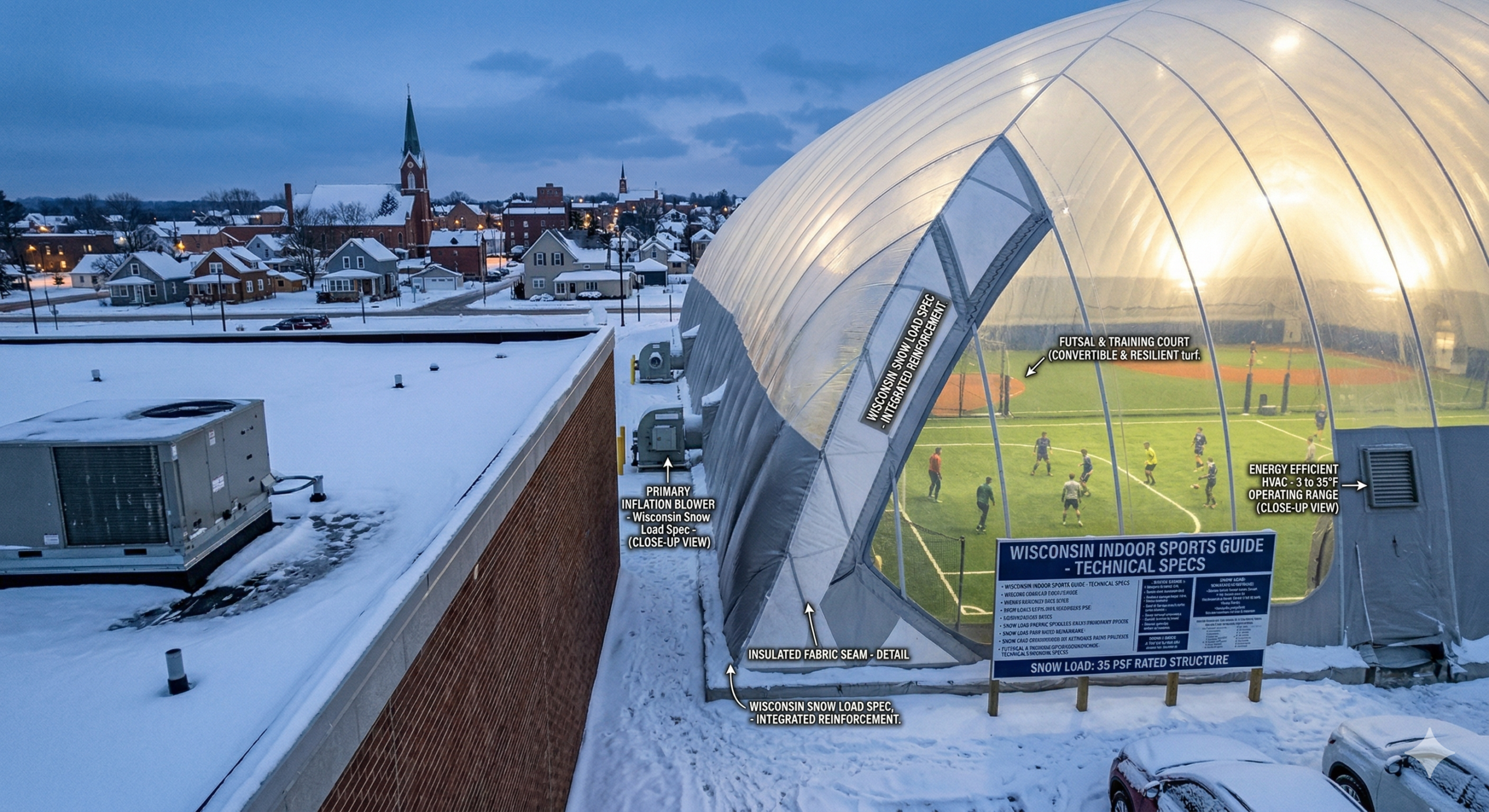
The insulated membrane handles Wisconsin’s minimum 35 PSF snow loads while remaining flexible enough to prevent ice damage that destroys rigid structures. You’ll find Wisconsin indoor sports facilities using air domes stay operational year-round without expensive heating systems breaking down.
Unlike traditional buildings, your Wisconsin tennis dome won’t suffer from foundation frost heaving or roof collapse from sudden snow accumulation. The dome’s air pressure distributes weight evenly, making it ideal for Wisconsin’s unpredictable weather patterns and freeze-thaw cycles.
Tennis vs Soccer vs Baseball: Space and Design Requirements
You’ll need to contemplate drastically different space requirements when choosing between tennis, soccer, and baseball air domes.
Tennis courts require the least square footage but need specific dimensions of 78 by 36 feet, while soccer fields demand much larger areas up to 120 by 80 yards.
Baseball facilities present unique challenges with asymmetrical layouts and varying height requirements from the infield to outfield areas.
Court Dimensions and Layout
Three distinct sports require dramatically different spatial considerations when planning your Wisconsin sports facility.
Tennis courts demand precise 78-foot by 36-foot playing surfaces with additional 12-foot clearances on all sides, totaling approximately 7,200 square feet per court. You’ll need minimum 20-foot ceiling heights to accommodate high lobs and serves.
Soccer facilities require massive open spaces – typically 200 by 85 feet for full-size fields, though you can accommodate smaller formats.
Baseball presents the most complex layout challenges, needing 90-foot baselines and substantial foul territory. You’ll want at least 320 feet down the foul lines and 400 feet to center field for regulation play.
Consider multi-use designs with removable nets or convertible spaces to maximize your investment and accommodate seasonal demand fluctuations across different sports.
Facility Height Requirements
While court dimensions establish your facility’s footprint, ceiling height requirements create equally critical design constraints that vary dramatically between sports.
Tennis facilities need minimum 36-foot clearance above courts, with 40 feet preferred for competitive play. You’ll want additional height for lighting fixtures and structural elements.
Soccer demands much greater vertical space – indoor fields require 50-65 feet minimum to accommodate high kicks and crosses. Professional facilities often exceed 70 feet for ideal play conditions.
Baseball presents the most challenging height requirements, needing 85-120 feet depending on field size and intended use.
Youth facilities can operate with lower clearances, but adult leagues require substantial vertical space for pop flies and batting practice.
These height differences greatly impact your air dome selection, structural engineering requirements, and overall construction costs in Wisconsin’s demanding climate conditions.
Understanding Wisconsin’s 35 PSF Snow Load Requirements
Snow loads present a critical structural consideration when planning indoor sports facilities in Wisconsin. You’ll need to meet the state’s minimum requirement of 35 PSF (1.67 kPa) snow load capacity for your facility’s design.
This requirement isn’t arbitrary—Wisconsin’s harsh winters can dump substantial snow accumulations that create dangerous structural stress. Your air dome or indoor facility must withstand this weight without compromising safety or performance.
You’ll find that snow load requirements can vary by municipality, so check local building codes before finalizing plans. Some areas might require higher ratings based on historical weather patterns or elevation.
Don’t underestimate this specification when budgeting. Meeting snow load requirements affects material costs, structural engineering fees, and installation complexity.
Your facility’s long-term durability depends on proper snow load compliance from day one.
Heating Systems That Handle -10°F Winter Temperatures
You’ll need a robust heating system that can maintain comfortable temperatures when Wisconsin’s winter plunges to -10°F or below.
Three proven options excel in indoor sports facilities: radiant floor heating systems that warm from the ground up, high-efficiency gas furnaces that deliver consistent heat throughout large spaces, and modern heat pump technology that’s increasingly effective in cold climates.
Each system offers distinct advantages for different facility sizes and budgets.
Radiant Floor Heating Systems
Since Wisconsin’s brutal winters can plummet to -10°F, radiant floor heating systems offer an ideal solution for maintaining consistent temperatures in your indoor sports facility.
You’ll benefit from even heat distribution across the entire floor surface, eliminating cold spots that can affect athletic performance.
These systems work by circulating heated water through tubes embedded in concrete slabs or installing electric heating elements beneath flooring materials.
You can expect 20-30% energy savings compared to forced-air systems because radiant heating warms objects directly rather than heating air that rises to the ceiling.
Installation costs range from $6-20 per square foot depending on system type.
Electric systems cost less upfront but have higher operating expenses, while hydronic systems require larger initial investments but deliver superior long-term efficiency for large facilities.
High-Efficiency Gas Furnaces
When temperatures drop to Wisconsin’s bone-chilling -10°F lows, high-efficiency gas furnaces provide the robust heating power your indoor sports facility demands.
You’ll need units with 90% AFUE ratings or higher to manage extreme temperature swings from -10°F to 85°F effectively. These systems deliver consistent airflow throughout large spaces like tennis courts and soccer fields.
Install multiple zones with programmable thermostats to control different areas independently. You’ll save considerably on operating costs compared to electric heating, especially during peak winter months.
Choose furnaces with modulating burners that adjust output based on demand rather than cycling on-and-off continuously.
Proper sizing matters – oversized units waste energy while undersized systems can’t maintain comfortable temperatures during Wisconsin’s harshest weather.
Professional load calculations guarantee peak performance for your facility’s specific requirements.
Heat Pump Technology
Although traditional heat pumps struggled in Wisconsin’s frigid winters, modern cold-climate heat pumps now operate efficiently down to -13°F and continue providing heat even at -25°F.
You’ll find these systems particularly effective for air domes since they provide both heating and cooling capabilities your facility needs year-round.
Cold-climate heat pumps use variable-speed compressors and enhanced vapor injection technology to maintain performance in extreme temperatures.
You’ll achieve 200-300% efficiency ratings even during Wisconsin’s harshest winter conditions, greatly reducing operating costs compared to traditional electric heating.
Installation costs range from $15,000-$35,000 depending on your facility size, but you’ll recover this investment through lower utility bills.
Many Wisconsin municipalities offer rebates for heat pump installations, and you’ll qualify for federal tax credits when upgrading your sports facility’s heating system.
Air Dome Costs: From $120K Single Courts to Multi-Sport Complexes
Air dome costs in Wisconsin start at $120,000 for a single tennis court facility covering 9,360 square feet, but you’ll find prices escalate quickly as you add courts or expand into multi-sport configurations.
The $120K-$200K range for single courts reflects variations in insulation quality, structural specifications, and climate control systems needed for Wisconsin’s harsh winters.
Multi-sport complexes commanding premium prices often feature multiple courts, advanced heating systems, and enhanced structural engineering to handle the state’s 35 PSF snow loads.
You’re looking at considerably higher investments when designing facilities for soccer, baseball, or combined sports under one dome.
Equipment quality, installation complexity, and local building codes across Wisconsin municipalities all impact your final costs, making detailed quotes essential for accurate budgeting.
Navigating Wisconsin Building Codes and Municipal Permits
Before you break ground on your Wisconsin air dome project, you’ll need to navigate a complex web of building codes that vary considerably from one municipality to another.
While state requirements mandate structures handle 35 PSF snow loads and extreme temperature swings from -10°F to 85°F, local jurisdictions add their own layers of regulations.
Start by contacting your municipal building department early in the planning process. You’ll typically need permits for foundation work, electrical systems, and the air dome structure itself.
Many Wisconsin municipalities require engineered drawings that account for wind loads, soil conditions, and emergency egress requirements.
Don’t overlook zoning restrictions that might limit building height, setbacks, or usage types.
Some communities classify air domes as temporary structures, while others treat them as permanent installations, dramatically affecting permit requirements and costs.
Site Selection and Installation Timeline for Your Air Dome
Once you’ve secured your permits, selecting the right site becomes your next critical decision. You’ll need level ground with proper drainage, utility access, and adequate space for your dome plus safety clearances. Consider wind exposure, as Wisconsin’s weather patterns affect structural loads.
| Installation Phase |
Duration |
Key Activities |
| Site Preparation |
2-3 weeks |
Excavation, foundation, utilities |
| Dome Delivery |
1-2 days |
Equipment transport, staging |
| Inflation & Setup |
3-5 days |
Membrane installation, pressurization |
Installation typically takes 4-6 weeks total. Summer installations work best, avoiding Wisconsin’s harsh winters. You’ll coordinate with contractors for electrical, heating systems, and final inspections. Plan your timeline around sports seasons—many facilities target spring installation for fall opening.