Have you ever looked out your window on a completely still, gray day and thought about the wind turbines sitting motionless on a distant hill? Or maybe you’ve watched a sudden rainstorm roll in and wondered what happens to the solar panels on your neighbor’s roof?
I think about it a lot. Actually, our whole team thinks about it constantly.
We are living in an incredible moment in human history. We’re finally transitioning away from the dirty energy of the past and embracing the clean, boundless power of the sun and the wind. It’s exciting, it’s necessary, and frankly, it’s about time. But behind the closed doors of our industry, we all talk about the same giant elephant in the room: the intermittency problem. The sun sets. The wind dies down. And yet, we still need to turn on our lights, heat our homes, and run our hospitals.
For a long time, the energy storage puzzle has kept a lot of us awake at night. But today, I want to share a story with you. It’s a story about a wild idea, an unlikely transatlantic friendship, and a secret project we’ve been brewing that might just change how the world stores its power.
We’re taking a massive leap into the world of Long-Duration Energy Storage (LDES). We are teaming up with a brilliant group of innovators in Italy and an absolute powerhouse of a company right here in the United States to bring a revolutionary concept to life.
I can’t give you all the juicy details just yet—my legal team would probably have a heart attack—but I can tell you how this technology works, why we’re so passionate about it, and why this collaboration gives me so much hope for our planet’s future.
The Smartphone Problem, but for Cities
To understand why we’re so thrilled about this, think about your smartphone.
We’ve all experienced that mild panic when we see the battery icon drop into the red. Now, imagine that anxiety scaled up to an entire city. For the past decade, the hero of the renewable energy revolution has been the lithium-ion battery. They are amazing pieces of technology. But they are essentially sprinters. They are fantastic for giving the grid a quick jolt of energy to smooth out a momentary hiccup.
But what happens when a winter freeze blankets a region for four days, and the solar panels are covered in snow? A lithium-ion battery simply cannot run a marathon. Trying to build enough of them to power a city for days on end is practically impossible, incredibly expensive, and requires mining a massive amount of rare earth minerals.
We realized we couldn’t just keep building bigger smartphone batteries to solve a civilization-level problem. We needed something robust, scalable, and built from the stuff we already have lying around. We needed a true marathon runner.
The Irony of CO2: From Villain to Hero
This is where our story takes a beautifully ironic twist.
If I say “carbon dioxide,” you probably immediately think of climate change, smokestacks, and the very crisis we are trying to solve. For years, CO2 has been the ultimate villain in our environmental story.
But what if we could flip the script? What if we could take the villain and turn it into the hero?
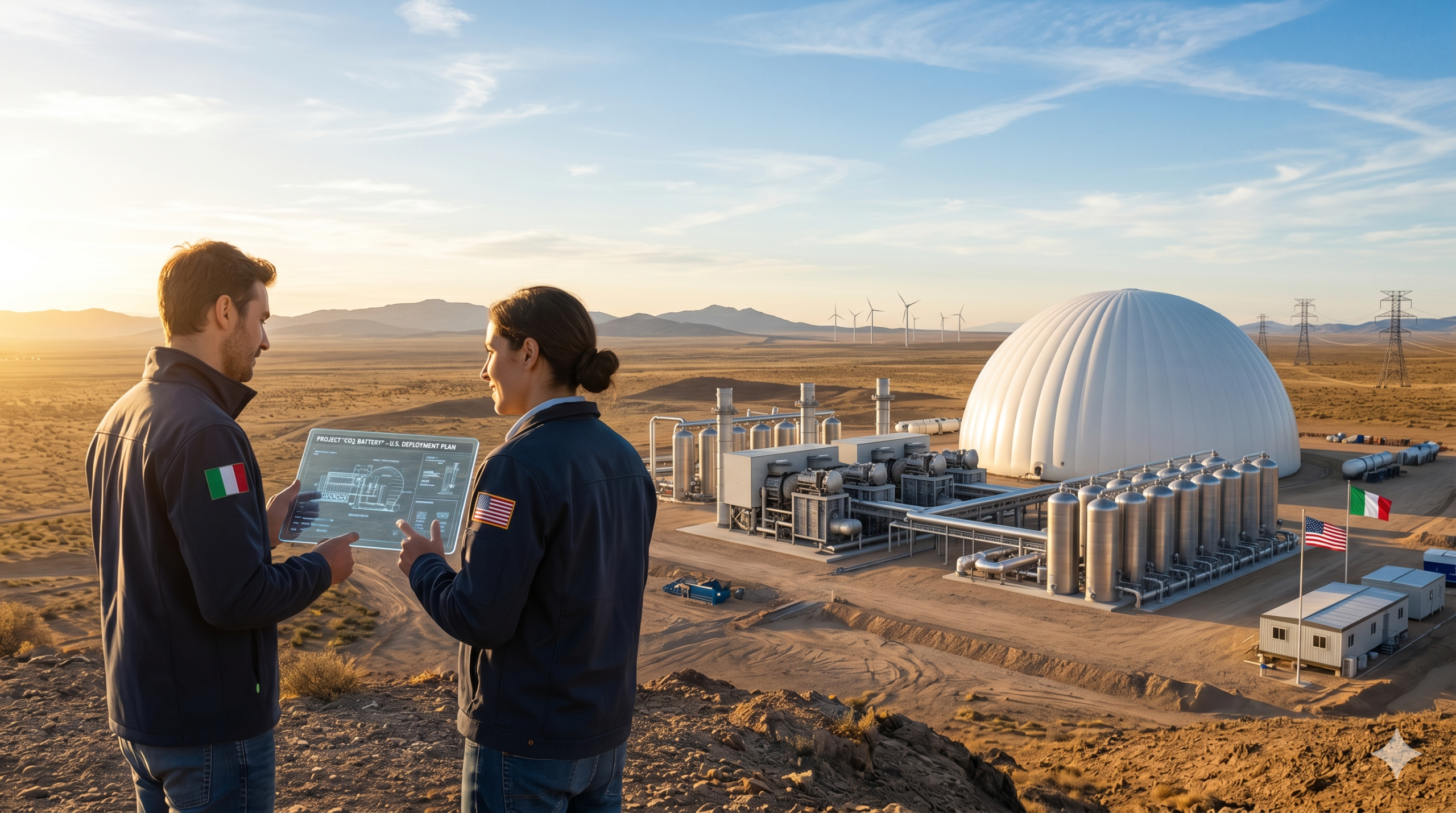
That is the genius behind the “CO2 Battery” concept we are working with. Invented by some of the most creative engineering minds I’ve ever had the pleasure of meeting, this technology uses carbon dioxide to store massive amounts of energy. And no, we aren’t burning anything, and we aren’t releasing anything into the atmosphere. It’s a completely closed loop.
I like to think of the system as a giant, mechanical lung. Here’s how it breathes:
1. The Inhale (Charging): Picture a breezy Sunday afternoon. The wind turbines are spinning like crazy, and there’s more electricity on the grid than anyone knows what to do with. Instead of letting that clean energy go to waste, our system wakes up. It uses that surplus electricity to take CO2 gas out of a massive, flexible balloon-like structure we call the “Dome.” A compressor squeezes the gas, turning it into a liquid. During this squeezing, a lot of heat is generated, which we capture and save in special thermal bricks.
2. Holding the Breath (Storage): Now, the energy is trapped. The CO2 is sitting comfortably as a liquid in standard steel tanks at regular, everyday temperatures. It doesn’t need massive, energy-hogging freezers to stay cold. It can just sit there, patiently holding onto all that potential energy for hours, days, or even weeks without losing an ounce of power.
3. The Exhale (Discharging): Fast forward to a Tuesday evening. People are coming home, turning on their ovens, and blasting their heaters. The sun is down, and the grid is stressing out. Our system exhales. We take that liquid CO2, warm it back up using the heat we stored earlier, and it rapidly expands back into a gas. This forceful expansion spins a turbine, pushing clean, reliable electricity right back into the homes that need it. The CO2 flows safely back into the Dome, ready to take another breath.
It’s elegant. It relies on standard steel pipes, tanks, and turbines that the industrial world has been making for a century. There are no toxic chemicals, no rare earth mining, and the machinery lasts for decades. It’s just simple, beautiful thermodynamics.
Espresso, Engineering, and the Italian Connection
You don’t get to a breakthrough like this without a bit of passion, and let me tell you, our technology partners in Italy have passion in spades.
When we first started exploring this concept, we spent hours on video calls with their engineering team. I remember flying out to meet them, stepping into a room filled with blueprints, the smell of strong espresso, and an infectious, buzzing energy. Italy has an incredible, deeply rooted history of mechanical engineering, and you can feel it in the way these folks talk about turbines and fluid dynamics.
They looked at the climate crisis not just as a tragedy, but as the ultimate engineering puzzle. They had the audacity to look at CO2 and say, “We can build a machine out of this.” Partnering with them hasn’t just been a business transaction; it’s been an exchange of shared values. We are learning from their technical mastery and their unwavering belief that human ingenuity can fix the messes we’ve made.
The American Muscle: Our Secret Partner
But having a brilliant invention in Europe is only half the battle. If you want to change the world, you have to build at a staggering scale. You need massive infrastructure, deep resources, and a footprint that spans continents.
That’s where the second half of our transatlantic partnership comes in.
We are incredibly proud to announce that we are teaming up with a major company right here in the United States to bring this concept to the American grid.
I know, I know—I can almost hear you shouting at the screen: “Just tell us who it is!” Trust me, it is taking every ounce of my willpower not to shout their name from the rooftops. This is a company with a massive industrial legacy in the U.S. They know how to build big things, they know how the American energy market works, and most importantly, they share our vision that the future of power has to be clean, reliable, and accessible to everyone.
By bringing our Italian partner’s technological artistry together with our American partner’s incredible industrial muscle, we are creating a dream team.
So, Why All the Secrecy?
I know it can be frustrating to read an announcement that feels a bit like a movie teaser. Why the mystery?
The honest truth is that overhauling the grid is messy, complicated human work. We aren’t just launching an app; we are dealing with physical steel, gigawatts of electricity, land permits, utility regulations, and the coordination of hundreds of people across multiple time zones.
Right now, we are in the “rolling up our sleeves” phase. We are hashing out the intricate details of how this deployment will work. We are mapping out the logistics, dotting our i’s, and crossing our t’s. We decided to share this concept with you now because we simply couldn’t contain our excitement, but we are keeping the names and exact dates quiet until the concrete is ready to pour.
When we do a full reveal, we don’t just want to hand you a press release. We want to show you exactly where the shovels are hitting the dirt.
A Brighter Horizon
We spend a lot of time reading headlines about the climate, and it’s easy to feel overwhelmed. It’s easy to feel like the problem is too big for us to solve.
But when I look at what we are building right now—when I see American and Italian engineers laughing over a Zoom call, figuring out how to turn carbon dioxide into a battery that could power thousands of homes—I don’t feel overwhelmed. I feel incredibly optimistic.
We are moving away from an energy system that takes from the earth, and moving toward one that works with it. We are building a grid that can take a deep breath on a windy day, and keep your lights on through the darkest night.
We can’t wait to introduce you to our partners and show you what we are building together. Thank you for being on this journey with us. Stay tuned—the best is yet to come.