Tag: Air dome costs

  • Seasonal vs Year-Round Air Dome Decision

    Seasonal vs Year-Round Air Dome Decision

    You’re facing a critical decision that’ll impact your facility’s budget for years to come. Choosing between a seasonal air dome ($700K-$1M) and a year-round installation ($800K-$1.2M) isn’t just about upfront costs—it’s about hidden expenses that can quietly drain your resources. While that $100K-$300K price difference might seem straightforward, the real financial picture becomes clear only when you factor in setup, removal, storage, and weather-related risks that most operators completely overlook.

    Air Dome Costs: Seasonal ($700K-$1M) vs Year-Round ($800K-$1.2M)

    Two distinct pricing tiers separate seasonal and year-round air domes, with seasonal options starting at $700,000 to $1 million while year-round installations range from $800,000 to $1.2 million.

    When you’re evaluating seasonal vs year-round air dome options, you’ll notice the upfront difference isn’t dramatic—typically $100,000 to $200,000 more for permanent structures.

    However, your temporary vs permanent dome decision involves hidden costs. Seasonal domes require annual setup and removal expenses ranging from $16,000 to $30,000, plus you’ll need dedicated storage space measuring 10′ x 20′.

    Over five years, these recurring costs can offset initial savings.

    Your seasonal dome vs fixed installation choice ultimately depends on usage patterns. If you’ll operate nine to twelve months annually, permanent installations deliver better value despite higher upfront investment.

    Hidden Expenses: Setup, Removal, and Storage Requirements for Seasonal Domes

    Beyond the sticker price, seasonal air domes carry recurring expenses that can greatly impact your total cost of ownership.

    You’ll face annual setup and removal costs ranging from $16,000 to $30,000, which includes professional installation, equipment rental, and labor. These expenses occur every single year your dome operates.

    Storage presents another ongoing challenge.

    You’ll need a dedicated 10′ x 20′ space to house your deflated dome during off-seasons. This storage area must remain dry, secure, and climate-controlled to prevent damage from moisture, pests, or temperature fluctuations.

    Factor in storage facility rental costs or the opportunity cost of using your own space.

    Don’t overlook transportation expenses either.

    Moving your dome between storage and installation sites requires specialized vehicles and handling equipment, adding hundreds to thousands annually.

    Break-Even Point: When Permanent Air Domes Beat Seasonal Options

    You’ll reach the break-even point between seasonal and permanent air domes faster than you might expect when you factor in annual setup costs.

    Your 20,000 sq ft seasonal dome’s $16K-$30K yearly expenses mean you’ll spend an additional $80K-$150K over five years compared to a permanent structure.

    Calculate your total cost of ownership over 7-10 years, and you’ll likely find the permanent dome’s higher upfront investment pays off through eliminated recurring costs.

    Annual Cost Calculations

    Understanding the break-even point between seasonal and year-round air domes requires examining both upfront investments and ongoing operational costs.

    For a 20,000 sq ft dome, you’ll face $700K-$1M upfront for seasonal options versus $800K-$1.2M for permanent structures.

    Your annual operational costs tell the real story. Seasonal domes require $16K-$30K yearly for setup and removal, plus storage expenses for a 10′ x 20′ space. Year-round domes eliminate these recurring costs entirely.

    Calculate your break-even timeline by dividing the upfront cost difference by annual operational savings.

    With $100K-$200K higher initial investment but $16K-$30K annual savings, you’ll typically break even within 3.3-12.5 years. If you’re planning 9-12 months of annual use, permanent domes become financially advantageous.

    Multi-Year ROI Analysis

    When your facility operates more than seven months annually, the financial mathematics shift dramatically in favor of permanent air domes. You’ll reach break-even between years three and four, depending on your annual setup costs and usage intensity.

    Here’s your ROI timeline: Year one shows seasonal domes ahead by $100K-$200K due to lower upfront investment. By year two, you’re still saving $84K-$170K with seasonal options.

    However, year three marks the turning point where cumulative costs converge. From year four onward, you’ll save $16K-$30K annually with permanent structures.

    Over ten years, permanent domes deliver $112K-$210K in total savings. Factor in reduced labor disruption, eliminated weather delays during setup, and consistent facility availability—permanent air domes become the clear financial winner for extended seasonal operations.

    Storage Solutions: Planning for 20,000 Sq Ft Seasonal Air Dome Systems

    One critical aspect of owning a 20,000 sq ft seasonal air dome that’s often overlooked during the planning phase is the storage requirement during off-season months.

    You’ll need approximately 200 square feet of storage space (10′ x 20′) to properly house your dome membrane, blower systems, and accessories.

    Consider climate-controlled storage to protect your investment from moisture, temperature fluctuations, and UV exposure.

    Many facilities opt for dedicated storage buildings or rent warehouse space specifically for dome components.

    You’ll also need adequate ventilation to prevent mold and mildew formation on fabric materials.

    Factor storage costs into your annual operating budget—typically $1,200-$3,600 yearly for commercial storage.

    Some operators negotiate shared storage arrangements with other seasonal dome owners to reduce individual costs while maintaining proper storage conditions.

    9+ Month Usage: Why Year-Round Air Domes Make Financial Sense

    While seasonal air domes initially appear more cost-effective with their lower upfront investment of $700K-$1M compared to year-round systems at $800K-$1.2M, the financial mathematics shift dramatically when you’re operating nine months or more annually.

    The recurring costs quickly erode seasonal systems’ initial savings:

    Cost Factor Seasonal Year-Round
    Year 1 Total $716K-$1.03M $800K-$1.2M
    Year 5 Total $764K-$1.15M $800K-$1.2M
    Year 10 Total $844K-$1.3M $800K-$1.2M
    Storage Space Required None
    Setup Risk Annual Eliminated

    You’ll reach break-even around year three to five. Beyond this point, year-round domes deliver superior ROI while eliminating storage headaches and weather-dependent installation windows that can delay your season openings.

    Real-World Air Dome ROI: Cost Analysis Over 5-10 Years

    Three critical factors determine your air dome’s actual return on investment: operational intensity, local climate conditions, and facility utilization rates.

    Over five years, a seasonal dome‘s total cost reaches $780K-$1.15M ($700K initial + $80K-$150K setup/removal).

    Year-round domes cost $800K-$1.2M with no recurring expenses.

    If you’re operating 9+ months annually, year-round domes break even by year two.

    The math shifts dramatically with usage patterns—seasonal domes favor 6-month operations, while year-round models excel with consistent use.

    Storage costs add $2K-$5K annually for seasonal units.

    Labor disruptions during changes can impact revenue by 10-15%.

    Climate Considerations: Weather Impact on Seasonal vs Permanent Domes

    Your dome’s climate resilience directly impacts whether seasonal or permanent installation makes financial sense.

    Seasonal domes face repeated stress from setup and teardown cycles, while permanent structures must withstand year-round weather extremes including snow loads, high winds, and temperature fluctuations.

    You’ll need robust temperature control systems and storm-resistant designs, but the risk-reward equation changes dramatically based on your local weather patterns.

    Winter Weather Resistance

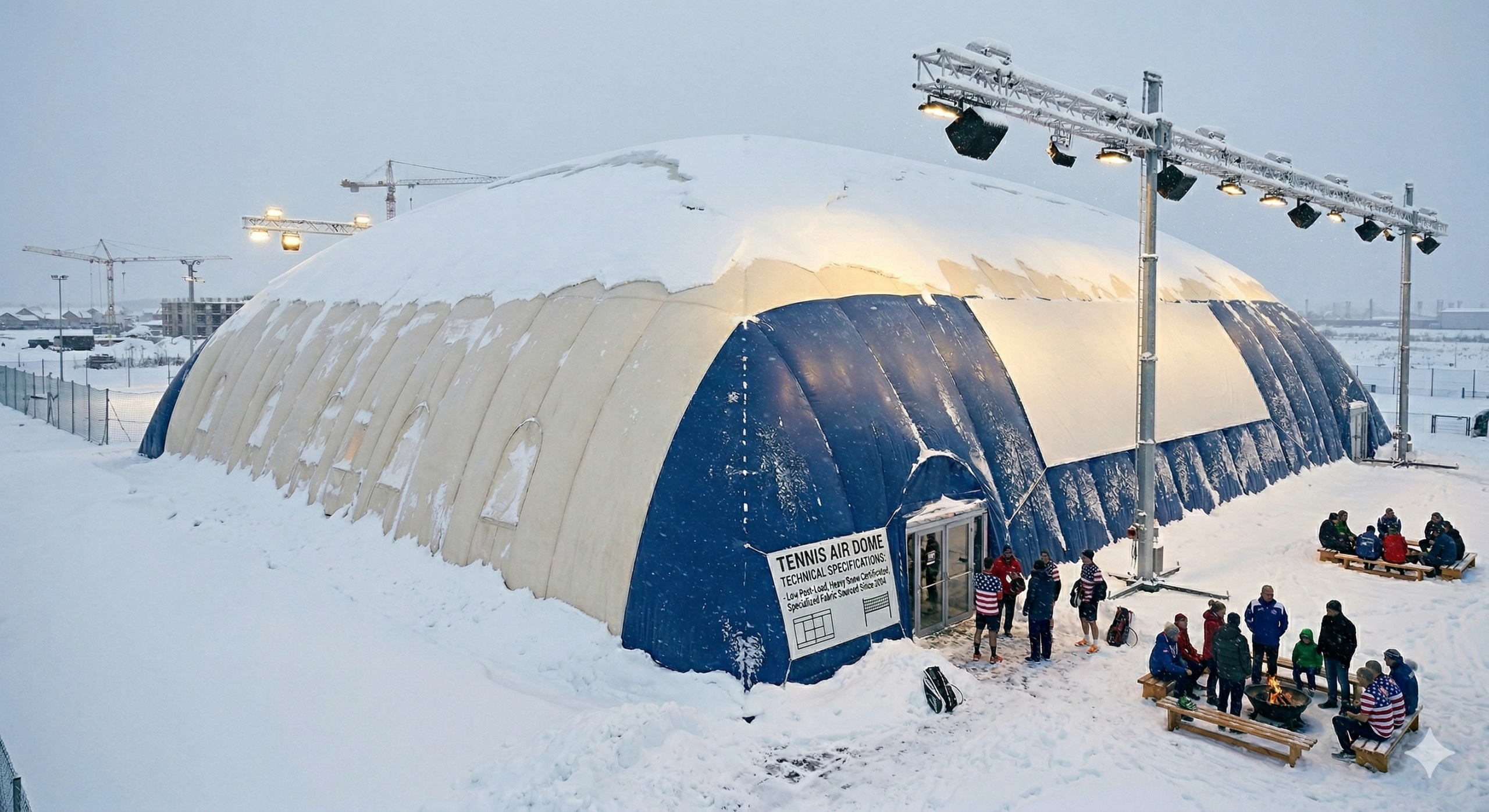
    When winter storms arrive with heavy snow loads and freezing temperatures, the structural differences between seasonal and year-round air domes become critical factors in your facility’s survival.

    Year-round domes feature reinforced fabric systems and enhanced anchoring specifically engineered for harsh winter conditions. They’ll withstand snow accumulation up to 40 pounds per square foot and temperatures as low as -40°F without compromising structural integrity.

    Seasonal domes weren’t designed for these extreme conditions. Their lighter materials and standard anchoring systems can fail under heavy snow loads, potentially causing:

    • Complete structural collapse from excessive weight
    • Fabric tears from ice formation and expansion
    • Air leakage through temperature-stressed seams
    • Foundation damage from freeze-thaw cycles

    You’ll face considerably higher winter maintenance costs and safety risks with seasonal options during severe weather events.

    Temperature Control Systems

    Because temperature control systems directly impact both operational costs and athletic performance, the choice between seasonal and year-round air domes creates vastly different heating and cooling requirements throughout the year.

    Seasonal domes let you optimize climate control for specific months when you’ll use the facility most. You can install heating systems during winter installations or cooling equipment for summer sports seasons, reducing energy costs by avoiding year-round climate management.

    Year-round domes require extensive HVAC systems handling extreme temperature variations across all seasons. You’ll need robust heating for winter months and adequate cooling for summer heat.

    While initial HVAC investments run higher, you’ll achieve better energy efficiency through consistent system operation rather than intermittent seasonal heating spikes that seasonal domes experience during setup periods.

    Storm Damage Risks

    Storm damage risks vary dramatically between seasonal and year-round air domes, with each design philosophy creating distinct vulnerabilities during severe weather events.

    Your seasonal dome faces unique challenges since you’ll typically remove it before winter’s harshest conditions. However, unexpected storms during operating seasons can catch you off-guard with limited structural reinforcement options.

    You’re also vulnerable during setup and takedown periods when the structure isn’t fully secured.

    Year-round domes withstand more severe weather but face prolonged exposure to multiple storm seasons. Consider these key risk factors:

    • Wind resistance: Permanent structures handle sustained winds better than temporary installations.
    • Snow loading: Year-round domes require engineered snow load calculations.
    • Hail damage: Both types need puncture-resistant materials in hail-prone regions.
    • Emergency deflation: Seasonal domes offer quicker protective deflation options.
  • Multi-Court Air Dome Cost Analysis

    Multi-Court Air Dome Cost Analysis

    You’ll pay between $250,000 and $4.6 million for a multi-court air dome, with tennis facilities on the lower end and football domes commanding premium prices. Foundation and site preparation alone consume 20-40% of your total budget, while operating costs run $3-6 per square foot annually. Material quality, size, and installation complexity drive pricing, but larger structures offer better per-square-foot value. Understanding these cost factors will help you make informed decisions about your facility investment.

    Total Air Dome Costs by Sport and Size

    When planning your air dome investment, understanding sport-specific costs helps you make informed decisions about facility size and configuration.

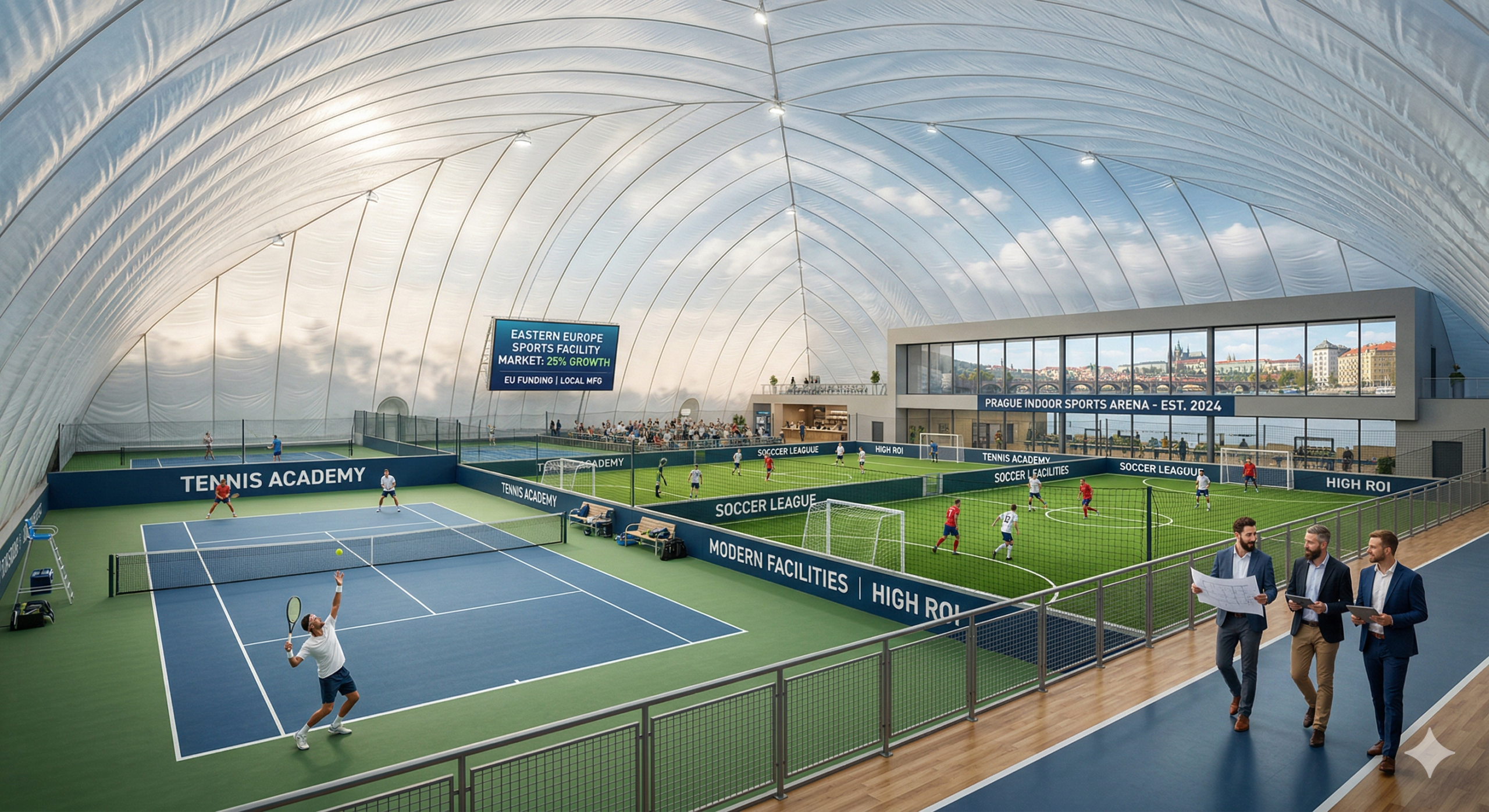
    Tennis facilities offer excellent multi court air dome cost efficiency, with four-court configurations ranging from $250K-$400K for basic structures, though premium installations reach $2.9 million. Your 4 court tennis bubble cost depends heavily on amenities and membrane quality.

    Large sports dome pricing varies considerably by sport. Baseball domes cost $1.6-$4.2 million, while football facilities range $2.2-$4.6 million. Soccer domes fall between $2.1-$4.2 million. Specialty sports like lacrosse command $2.3-$4.2 million, and golf driving ranges cost $2-$3.4 million.

    Per-square-foot costs range $10-$50 for membrane systems, plus $10 for site preparation. These durable materials result in fewer replacements and lower long-term operational costs.

    Multi-sport configurations covering 120,000 square feet maximize your investment by accommodating multiple playing surfaces under one structure.

    What Drives Air Dome Pricing (Materials, Labor, and Site Factors)?

    Understanding air dome pricing requires examining five critical cost drivers that determine your final investment.

    Material quality greatly impacts costs—durable vinyl and reinforced PVC command premium pricing but reduce long-term maintenance expenses compared to lower-quality alternatives.

    Size affects pricing exponentially, though larger structures like a multiple tennis court dome achieve better per-square-foot rates starting at $12.

    Installation complexity scales with dimensions, requiring specialized labor and extended timelines. Air domes offer faster installation compared to traditional permanent structures, reducing overall project costs.

    Site-specific conditions dramatically influence foundation costs, with hybrid grade beam systems representing major expenses.

    Additional features including LED lighting, HVAC systems, and specialized doors add substantial costs beyond base packages.

    For a 6 court indoor facility cost, these factors combine to create considerable pricing variations depending on your specific requirements and location.

    Foundation and Site Preparation Expenses

    Foundation and site preparation represent the largest variables in your multi-court air dome budget, often accounting for 20-40% of total project costs.

    Foundation expenses range dramatically from $3,795 for small projects to $350,000+ for large commercial installations. Your costs depend heavily on soil composition, frost line depth, and local wind codes—factors that can create $1,200-$3,200 variations between contractor quotes.

    You’ll need grade-beam concrete foundations with angle iron anchoring for standard installations, though earth anchors work for temporary setups.

    Geographic location greatly impacts pricing, as seen with Michigan’s 100,000 sq.ft. dome requiring a $350,000 hybrid foundation system. Professional installation teams will conduct an initial assessment of site conditions before beginning foundation work.

    Flat terrain with minimal frost requirements reduces excavation expenses, while poor soil conditions demand deeper footings and specialized anchoring solutions.

    Air Dome Engineering and Permit Costs

    Professional engineering and permit costs will add approximately $20,000 to your multi-court air dome project, representing a fixed expense that doesn’t scale proportionally with dome size.

    You’ll need licensed engineers to stamp structural and mechanical components, ensuring compliance with International Building Code (IBC) and ASCE 55-16 standards across all jurisdictions.

    Your engineering team must maintain proper licensing across multiple states and countries, with requirements varying by location.

    They’ll prepare essential permit drawings for local construction approval, with documentation standards determined by each permitting authority.

    Additional costs may arise from supplementary services like civil engineering for site conditions, electrical work for HVAC systems, or architectural services.

    These expenses depend on your specific site requirements and local code variations beyond standard structural and mechanical engineering work. The engineering process helps determine the complete dome package scope and final project cost through comprehensive analysis.

    Interior Equipment and Flooring Investment

    While engineering costs remain fixed regardless of dome size, your interior equipment and flooring investment scales directly with facility dimensions and intended sports applications.

    Hard court surfaces integrate into your overall square footage pricing, while specialized options like clay courts and artificial turf systems require additional base layers and material considerations.

    Your flooring selection greatly impacts total costs:

    1. Modular plastic tiles enable quick installation and replacement for tennis and pickleball facilities.
    2. Clay court installations vary in expense based on material quality and maintenance requirements.
    3. Artificial turf systems require base preparation, quality selection, and infill materials.
    4. Hard court surfaces offer durability for multi-sport use with integrated pricing.

    Standard equipment additions include net systems, scoreboards, bleachers, and sport-specific goals within your extensive dome investment. All facilities include energy-efficient LED lighting systems that contribute to reduced operational costs over time.

    HVAC, Lighting, and Climate Control Systems

    Beyond structural and flooring investments, your HVAC, lighting, and climate control systems represent critical operational components that directly impact both upfront costs and long-term facility performance.

    These systems are engineered based on your local weather conditions and designed to handle wind and snow loads specific to your region.

    Your facility includes high-performance air blowers integrated into the dome structure, plus water heaters and air conditioning units.

    Energy-efficient LED lighting systems are customizable for multi-court facilities, with ball-resistant options designed specifically for sports applications.

    You’ll need professional HVAC technician hookup and a licensed electrician for proper installation.

    Multiple HVAC configurations are available, including backup blower engines and gas heaters requiring natural gas hookup for supplemental heating operations.

    Air Dome vs Permanent Building Cost Comparison

    When evaluating facility options, you’ll find air domes offer substantial cost advantages over permanent structures.

    Air-supported dome facilities typically cost $1–$3 million including all systems, while permanent sports buildings range from $5–$10 million for standard metal structures. This represents savings of 50–75% compared to traditional construction.

    The cost differential becomes clear when examining key factors:

    1. Material costs – Air domes use $10–$25 per square foot versus expensive steel framing systems.
    2. Construction timeline – Installation takes days or weeks versus months or years for permanent buildings.
    3. Labor requirements – Minimal on-site assembly compared to complex traditional construction procedures.
    4. Foundation needs – Simplified anchoring systems versus extensive structural support requirements.

    You’ll achieve faster deployment while notably reducing your overall project investment.

    Operating Costs and Long-Term ROI Analysis

    Understanding upfront costs represents only part of your financial planning equation.

    You’ll face annual operating expenses of $3–$6 per square foot, with utilities consuming $0.50–$1.50 per square foot yearly.

    A three-court tennis dome costs $60,000–$80,000 for four-month seasonal operation, while year-round facilities require approximately $100,000 annually including mortgage and utilities.

    Your ROI improves considerably with continuous operation since year-round availability maximizes booking revenue and programming opportunities.

    However, you’ll need continuous air pressure maintenance, increasing energy consumption compared to seasonal structures.

    Factor in staffing expenses for coaching and facility management, plus mandatory insurance coverage.

    Large multi-sport domes can reach $500,000 in annual operating costs, but their revenue potential justifies the investment through diverse programming and extended operational capacity.

    Frequently Asked Questions

    Can Air Domes Withstand Extreme Weather Conditions Like Hurricanes and Heavy Snow?

    Yes, you’ll find air domes are engineered to handle extreme weather exceptionally well.

    They’ll withstand hurricanes up to 67m/s and heavy snow loads exceeding 250kg/sqm. You’ll experience minimal displacement during high winds – less than 10cm compared to competitors’ 2m deflection.

    The structures operate reliably from -55°C to +70°C, and you’re protected by triple redundancy inflation systems plus bias harness cable networks that distribute forces evenly.

    What Financing Options Are Available for Multi-Court Air Dome Construction Projects?

    You’ve got several financing options for multi-court air dome projects.

    Commercial leasing through companies like Grenke Leasing and LED.Finance offers flexible payment terms.

    Personal loans up to $100,000 are available through third-party lenders without collateral.

    You can also pursue public grants like UPARR and Land Water Conservation Fund, or explore private funding through USA Track & Field Foundation.

    Alternative strategies include sponsorship agreements, crowdfunding campaigns, and local fundraising efforts.

    How Long Does It Typically Take to Construct a Multi-Court Air Dome?

    You’ll typically complete a multi-court air dome construction in 12-16 weeks total.

    Once your foundation’s ready, the dome installation and inflation happens incredibly fast—just 2-5 days for most projects.

    However, you’ll need to account for the pre-construction phase including engineering, permits, and manufacturing, which takes 8-12 weeks.

    Larger multi-court facilities may extend the timeline slightly, but you’ll still be operational months faster than traditional construction methods.

    Are There Zoning Restrictions or Permits Needed Specifically for Air Dome Structures?

    You’ll need operational permits for air domes exceeding 400 square feet, plus compliance with Type II-B building code classification.

    Your application must include site plans, dimensions, fire safety assessments, and egress verification.

    You’re limited to one-story structures with specific height restrictions.

    Check local zoning since regulations vary by municipality – some areas have additional requirements if you’re within 540 feet of residential zones.

    What Happens if the Air Dome Membrane Gets Damaged or Punctured?

    You’ll face different repair options depending on damage size.

    Small tears under 50mm can be patched with reinforcement, while larger damage over 300mm requires factory repair or replacement.

    You can detect punctures using soapy water to spot bubbles or listening for escaping air.

    Most repairs need specialized techniques like heat welding for PVC membranes and require 24-hour curing before you can reinflate the dome safely.

  • Air Dome Cost Breakdown 2026 Complete Guide

    Air Dome Cost Breakdown 2026 Complete Guide

    You’ll spend between $50,000 and $350,000 on your air dome project in 2026, depending on size, materials, and site requirements. Dome packages cost $10-$25 per square foot, while complete installations run $25-$50 per square foot including materials and labor. Annual operating expenses range from $3-$6 per square foot for blowers, HVAC, and maintenance. Larger domes offer markedly better value, with costs up to 400% lower per square foot than smaller facilities. This thorough breakdown reveals exactly where your investment goes.

    Total Air Dome Project Costs: $50,000 to $350,000 Budget Breakdown

    Air dome investments span a significant range, with complete projects typically falling between $50,000 and $350,000 depending on your facility’s size and specifications.

    Your air dome installation cost breaks down into several key components that determine your total investment.

    The dome package itself costs $10-$25 per square foot ($108-$269 per square meter), with mid-sized tennis facilities requiring mid-six-figure investments.

    You’ll need approximately $20,000 for structural and mechanical engineering to guarantee code compliance.

    Foundation expenses vary dramatically based on soil conditions and local requirements.

    Larger domes deliver better per-square-foot value, while premium materials and custom features increase costs. These premium upgrades include flame-retardant membranes and high light-transmission covers for enhanced safety and performance.

    You can reduce expenses by providing volunteer labor for manual installation tasks and procuring heavy equipment independently, achieving 50-75% savings compared to permanent construction.

    Construction and Installation: Material, Labor, and Foundation Expenses

    Construction represents the largest expense category in your air dome project, with material costs ranging from $25-50 per square foot ($269-538 per square meter) for complete installations.

    Premium membrane materials with flame-retardant properties and high light transmission cost $10-25 per square foot ($108-269 per square meter), while basic structures start at $12 per square foot ($129 per square meter).

    Labor expenses reach approximately $74,000 for seven-day installations, including specialized HVAC and electrical technicians.

    You’ll achieve 50% faster installation times compared to permanent buildings, reducing overall labor requirements. Small domes can be installed in 1-2 days, while larger installations may require several weeks depending on complexity.

    Foundation systems represent significant additional costs, with hybrid grade beam and earth anchor systems costing around $350,000 for 100,000-square-foot installations.

    Air dome cost calculations must include engineering fees of approximately $20,000 for structural design and permit compliance.

    Air Dome Operating Costs: Annual Maintenance and Utilities by Size

    Operating expenses consume $3-6 per square foot ($32-65 per square meter) annually across all air dome sizes, with utility costs representing your largest ongoing financial commitment. Your sports bubble operating costs break down into four primary categories: blower inflation, HVAC systems, routine maintenance, and fabric replacement reserves.

    Cost Category Annual Rate Description
    Blower Operations $0.10-0.20/sq ft ($1.08-2.15/sq m) Continuous inflation system electricity
    Climate Control $0.50-1.50/sq ft ($5.38-16.15/sq m) Heating, cooling, and ventilation utilities
    Maintenance 7-12% of initial investment Inspections, repairs, and component upkeep
    Fabric Replacement Every 10-15 years $10,000-$1M+ depending on dome diameter

    Three tennis courts generate $60,000-$80,000 in annual operational expenses, delivering 50-75% savings compared to permanent structures. HVAC maintenance follows commercial building standards with minimal additional requirements for dome-specific components.

    Small vs Large Air Dome Economics: When Size Saves Money

    Scale transforms air dome economics greatly, with larger installations delivering per-square-foot costs up to 400% lower than smaller facilities.

    You’ll find dome packages starting at $12 per square foot for large installations, while smaller domes can cost $50 per square foot. This dramatic difference stems from fixed costs spreading across greater surface area.

    Your foundation expenses demonstrate this principle clearly—a 100,000-square-foot dome’s foundation costs just $3.50 per square foot, while smaller installations face proportionally higher foundation expenses. Acceptable substrates require poured-in-place concrete with minimum 25 MPa compressive strength to handle anchor loads of 12-18 kN per anchor point.

    Air supported structure cost efficiency improves markedly with scale because installation complexity remains constant regardless of size.

    Large domes also offer superior maintenance economics, with annual per-square-foot maintenance costs of $0.10-0.20 plus utilities at $0.50-$1.50, making bigger installations increasingly cost-effective over time.

    Air Dome ROI: 10-Year Cost Comparison vs Traditional Buildings

    When evaluating long-term facility investments, air domes deliver compelling financial advantages that become increasingly pronounced over a decade. You’ll save 50–75% on initial construction costs compared to traditional buildings, with air dome roi calculations showing breakeven within 3–5 years through operational efficiencies.

    Your ten-year operational expenses run $3–$6 per square foot annually, including energy-efficient LED lighting and high-performance air blowers. For tennis bubble cost comparisons, you’re looking at $10–$25 per square foot versus $100–$250 for conventional structures.

    The sealed envelope design reduces thermal loss while integrated HVAC systems maintain consistent climate control.

    Material efficiency delivers additional savings, requiring 25% fewer materials than equivalent traditional buildings. Your disaster-proof design withstands hurricanes and earthquakes, reducing emergency repair costs throughout the facility’s lifespan. Advanced security solutions now protect facility management systems from online threats that could potentially disrupt operations or compromise sensitive cost data.

    Frequently Asked Questions

    Can Air Domes Withstand Extreme Weather Like Hurricanes and Heavy Snow Loads?

    Yes, you’ll find air domes are engineered to handle extreme weather conditions. They withstand winds up to 150 mph (241 km/h) and snow loads of 51 psf (244 kg/m²).

    You’ll benefit from increased air pressure that stiffens walls during storms, plus TEDLAR fabric that sheds snow automatically.

    The triple redundancy inflation system with backup generators guarantees you’re protected even during power outages, while the patented anchoring system secures everything against hurricane-force conditions.

    What Permits and Zoning Approvals Are Required Before Installing an Air Dome?

    You’ll need building permits stamped by licensed engineers, costing approximately $20,000 for structural and mechanical documentation.

    Check with your local building department first—some jurisdictions classify air domes as temporary structures, potentially exempting them from standard permits.

    Rural counties often have relaxed requirements, while urban areas require full IBC and ASCE 55-16 compliance.

    Start permit research early since approval processes can take weeks to months depending on your location’s complexity.

    How Long Do Air Dome Membranes Typically Last Before Requiring Replacement?

    You’ll get 10-15 years from standard fabric membranes under normal conditions, though well-maintained air-supported domes can last 10-20 years.

    Higher-end models reach 30+ years, while double-membrane systems extend life to 40+ years.

    Rigid-frame domes with membrane covers typically last 20-30 years.

    Your dome’s lifespan depends on UV exposure, climate conditions, installation quality, and maintenance practices.

    Regular cleaning and prompt repairs greatly extend membrane life beyond standard expectations.

    Are Air Domes Suitable for Year-Round Use in Sub-Zero Winter Climates?

    Yes, you’ll find air domes are excellent for year-round use in sub-zero climates.

    They’re engineered to handle temperatures from -30°C to +70°C (-22°F to +158°F) with snow loads exceeding 75 kg/sq m (15 lb/sq ft).

    The curved design naturally sheds snow while advanced heating systems maintain comfortable interior conditions.

    You can expect reliable operation even in extreme cold, as documented in northern Canada installations that extended sports seasons from three to twelve months.

    What Happens if the Air Dome Deflates During an Emergency or Power Outage?

    If your air dome deflates during an emergency, you’ll have several minutes to evacuate safely through normal doorways. You can lift the dome fabric overhead and push it toward the fan side, or crawl under the edges away from the fan.

    Backup generators prevent immediate deflation during power outages. For rapid evacuation, supervisors can cut emergency exits in the plastic membrane using scissors, though this accelerates deflation.