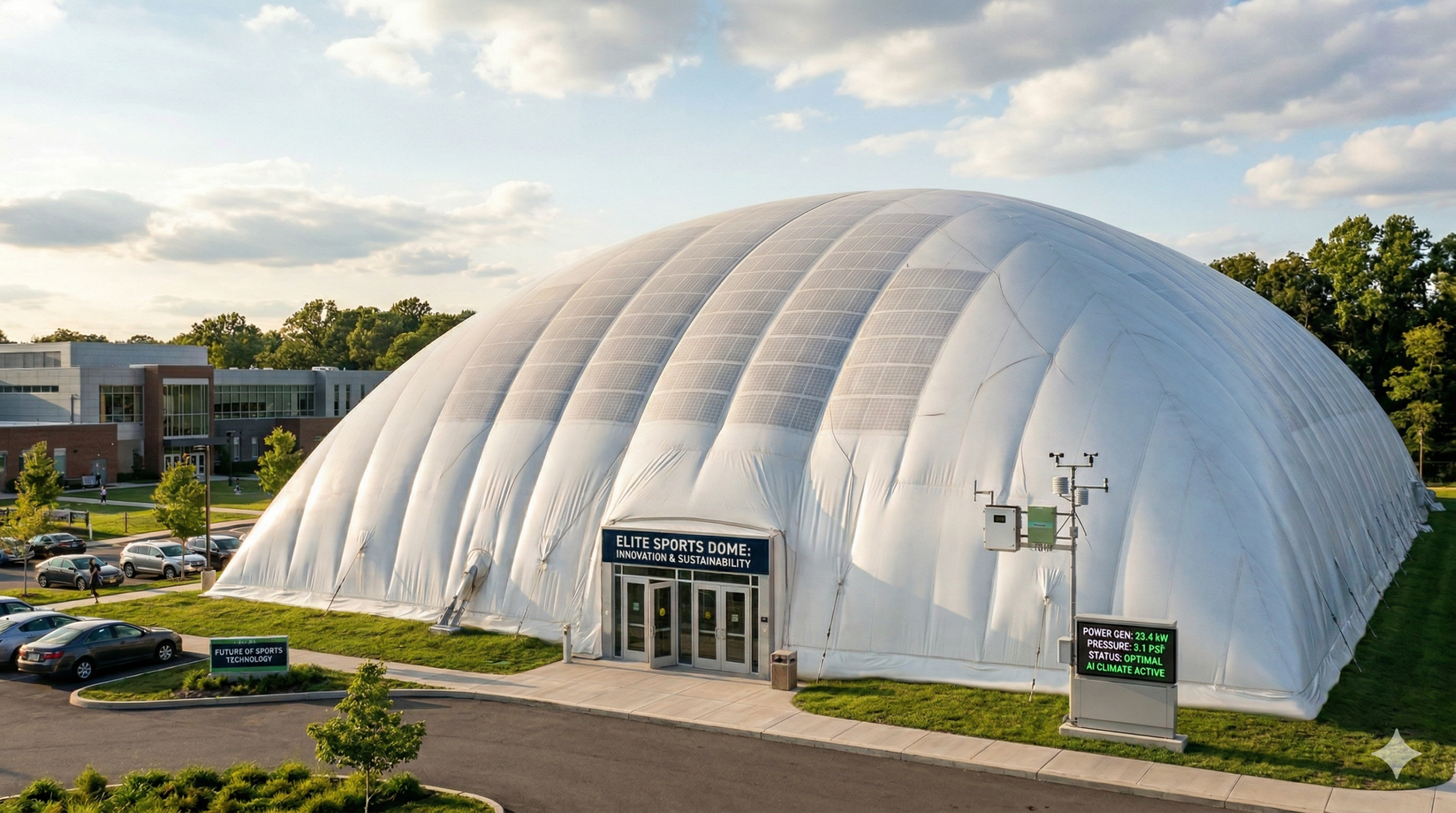
You’re planning an air dome facility, but calculating the right size isn’t as straightforward as you’d expect. Most facility owners underestimate the space requirements, focusing only on court dimensions while overlooking vital elements like proper clearance zones, ventilation systems, and structural support needs. Getting these calculations wrong can cost you thousands in redesigns or leave you with a cramped, non-functional space that doesn’t meet safety standards or user expectations.
How Much Space Does Your Tennis Court Air Dome Actually Need?
When planning your tennis court air dome, you’ll need considerably more space than just the court’s official dimensions. A single tennis court measures 78′ x 36′, but your air dome requires 78′ x 120′ (9,360 sq ft) to guarantee safe play with proper clearance zones.
Don’t forget to add 20-30% extra space for essential features like walkways, spectator seating, and storage areas. This brings your total footprint to approximately 12,000 sq ft for a single court facility.
For multiple courts, a four-court air dome needs 120′ x 200′ (24,000 sq ft) minimum.
Using an air dome size calculator helps you determine exact specifications based on your unique requirements, local building codes, and planned amenities. Proper planning prevents costly modifications later.
Real Air Dome Examples: 1, 2, and 4-Court Space Comparisons
Real-world installations demonstrate the dramatic space differences between single and multi-court air dome facilities. A single-court dome requires approximately 9,360 square feet, but you’ll need closer to 12,000 square feet when including essential amenities like seating and storage areas.
Two-court facilities typically need 16,000-18,000 square feet, offering better cost efficiency per court than single installations. You’re looking at roughly $180,000-$220,000 for professional-grade construction.
Four-court complexes require 24,000-30,000 square feet and represent the sweet spot for commercial operations. These larger facilities maximize your investment through shared infrastructure costs and increased revenue potential.
This sports dome sizing guide shows that while initial costs increase with size, your per-court investment decreases considerably.
Multi-court domes also provide operational flexibility during maintenance periods.
Why Air Domes Need More Space Than Outdoor Courts
Although outdoor tennis courts measure a standard 78′ x 36′, air domes require considerably more enclosed space to function safely and effectively. You’ll need additional clearance for several critical factors that don’t affect outdoor courts.
| Space Requirement | Outdoor Courts | Air Domes |
|---|---|---|
| Ball clearance | Natural boundaries | 20-25′ height minimum |
| Player safety zones | Open-ended | Enclosed buffer zones |
| Equipment access | Direct entry | Airlock systems |
Your tennis dome dimensions must account for structural elements like anchor points, ventilation systems, and emergency exits. Unlike outdoor facilities, you can’t simply mark court lines and start playing. The pressurized environment demands proper air circulation space, and players need adequate overhead clearance for serves and lobs without hitting the dome ceiling.
Should Your Air Dome Include Storage and Spectator Areas?
Where will you store your tennis equipment, maintenance tools, and seasonal gear once your air dome is operational? Storage areas are essential but often overlooked when learning how to size air dome facilities.
You’ll need dedicated space for nets, balls, court maintenance equipment, and emergency supplies.
Spectator areas add significant value but require careful planning. Bleacher seating along sidelines needs 8-12 feet of depth, while elevated viewing areas require structural support and emergency exits.
Consider your facility’s primary use—private clubs may prioritize storage, while commercial operations need spectator capacity for tournaments and lessons.
Integration is key. Built-in storage rooms and viewing areas cost less than separate structures and maintain the dome’s structural integrity.
Plan these elements during initial sizing to avoid expensive modifications later.
How Air Dome Size Affects Your Total Investment
Every square foot you add to your air dome directly impacts three major cost categories: initial construction, ongoing operational expenses, and long-term maintenance.
Understanding this relationship helps you determine the proper dome size for courts without overspending on unnecessary space.
Here’s how size affects your investment:
- Construction costs increase by $8-12 per square foot, meaning a 12,000 sq ft dome costs $24,000-36,000 more than a 9,000 sq ft structure.
- Energy expenses rise proportionally with volume – larger domes require more powerful blowers and climate control systems.
- Maintenance costs scale with surface area, as you’ll need more fabric repairs, cleaning, and eventual replacement materials.
Calculate your minimum required space first, then add only essential features.
This approach guarantees you’re investing in functionality rather than excessive square footage.