Tag: air dome

  • Indoor Soccer Complex Air Dome

    Indoor Soccer Complex Air Dome

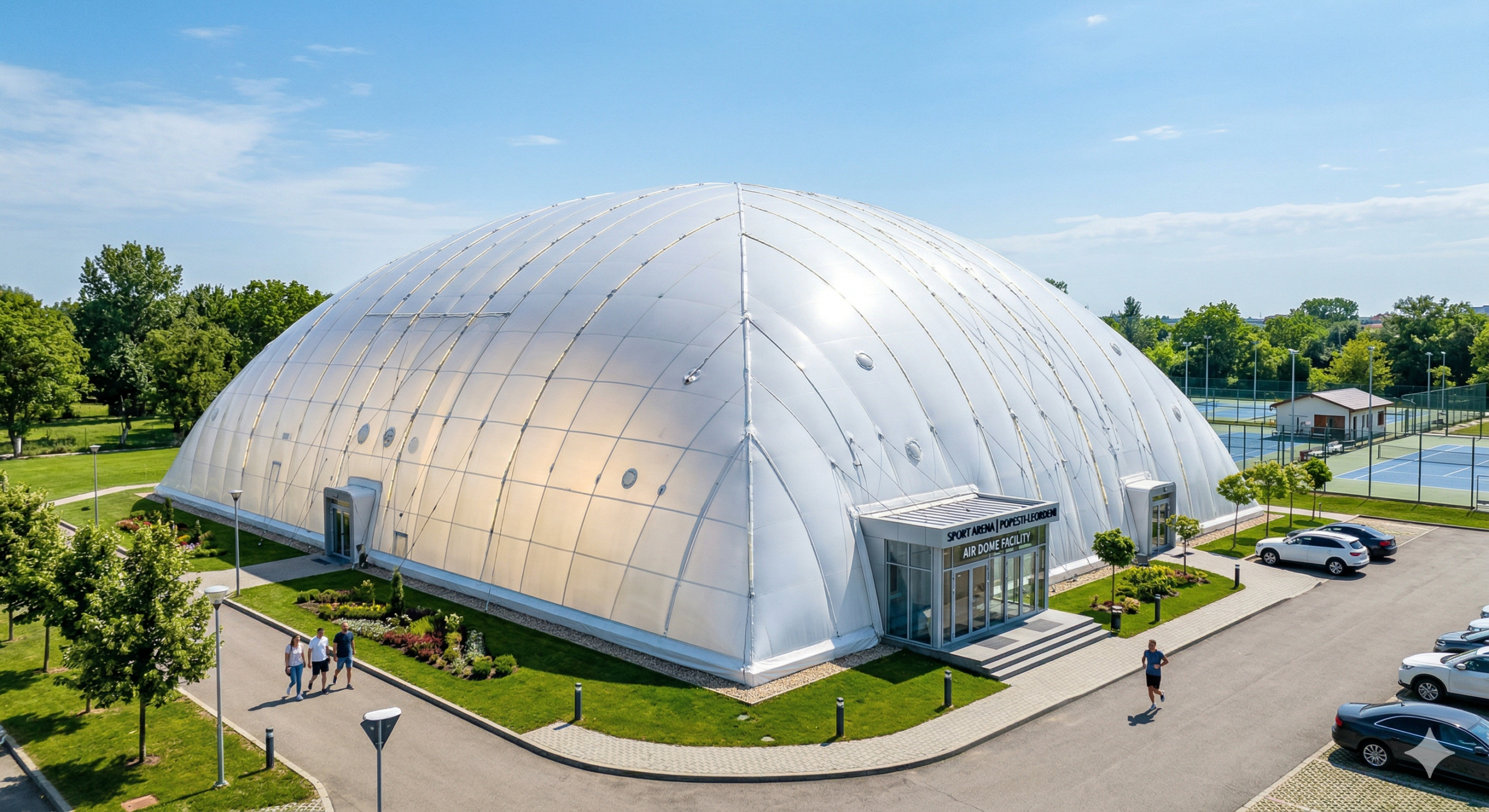
    You’ve likely seen those gleaming traditional soccer facilities and wondered if there’s a smarter way to enter the indoor sports market. Air dome technology has quietly revolutionized how entrepreneurs approach soccer complex development, offering construction timelines that’ll surprise you and operating margins that traditional buildings simply can’t match. While your competitors sink hundreds of thousands into conventional structures, you’re about to discover why the most successful indoor soccer businesses are choosing an entirely different path.

    Why Indoor Soccer Air Domes Beat Traditional Buildings

    When you’re planning an indoor soccer complex, air domes offer compelling advantages over traditional brick-and-mortar buildings. Your indoor soccer complex dome costs considerably less to construct—typically 60-70% cheaper than conventional structures.

    You’ll also save on heating and cooling since the pressurized air system provides natural insulation.

    A soccer facility air dome goes up faster, often within weeks rather than months or years for traditional construction. You won’t need expensive steel frameworks or foundations, reducing both material costs and construction time.

    Your soccer training center dome offers flexibility too—you can relocate it if needed, unlike permanent buildings.

    The wide-open interior space maximizes your playing area without support columns interfering with gameplay.

    Plus, you’ll benefit from excellent acoustics and natural lighting options that enhance the player experience.

    Indoor Soccer Air Dome Construction Costs vs Brick-and-Mortar

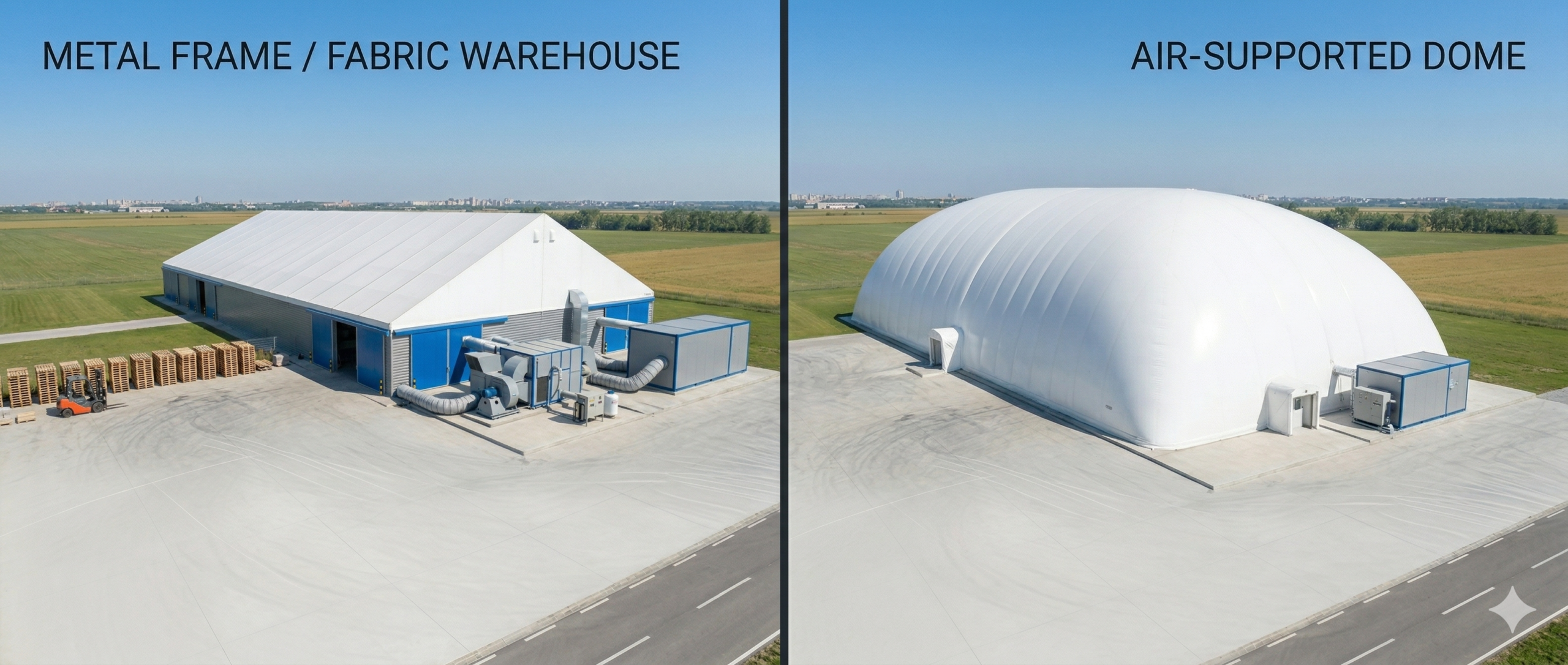
    The numbers tell a clear story when comparing air dome versus traditional construction costs for your indoor soccer complex. You’ll save 40-60% on initial construction with a commercial soccer dome compared to brick-and-mortar facilities.

    Cost Component Air Dome Traditional Building
    Construction per sq ft $15-25 $80-120
    Foundation requirements Minimal concrete pad Full foundation/footings
    Timeline to completion 8-12 weeks 12-18 months
    Total project cost $400K-800K $1.2M-2.5M

    Your commercial soccer dome eliminates expensive structural steel, extensive HVAC systems, and complex roofing. You’ll also reduce permitting complexity and labor costs considerably. The air-supported structure requires only basic utilities and a simple concrete slab, making it ideal for entrepreneurs seeking faster ROI on their indoor soccer investment.

    Sizing Your Indoor Soccer Air Dome for Maximum Revenue

    When sizing your indoor soccer air dome, you’ll need to choose between fewer large fields or more smaller fields to maximize your revenue potential.

    Your field configuration directly impacts how many games you can host simultaneously and your overall revenue per square foot.

    The key is finding the sweet spot between field size, spectator capacity, and operational efficiency that generates the highest annual income.

    Field Configuration Options

    Since maximizing your facility’s earning potential depends heavily on field layout choices, you’ll need to weigh the trade-offs between fewer large fields versus more compact playing surfaces.

    You can configure your air dome with 2-3 full-sized fields measuring 240′ x 360′ (73m x 110m) each, which attract competitive leagues and tournaments but limit scheduling flexibility.

    Alternatively, install 4-6 smaller fields at 150′ x 225′ (45.7m x 68.6m) to accommodate more simultaneous games and diverse age groups.

    Smaller fields generate higher hourly rates through increased booking capacity, while full-sized fields command premium pricing for adult leagues.

    Consider your target market carefully—youth programs thrive on compact fields, whereas serious adult players demand regulation dimensions.

    Your configuration choice directly impacts that $300K-$800K annual revenue potential.

    Revenue Per Square Foot

    Calculate your facility’s revenue per square foot to determine the ideal air dome size for your investment.

    With commercial indoor soccer complexes generating $300K-$800K annually, you’ll want to maximize your space efficiency. A 2-3 full field configuration requires approximately 86,400-129,600 square feet, yielding $2.31-$9.26 per square foot.

    Smaller 4-6 field layouts need 41,400-62,100 square feet, generating $4.83-$19.32 per square foot.

    Don’t forget auxiliary spaces that boost revenue. Spectator bleachers accommodating 200-400 people create additional income through admissions and events. Your 400-square-foot concession area generates high-margin food and beverage sales.

    Factor in locker rooms, party rooms, and retail space when calculating total square footage. Higher occupancy rates and premium pricing for peak hours will drive your per-square-foot returns upward.

    Climate Control Systems That Keep Players Comfortable

    You’ll need robust temperature regulation technology to maintain consistent 65-70°F conditions year-round, ensuring players perform at their peak regardless of outside weather.

    Your HVAC system must handle the heat load from 20-40 active players while preventing condensation buildup on your dome structure.

    Strategic air circulation optimization creates even temperature distribution and eliminates hot spots that could affect game quality and player comfort.

    Temperature Regulation Technology

    When players sprint across your indoor soccer fields for hours each day, maintaining ideal temperature becomes critical for both performance and safety.

    You’ll need advanced HVAC systems that can handle the massive heat loads generated by 20-40 active players simultaneously.

    Smart thermostats with zone control let you adjust temperatures across different field areas independently. Variable refrigerant flow systems provide precise cooling while reducing energy costs by up to 30%.

    Heat recovery ventilators capture warm exhaust air to preheat incoming fresh air, maximizing efficiency.

    Your system should maintain 65-68°F during active play, with humidity levels between 40-60%.

    Install radiant heating panels for quick warm-up during cold months. Backup systems guarantee continuous operation during peak revenue hours, protecting your $300K-$800K annual income stream.

    Air Circulation Optimization

    Since stagnant air creates hot spots and reduces player performance, your indoor soccer complex requires strategic air circulation that moves fresh oxygen throughout every corner of your facility.

    You’ll need industrial-grade fans positioned at key intervals to create continuous airflow patterns across your 240′ x 360′ fields.

    Install ceiling-mounted circulation fans that operate at variable speeds, allowing you to adjust intensity based on occupancy and activity levels.

    Position intake vents near the ground and exhaust vents at ceiling height to establish natural convection currents. This creates a循環 system that pulls cooler air down while pushing warm, humid air upward and out.

    You’ll want to maintain 6-8 air changes per hour during peak usage.

    Strategic placement prevents dead air zones in corners and guarantees spectators in your 200-400 capacity bleachers stay comfortable throughout matches.

    Indoor Soccer Business Models That Generate $300K-$800K

    The most profitable indoor soccer complexes combine multiple revenue streams that capitalize on their field space throughout the day and week.

    You’ll maximize earnings by running youth leagues during evenings, adult leagues at night, and hosting birthday parties on weekends. Corporate team-building events and summer camps fill daytime slots when schools are in session.

    Your facility layout directly impacts profitability. Installing 2-3 full fields generates higher revenue per square foot than 4-6 smaller fields, but smaller fields offer scheduling flexibility for different age groups.

    You’ll need 200-400 seat bleachers for tournaments and championship games, which command premium pricing.

    Don’t overlook your 400-square-foot concession area—it’s pure profit margin. Tournaments and league nights drive food and beverage sales that can represent 15-20% of total revenue.

    Operating Costs and Maintenance for Soccer Air Domes

    Although air dome technology reduces construction costs, your ongoing operational expenses will greatly impact profitability.

    Electricity costs for continuous air blowers range $800-$1,500 monthly, depending on dome size and local utility rates. You’ll need backup generators costing $15,000-$30,000 to prevent collapse during power outages.

    Annual membrane maintenance includes cleaning, patching tears, and inspecting anchor systems, typically costing $5,000-$12,000.

    Expect membrane replacement every 15-20 years at $80,000-$150,000 per field. Snow removal equipment is essential in cold climates to prevent excessive weight loads.

    HVAC systems maintain comfortable temperatures year-round, adding $300-$800 monthly.

    Professional inspections guarantee structural integrity and insurance compliance.

    Budget 8-12% of gross revenue for total facility maintenance, including lighting, flooring repairs, and safety equipment updates to maintain peak playing conditions.
  • Pickleball Air Dome Guide 2026

    Pickleball Air Dome Guide 2026

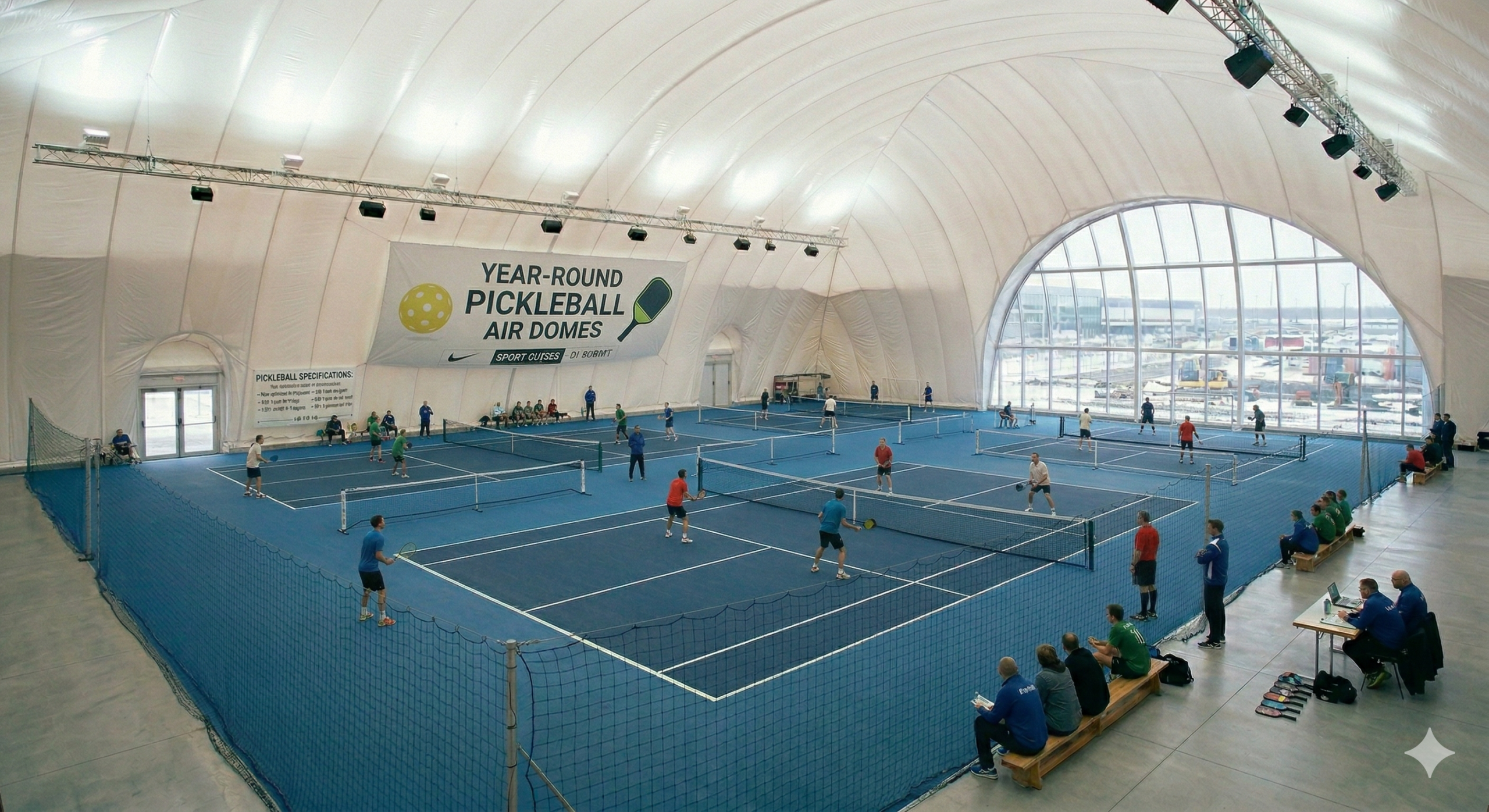
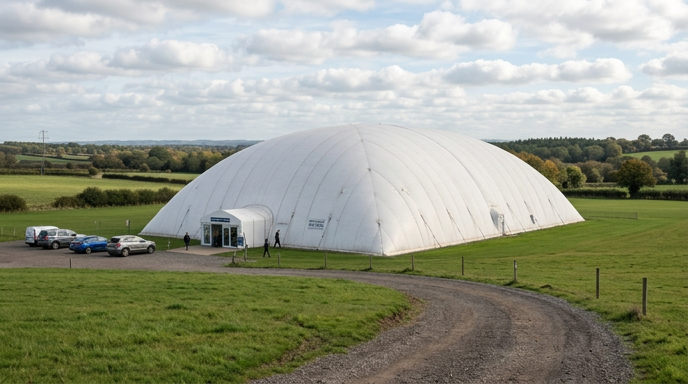
    You’re considering a pickleball air dome for 2026, but the investment goes far beyond the initial $15,000-$50,000 price tag. While installation costs grab your attention first, the real challenge lies in understanding the complex web of ongoing expenses, regulatory requirements, and operational decisions that’ll determine whether your facility thrives or struggles. The difference between a profitable year-round operation and a costly mistake often comes down to details most owners discover too late.

    Pickleball Air Dome Costs: Installation and Long-Term Investment

    Installing a pickleball air dome requires a significant upfront investment, but it’ll pay dividends through year-round play and reduced long-term facility costs.

    You’ll typically spend $15,000-$25,000 per court for a basic pickleball air dome installation, including foundation work and equipment. Premium indoor pickleball dome systems with advanced climate control can reach $35,000-$50,000 per court.

    However, your pickleball court cover eliminates weather cancellations, extending your playing season by 3-4 months annually.

    You’ll save on court resurfacing costs since the dome protects against UV damage and weather deterioration. Energy-efficient LED lighting and insulation systems keep operational costs manageable at $200-$400 monthly for heating and cooling.

    Most facilities recoup their investment within 2-3 years through increased membership and court rental revenue.

    Air Dome Size Requirements and Multi-Court Layout Options

    Three key dimensions determine your pickleball air dome’s functionality: court size, buffer zones, and ceiling height.

    Each court requires a minimum 20′ x 44′ playing surface, but you’ll want 30′ x 64′ including safety buffers. Your dome needs at least 20′ ceiling height for proper ball clearance.

    When planning your pickleball bubble facility, consider these multi-court configurations:

    1. Single court setup – 30′ x 64′ dome for recreational use
    2. Four-court layout – Fits within standard tennis court footprint
    3. Eight-court facility – 100′ x 150′ dome maximizes player capacity
    4. Twelve-court complex – Premium configuration for tournament play

    Larger facilities offer better economies of scale and revenue potential.

    You’ll need 30-50 foot candles of lighting throughout. The eight-to-twelve court range provides the best balance between investment costs and operational efficiency for most commercial operations.

    Types of Pickleball Air Dome Structures and Material Choices

    Single-membrane structures use one fabric layer with continuous air pressure, creating cost-effective solutions for seasonal use.

    Double-membrane systems feature two fabric layers with insulating air space between them, delivering superior energy efficiency and year-round comfort in harsh climates.

    Your climate determines ideal material choice.

    Hot regions benefit from reflective white fabrics reducing cooling costs.

    Cold areas require insulated double-membrane construction preventing condensation and heat loss.

    Site Preparation and Permit Requirements for Air Dome Installation

    You’ll need to establish proper foundation requirements before installing your pickleball air dome, which typically involves creating a level concrete pad or reinforced surface that can support the structure’s anchoring system.

    The zoning permit process requires you to submit detailed site plans and structural specifications to your local building department, often taking 4-8 weeks for approval.

    You must also verify that your property meets setback requirements and doesn’t violate any height restrictions or noise ordinances in your area.

    Foundation Requirements Planning

    Before your pickleball air dome can provide year-round playing conditions, you must establish a solid foundation that meets both structural requirements and local building codes.

    Your foundation serves as the critical anchor point for the dome’s inflation system and structural integrity.

    Consider these essential foundation requirements:

    1. Concrete perimeter footing – Install reinforced concrete footings around the dome’s perimeter to secure anchor points and handle wind loads.
    2. Interior court surfacing – Choose between concrete, asphalt, or specialized court surfaces that provide proper drainage and player safety.
    3. Utility integration – Plan for electrical conduits, HVAC connections, and plumbing rough-ins before pouring concrete.
    4. Frost protection – Make certain footings extend below frost line in cold climates to prevent heaving and structural damage.

    Professional engineering consultation guarantees your foundation meets manufacturer specifications and local requirements.

    Zoning Permit Process

    While your foundation plans take shape, securing proper zoning permits becomes your next critical milestone in the air dome installation process.

    You’ll need to contact your local zoning board early since approval timelines vary greatly between jurisdictions. Most municipalities classify air domes as temporary or semi-permanent structures, but specific regulations differ widely.

    Start by requesting a pre-application meeting to discuss your project’s scope and requirements. You’ll typically need site plans, structural drawings, and proof of liability insurance.

    Commercial zones generally offer smoother approval paths than residential areas, where noise and traffic concerns may arise.

    Submit applications for building permits, special use permits, and potentially conditional use permits.

    Factor in 60-90 days for processing, as appeals or modifications can extend timelines considerably.

    Climate Control and Lighting Systems for Year-Round Play

    You’ll need a robust HVAC system to maintain consistent temperatures and air circulation throughout your dome’s interior space.

    Your lighting setup must meet the 30-50 foot candles standard using energy-efficient LED fixtures that won’t overheat the enclosed environment.

    These two systems work together to create comfortable playing conditions regardless of outside weather.

    HVAC System Requirements

    Although air domes provide excellent protection from outdoor elements, they require sophisticated HVAC systems to maintain ideal playing conditions throughout the year.

    You’ll need to take into account several critical factors when designing your climate control system.

    Your HVAC system must handle unique challenges that standard indoor facilities don’t face:

    1. Temperature regulation – Maintain 65-75°F (18-24°C) for optimal player comfort and ball performance
    2. Humidity control – Keep levels between 40-60% to prevent condensation on dome surfaces
    3. Air circulation – Guarantee consistent airflow throughout the space without creating drafts that affect ball trajectory
    4. Pressurization balance – Maintain proper air pressure to keep the dome inflated while providing fresh air exchange

    You’ll also need backup systems to prevent dome collapse during equipment failures, making redundancy essential for safe operation.

    LED Lighting Standards

    Proper lighting becomes just as important as climate control when creating an ideal playing environment inside your air dome.

    You’ll need to maintain 30-50 foot candles of uniform illumination across all court surfaces to guarantee players can track the ball effectively during fast-paced rallies.

    LED fixtures offer the best solution for pickleball air domes because they’re energy-efficient, generate minimal heat, and provide consistent light output.

    You should position lights at least 20 feet above the playing surface to prevent glare and shadows that could interfere with gameplay.

    Install fixtures strategically to eliminate dark spots, particularly at net areas where most volleys occur.

    Consider dimming capabilities for different skill levels and training sessions.

    Quality LED systems will reduce your operational costs while delivering the bright, even lighting that serious pickleball players demand.

    Air Dome Maintenance Costs and Seasonal Operations

    When planning your pickleball air dome facility, understanding maintenance costs and seasonal operations will greatly impact your budget and profitability.

    You’ll need to account for ongoing expenses that keep your facility running smoothly throughout different seasons.

    Your primary maintenance considerations include:

    1. HVAC system servicing – Regular filter changes, blower maintenance, and seasonal tune-ups typically cost $2,000-4,000 annually.
    2. Fabric inspection and repairs – Minor patching and seam maintenance runs $500-1,500 per season.
    3. Anchor system checks – Foundation and tie-down inspections guarantee structural integrity for $300-800 yearly.
    4. Winter weatherization – Snow load management and heating costs can add $1,000-3,000 monthly in cold climates.

    You’ll also face seasonal operational adjustments, including increased heating costs during winter months and potential temporary deflation during severe weather events.

  • Tennis Air Dome Complete Guide USA

    Tennis Air Dome Complete Guide USA

    You’ve probably wondered how tennis facilities maintain year-round play despite harsh winters or unpredictable weather patterns. Tennis air domes offer a practical solution that’s gaining traction across the USA, but there’s more to evaluate than simply inflating a structure over your courts. From understanding the engineering behind pressurized systems to maneuvering substantial upfront investments and ongoing operational costs, you’ll need to weigh several critical factors before determining if this approach aligns with your facility’s long-term goals.

    What Is a Tennis Air Dome and How Does It Work?

    Imagine stepping into a massive inflated bubble where you can play tennis year-round, regardless of weather conditions outside. That’s exactly what a tennis air dome offers – an indoor tennis dome that creates a controlled playing environment through pressurized air systems.

    These structures work by maintaining constant air pressure inside the dome, which keeps the fabric membrane inflated and structurally sound. Powerful fans continuously circulate air while maintaining slightly higher pressure than outside atmospheric conditions.

    This tennis bubble specifications system requires no internal support beams, creating an unobstructed playing space.

    Your tennis air dome guide wouldn’t be complete without understanding that these domes feature climate control systems, professional lighting, and ventilation that guarantees ideal playing conditions.

    They’re fundamentally portable tennis facilities that can be installed seasonally or permanently on existing courts.

    Tennis Air Dome Costs and Budget Planning

    Now that you understand how tennis air domes function, you’ll need to budget for this investment carefully.

    A single covered tennis court dome typically costs $15,000-$35,000 for basic models, while premium structures reach $50,000+. Installation adds $5,000-$15,000 depending on site preparation requirements.

    Operating costs include electricity for air blowers ($200-$500 monthly), heating/cooling systems ($300-$800 monthly in extreme climates), and annual maintenance ($2,000-$5,000).

    Factor in permit fees ($500-$2,000) and potential concrete pad installation ($8,000-$15,000).

    Multi-court domes offer better value per court but require larger upfront investments ($40,000-$100,000+).

    Consider financing options, as many manufacturers offer lease programs. Budget an additional 15-20% for unexpected costs like electrical upgrades or drainage improvements.

    Plan for fabric replacement every 10-15 years.

    Court Size Requirements and Space Planning

    You’ll need to plan for a minimum court size of 78′ x 120′ (23.8m x 36.6m) per tennis court within your air dome structure.

    If you’re considering multiple courts, a 2-court layout requires 78′ x 200′ (23.8m x 61m) of floor space.

    Don’t forget that your dome’s peak height must reach at least 45 feet (13.7m) to accommodate overhead shots and lobs during play.

    Standard Court Dimensions

    Planning your tennis air dome starts with understanding the precise space requirements for each court. You’ll need a minimum interior space of 78 feet wide by 120 feet long for a single court, with additional clearance beyond the baseline and sidelines for player safety and movement.

    The peak height must reach 45 feet to accommodate high lobs and serves without interference. This vertical clearance guarantees professional-level play remains uncompromised throughout your facility.

    Configuration Width Length Peak Height
    Single Court 78′ (23.8m) 120′ (36.6m) 45′ (13.7m)
    Double Court 78′ (23.8m) 200′ (61m) 45′ (13.7m)
    Triple Court 78′ (23.8m) 280′ (85.3m) 45′ (13.7m)
    Quad Court 156′ (47.5m) 200′ (61m) 45′ (13.7m)

    These dimensions provide the foundation for your dome’s structural engineering and installation planning.

    Multi-Court Layout Options

    Multi-court facilities maximize your investment by housing multiple playing surfaces under one dome structure.

    You’ll need to evaluate several layout configurations that optimize space while maintaining proper clearances between courts.

    For dual-court setups, you’ll require a minimum 78′ x 200′ (23.8m x 61m) footprint. This allows adequate space between courts and proper ball containment.

    Here are key multi-court layout evaluations:

    • Side-by-side arrangement requires 12′ minimum between court sidelines
    • End-to-end configuration needs 21′ clearance between baselines
    • Shared spectator areas reduce overall footprint requirements
    • Central entrance positioning improves traffic flow
    • Equipment storage can be integrated between courts

    Three or four-court facilities become increasingly cost-effective as you share structural, HVAC, and lighting systems across multiple playing surfaces while reducing per-court construction costs.

    Height Clearance Requirements

    While court dimensions follow standard regulations, vertical space becomes the critical factor that determines playability and player safety in your tennis air dome.

    You’ll need a minimum peak height of 45 feet (13.7 meters) to accommodate high lobs and overhead shots without interference. This clearance guarantees players can execute their full range of strokes naturally.

    The dome’s arched design means you’ll have maximum height at the center, gradually decreasing toward the sides.

    Position courts strategically so the peak height aligns with the court’s center line where most lobs occur.

    Don’t compromise on this specification – insufficient height restricts play quality and creates safety hazards when balls contact the dome ceiling.

    Professional installations often exceed minimum requirements to provide ideal playing conditions and account for dome settling over time.

    Climate Control and Lighting Standards

    Since tennis requires precise ball visibility and comfortable playing conditions, your air dome’s climate control and lighting systems form the foundation of player experience and safety.

    You’ll need to maintain temperatures between 55-75°F (13-24°C) for ideal comfort across seasons. Humidity control is equally critical—keep levels below 60% to prevent condensation on walls and equipment deterioration.

    Your lighting system must deliver 50-70 foot candles of uniform illumination throughout the playing surface. This guarantees proper ball tracking and reduces eye strain during extended play sessions.

    Essential climate and lighting standards include:

    • Temperature range: 55-75°F (13-24°C)
    • Humidity levels: Below 60%
    • Lighting intensity: 50-70 foot candles
    • Even light distribution across courts
    • Energy-efficient LED fixtures recommended

    Proper implementation of these systems guarantees year-round playability and player satisfaction.

    Single vs Multi-Court Tennis Air Dome Options

    When planning your tennis air dome, you’ll need to decide between a single-court or multi-court structure based on your specific needs and budget.

    Single-court domes offer lower initial costs and simpler maintenance, making them ideal for private use or smaller facilities.

    Multi-court options provide better cost efficiency per court and increased revenue potential, though they require larger upfront investments and more complex climate systems.

    Single Court Benefits

    Although multi-court facilities grab attention for their revenue potential, single-court tennis air domes offer distinct advantages that make them the smart choice for many operators.

    You’ll find single courts easier to manage operationally and financially more accessible with lower upfront investment requirements.

    Key benefits of single-court tennis air domes include:

    • Lower initial investment – Reduced construction and equipment costs
    • Simplified maintenance – Easier HVAC management and structural upkeep
    • Flexible scheduling – Complete control over court availability and pricing
    • Intimate atmosphere – Better player experience with focused environment
    • Faster ROI – Quicker path to profitability with lower break-even point

    You’ll also benefit from reduced utility costs, as heating and cooling a 78′ x 120′ space requires considerably less energy than larger multi-court facilities.

    Multi-Court Advantages

    Multi-court tennis air domes present compelling opportunities for operators seeking maximum revenue generation and facility utilization. You’ll accommodate more players simultaneously, increasing hourly income potential while spreading operational costs across multiple courts.

    The shared infrastructure model reduces per-court expenses for heating, lighting, and structural components.

    You can host tournaments, leagues, and group lessons more effectively with multiple courts under one dome. Players won’t wait as long for court availability, improving customer satisfaction and retention rates.

    The 78′ x 200′ configuration for two courts optimizes space efficiency compared to separate single-court installations.

    Multi-court facilities also provide operational flexibility during maintenance or repairs. If one court needs attention, you’ll maintain revenue streams from remaining courts, ensuring consistent cash flow throughout the season.

    Tennis Air Dome Installation Process and Timeline

    Since proper planning determines your project’s success, understanding the tennis air dome installation process helps you prepare for the typical 4-6 week timeline from groundbreaking to first serve.

    The installation follows these key phases:

    • Site preparation and foundation work (Week 1-2): Excavation, utilities, concrete pouring
    • Anchor ring installation (Week 2): Steel foundation ring placement and securing
    • Membrane installation (Week 3): Professional dome fabric assembly and attachment
    • Inflation and testing (Week 3-4): System pressurization and safety checks
    • Interior finishing (Week 4-6): Lighting, HVAC, court surfaces, and accessories

    Weather conditions greatly impact your timeline, especially during foundation work.

    You’ll coordinate with multiple contractors including excavators, concrete specialists, and dome technicians.

    Most manufacturers provide project management services to streamline the process and guarantee proper sequencing of trades.

    Ongoing Maintenance and Operating Expenses

    Smart budgeting for your tennis air dome extends far beyond the initial installation costs, as ongoing maintenance and operating expenses typically range from $15,000 to $35,000 annually per court.

    You’ll face considerable electricity bills for continuous air circulation and climate control systems, particularly during extreme weather conditions. Regular fabric inspections and repairs prevent costly emergency replacements, while HVAC maintenance guarantees ideal playing conditions year-round.

    Your major expense categories include utility costs (40-50% of annual budget), routine maintenance contracts, insurance premiums, and periodic fabric replacements every 15-20 years.

    You can reduce operating costs through energy-efficient LED lighting upgrades, programmable climate controls, and preventive maintenance schedules.

    Multi-court facilities benefit from economies of scale, lowering per-court operational expenses considerably.

    Best Tennis Air Dome Manufacturers and Suppliers

    Selecting the right manufacturer greatly impacts your dome’s performance, longevity, and overall satisfaction with your investment. Research manufacturers with proven track records in tennis facility construction and strong warranty programs.

    When evaluating potential suppliers, prioritize these key factors:

    • Industry experience – Look for companies with 10+ years specializing in tennis air domes.
    • Project portfolio – Review completed installations similar to your facility size and requirements.
    • Engineering capabilities – Confirm they handle structural design, HVAC systems, and local permitting.
    • Service network – Verify they provide maintenance support and emergency repairs in your region.
    • Financial stability – Choose established companies that’ll honor long-term warranty commitments.

    Request detailed proposals from multiple manufacturers, including installation timelines, material specifications, and thorough cost breakdowns before making your final decision.

  • Air Dome Features and Customization Options

    Air Dome Features and Customization Options

    You’re investing in an air dome, but the standard options won’t cut it for your specific needs. Whether you’re powering a sports facility or industrial workspace, the choices you make regarding insulation layers, entry systems, lighting, and ventilation will directly impact your operational costs and user experience. The difference between selecting double-layer construction versus single-layer alone could save you thousands annually, and that’s just the beginning of what you’ll need to contemplate.

    Double-Layer vs Single-Layer Air Dome Energy Efficiency

    When you’re deciding between single and double-layer air dome construction, the energy efficiency difference becomes immediately apparent in your utility bills.

    Double-layer vs single-layer air dome energy efficiency creates a significant performance gap that directly impacts your operating costs.

    Double-layer systems provide 30-40% energy savings compared to single-layer alternatives, particularly noticeable in 20,000 square foot facilities.

    You’ll benefit from superior insulation properties that reduce heating and cooling demands throughout the year. The air gap between layers acts as a thermal barrier, maintaining consistent internal temperatures with less HVAC workload.

    Single-layer domes offer lower upfront costs but higher ongoing energy expenses.

    You’re trading initial savings for increased monthly utility bills. For year-round facilities, double-layer construction typically pays for itself through reduced energy consumption within three years.

    Air Dome Door Systems: Zipper vs Airlock Entry

    Your door system choice fundamentally determines how users access your air dome while maintaining internal pressure and climate control.

    Air dome door systems come in two primary configurations: zipper and airlock entries, each serving different operational needs.

    Zipper doors offer cost-effective access with simple operation. You’ll find them suitable for facilities requiring occasional entry and exit. However, they compromise pressure integrity during use, temporarily affecting climate control.

    Airlock systems provide superior pressure maintenance through double-door chambers. You enter the first door, allow it to seal, then proceed through the second door. This prevents pressure loss and maintains consistent internal conditions.

    Standard dimensions typically measure 6′ x 8′ (1.8m x 2.4m) for both systems.

    Choose zipper doors for budget-conscious projects with limited traffic. Select airlocks for facilities demanding continuous climate control and frequent access.

    Air Dome Lighting: LED vs Metal Halide Systems

    Two primary lighting technologies compete for air dome installations: LED systems and traditional metal halide fixtures.

    When selecting air dome features, you’ll find LED systems offer superior energy efficiency, consuming 50-70% less power than metal halide alternatives. LED fixtures provide instant-on capability, eliminating the warm-up time metal halides require. You’ll achieve better light distribution with LEDs, reducing dark spots and shadows across your dome’s interior.

    Metal halide systems cost less upfront but carry higher operational expenses through increased energy consumption and frequent bulb replacements.

    Among essential air dome upgrades, switching to LED technology delivers long-term savings and improved performance. Your choice between air dome lighting: LED vs metal halide systems depends on budget priorities and operational requirements, though LED technology increasingly dominates new installations.

    Ventilation and Custom Logo Options for Air Domes

    Although lighting systems grab attention during air dome planning, ventilation and branding elements greatly impact both functionality and visual appeal. When exploring ventilation and custom logo options for air domes, you’ll find sidewall vents provide essential airflow control while maintaining structural integrity. These dome accessories work alongside your HVAC system to regulate temperature and humidity effectively.

    Feature Standard Option Premium Option
    Sidewall Vents Manual operation Automated controls
    Logo Placement Single location Multiple positions
    Printing Method Vinyl application Heat-sealed graphics
    Ventilation Size 24″ x 24″ Custom dimensions
    Color Options Limited palette Full-color matching

    Custom logo printing transforms your dome into a branded facility, while proper ventilation guarantees peak air quality. You can specify logo placement, colors, and sizing to match your organization’s identity perfectly.

  • How to Buy a Tennis Air Dome in 2026

    How to Buy a Tennis Air Dome in 2026

    You’re considering a tennis air dome for 2026, but the process isn’t as straightforward as you might expect. While prices have stabilized compared to recent years, you’ll face new regulations, updated technology options, and shifting supplier landscapes that didn’t exist just two years ago. The key lies in understanding what’s changed in the industry and how these developments will impact your investment, timeline, and long-term operational costs.

    Tennis Air Dome Costs and Budget Planning for 2026

    Before diving into specific features and installation logistics, you’ll need to establish a realistic budget for your tennis air dome project in 2026.

    Tennis air dome costs and budget planning for 2026 requires understanding several pricing factors. Basic single-court domes start around $150,000-$200,000, while multi-court facilities can exceed $500,000.

    Your budget should include the dome structure, foundation work, electrical systems, HVAC equipment, and installation labor. Don’t forget ongoing operational costs like electricity, maintenance, and insurance.

    Seasonal domes cost less initially but require annual setup fees. This thorough air dome purchase guide emphasizes getting multiple quotes early, as material costs fluctuate.

    Consider financing options, including equipment loans and lease agreements, to manage cash flow effectively throughout your project timeline.

    Determine Your Court Size and Site Requirements

    The first critical step in your tennis air dome project involves calculating the exact dimensions and evaluating your site’s suitability.

    When learning how to buy tennis air dome structures, you’ll need minimum dimensions of 78′ x 120′ (23.8m x 36.6m) for a single court, totaling 9,360 square feet. This doesn’t include additional space for walkways and equipment.

    Your site must be level with proper drainage to prevent water accumulation. Check local zoning laws and obtain necessary permits before proceeding.

    Consider proximity to utilities like electricity and water connections, as these affect installation costs. Soil conditions matter too – soft ground may require additional foundation work.

    Measure twice and account for buffer zones around the court perimeter to guarantee players have adequate movement space during gameplay.

    Choose Your Tennis Air Dome Type and Key Features

    Once you’ve established your site requirements, you’ll face the critical decision between seasonal and permanent tennis air dome options. When buying tennis bubble structures, seasonal domes cost less upfront but require annual installation and removal. Permanent installations offer year-round play but demand higher initial investment.

    Feature Seasonal Permanent
    Cost $15,000-$40,000 $50,000-$150,000
    Installation Annual setup/takedown One-time installation
    Durability 5-7 years 15-25 years
    Insulation Basic single layer Double-wall options
    Lighting Portable systems Integrated LED

    Consider essential features like ventilation systems, emergency exits, insulation levels, and lighting quality. Double-wall construction provides superior insulation but increases costs. Evaluate your budget against long-term usage plans to determine which option delivers the best value for your specific needs.

    Compare Air Dome Suppliers and Get Smart Quotes

    After selecting your preferred dome type and features, you’ll need to identify reputable suppliers who can deliver quality structures within your budget.

    Research manufacturers with proven track records in tennis facility construction. Look for companies offering extensive warranties, installation services, and ongoing maintenance support.

    Request detailed quotes from 3-5 suppliers to compare pricing, specifications, and timelines. Your sports dome buying process should include evaluating each vendor’s experience with similar projects, checking customer references, and reviewing installation portfolios.

    Ask about financing options, permit assistance, and post-installation support.

    Don’t automatically choose the lowest bid—consider value, quality, and service reliability. Request itemized quotes showing materials, labor, permits, and additional features.

    Verify insurance coverage and licensing before making your final decision.

    Installation Timeline and Permitting Process

    Before construction begins, you’ll need to secure proper permits and understand the installation timeline for your tennis air dome. Most installations require building permits, electrical permits, and zoning approvals, which can take 4-12 weeks depending on your local municipality.

    The typical installation timeline follows these phases:

    1. Site preparation and foundation work – 2-4 weeks for concrete pad and utilities
    2. Dome delivery and setup – 1-2 weeks for fabric installation and inflation system
    3. Interior finishing – 1-3 weeks for lighting, HVAC, and court surfacing
    4. Final inspections and testing – 1 week for safety compliance and operational checks

    Your air dome selection guide should include permit requirements specific to your area. Weather conditions can extend timelines, so plan installations during favorable seasons.

    Most suppliers coordinate with local contractors to streamline the permitting and installation process.

  • Air Dome Electricity Costs Analysis

    Air Dome Electricity Costs Analysis

    You’re looking at monthly electricity bills that can make or break your air dome’s profitability. While that $1,200-$2,700 range might seem manageable at first glance, you haven’t seen the breakdown yet. Your blower fans are quietly draining over a third of your power budget, and winter HVAC costs can double those estimates overnight. Before you commit to another year of inflated energy expenses, there’s a strategic approach that could cut your bills considerably.

    What Air Dome Electricity Actually Costs: $1,200-$2,700 Monthly?

    When you’re evaluating air dome electricity costs, you’ll typically face monthly expenses ranging from $1,200 to $2,700 for a standard 20,000 square foot facility.

    Your blower operation costs represent the largest component, running $400-$800 monthly for 24/7 operation to maintain structural integrity.

    LED lighting adds another $200-$400 to your sports dome power costs, while HVAC systems can consume $600-$1,500 monthly during winter months.

    These air dome electricity cost variations depend on local utility rates, seasonal demands, and equipment efficiency.

    You can reduce expenses by approximately 20% through variable frequency drive (VFD) blowers, which adjust motor speed based on pressure requirements.

    Winter months typically see the highest bills due to increased heating demands and reduced energy efficiency in cold weather conditions.

    Blower Fan Power Bills: Your Biggest Air Dome Expense

    Because blower fans operate continuously to maintain your air dome’s structural integrity, they’ll consume 33-40% of your total electricity budget.

    For a 20,000 sq ft facility, expect $400-$800 monthly in blower costs alone. These fans can’t take breaks – they’re running 24/7, 365 days per year to keep your dome pressurized and stable.

    Your tennis bubble electric bill gets hit hardest by these workhorses.

    However, you can slash these air dome energy expenses considerably. Variable Frequency Drive (VFD) blowers automatically adjust their speed based on wind conditions and pressure requirements.

    They’ll reduce your fan electricity costs by 20%, potentially saving you $80-$160 monthly. While VFD systems cost more upfront, they pay for themselves through lower operating expenses within two years.

    Air Dome Lighting Costs For 20,000 Square Feet

    Your lighting choices directly impact your monthly electricity bill, with LED systems costing $200-$400 monthly compared to much higher traditional lighting expenses.

    You’ll find that LED fixtures consume considerably less energy while providing superior illumination for your 20,000 square foot air dome.

    Smart lighting controls can further reduce these costs by automatically adjusting brightness levels based on occupancy and natural light availability.

    LED Versus Traditional Options

    Although traditional metal halide and fluorescent lighting systems have dominated air dome facilities for decades, LED technology now offers superior cost efficiency for your 20,000 square foot structure.

    You’ll spend $200-$400 monthly on LED lighting versus $500-$900 for metal halide systems of comparable brightness. LEDs consume 60-70% less electricity while providing better light distribution and reducing heat load on your HVAC system.

    Metal halide fixtures require frequent bulb replacements every 12-18 months, adding $2,000-$4,000 annually in maintenance costs. LEDs last 10-15 years with minimal maintenance.

    You’ll also eliminate warm-up delays since LEDs reach full brightness instantly, unlike metal halides that need 15-20 minutes. The upfront LED investment typically pays for itself within 2-3 years through reduced electricity and maintenance expenses.

    Monthly Energy Consumption Rates

    When calculating your monthly lighting expenses for a 20,000 square foot air dome, you’ll find that energy consumption varies greatly based on your chosen lighting technology and usage patterns.

    LED systems typically cost $200-$400 monthly, while traditional metal halide fixtures can push expenses up to $800-$1,200 per month.

    Your actual consumption depends on several key factors:

    • Operating hours – Full-time facilities (12+ hours daily) versus part-time usage
    • Lighting intensity requirements – Competition-grade illumination versus recreational levels
    • Control systems – Dimming capabilities and motion sensors reduce consumption
    • Fixture efficiency ratings – Higher lumens per watt translate to lower monthly bills
    • Local electricity rates – Regional utility costs greatly impact total expenses

    Smart scheduling and automated controls can reduce your lighting costs by 15-30% annually.

    Smart Lighting Control Systems

    Smart lighting control systems can slash those monthly expenses by automatically adjusting illumination based on occupancy, daylight levels, and scheduled activities.

    You’ll typically save 30-50% on your $200-$400 monthly LED lighting costs through motion sensors that dim or shut off lights in unused areas. Daylight harvesting sensors reduce artificial lighting when natural light’s sufficient, while programmable schedules guarantee lights operate only during necessary hours.

    Zone-based controls let you illuminate specific court areas rather than the entire 20,000 sq ft space during practices or maintenance.

    Smart dimming maintains ideal lighting levels while consuming less power. Integration with building management systems provides real-time energy monitoring and usage analytics.

    These systems typically pay for themselves within 18-24 months through reduced electricity bills and extended LED lifespan from enhanced operation.

    Winter HVAC Bills That Can Double Your Electricity Costs

    Winter heating demands can push your air dome’s HVAC costs from $600 to $1,500 monthly, potentially doubling your total electricity bill.

    Your heating system’s efficiency becomes critical during peak winter months when you’re fighting against freezing temperatures while maintaining the dome’s structural integrity.

    You’ll face the highest energy consumption during cold snaps when your HVAC works overtime to keep interior temperatures stable.

    Peak Winter Energy Demands

    Although your air dome’s summer electricity bills might seem manageable, winter heating demands can dramatically spike your monthly costs to nearly double what you’re paying during warmer months.

    HVAC systems work overtime to maintain comfortable temperatures inside your dome while battling freezing outdoor conditions. This increased workload translates directly into higher electricity consumption and steeper utility bills.

    Peak winter energy demands typically occur during:

    • Early morning hours (5-8 AM) when temperatures drop lowest
    • Extended cold snaps lasting multiple days or weeks
    • High wind conditions that increase heat loss through the fabric
    • Equipment startup periods after power outages or shutdowns
    • Simultaneous operation of heating, lighting, and blower systems during peak usage times

    Understanding these patterns helps you anticipate and budget for seasonal cost increases effectively.

    Heating System Efficiency Impact

    When your air dome’s heating system operates at peak effectiveness, you’ll maintain reasonable winter electricity bills, but inefficient HVAC equipment can easily double your monthly costs from $600 to $1,500 per month for a 20,000 square foot facility.

    Your heating system’s age and maintenance directly impact these expenses. Well-maintained units with proper insulation keep costs manageable, while poorly serviced equipment forces your system to work harder.

    System Condition Monthly Cost Efficiency Rating
    Optimal Performance $600-$800 85-95%
    Average Condition $800-$1,200 70-84%
    Poor Maintenance $1,200-$1,500 50-69%

    Regular filter changes, ductwork inspections, and thermostat calibration prevent your HVAC from consuming excessive electricity. You’ll notice immediate savings when your heating system runs effectively rather than struggling against clogged filters and worn components.

    VFD Blowers Cut Air Dome Energy Bills By 20

    Variable Frequency Drive (VFD) blowers deliver a substantial 20% reduction in your air dome’s energy costs compared to traditional constant-speed blower systems.

    These smart motors automatically adjust their speed based on real-time pressure requirements, eliminating the wasteful energy consumption of fixed-speed units that run at maximum capacity regardless of actual demand.

    VFD technology transforms your blower operations through:

    • Automatic speed adjustment – Motors slow down during low-demand periods like mild weather days
    • Soft-start capabilities – Eliminates power surges that spike your electricity bills during startup
    • Pressure optimization – Maintains consistent dome pressure while using minimal energy
    • Extended equipment lifespan – Reduces mechanical stress on motors and fans
    • Remote monitoring integration – Allows real-time energy consumption tracking and adjustments

    This 20% savings translates to $80-$160 monthly reductions on your blower electricity costs.

    Smart Upgrades That Slash Air Dome Electricity Costs

    Beyond VFD blowers, several cutting-edge technologies can dramatically reduce your air dome’s electricity consumption while improving performance.

    Smart thermostats with zone control enhance HVAC usage by heating only occupied areas, cutting winter costs by 25-40%.

    Motion-activated LED systems illuminate sections as needed, reducing lighting expenses by 30-50% compared to constant operation.

    Installing solar panels can offset 60-80% of your dome’s electricity needs, particularly effective for daytime operations.

    Smart pressure sensors automatically adjust blower speeds based on weather conditions and occupancy, preventing energy waste from over-pressurization.

    Energy management systems monitor real-time consumption and identify inefficiencies.

    These integrated solutions can reduce your monthly electricity bills from $1,200-$2,700 to $600-$1,350, delivering substantial long-term savings while maintaining ideal dome conditions.

    Air Dome Power Costs In Different Climate Zones

    Climate greatly impacts your air dome’s electricity costs, with variations reaching 200-300% between regions. Your location determines heating, cooling, and humidity control demands that directly affect monthly power bills.

    Northern climates require substantial winter heating, pushing costs toward the $2,700 monthly maximum for 20,000 sq ft facilities. Southern regions face high summer cooling demands but benefit from reduced winter expenses. Temperate zones typically experience the most balanced costs year-round.

    Regional cost factors affecting your air dome:

    • Arctic regions: $2,200-$2,700/month due to extreme heating needs
    • Humid subtropical zones: $1,800-$2,400/month from dehumidification requirements
    • Desert climates: $1,600-$2,200/month with high cooling but low humidity costs
    • Mediterranean zones: $1,200-$1,800/month from moderate seasonal demands
    • Temperate oceanic regions: $1,300-$1,900/month with consistent moderate usage

    Understanding your climate zone helps predict operational expenses accurately.

    Calculate Your Total Air Dome Electricity Budget

    Accurate budgeting requires calculating all electricity components for your specific air dome setup. Start with your dome’s square footage to determine baseline costs.

    For a 20,000 sq ft facility, you’ll need $400-$800 monthly for blower fans running 24/7, $200-$400 for LED lighting, and $600-$1,500 for HVAC during winter months. This totals $1,200-$2,700 monthly.

    Consider cost-reduction strategies when calculating your budget. VFD blowers cut expenses by 20%, saving $240-$540 annually. Factor in your local electricity rates, seasonal variations, and usage patterns.

    Don’t forget additional systems like security lighting, emergency power, or specialized equipment that’ll increase consumption.

    Create separate budgets for peak winter months versus moderate seasons, as HVAC dramatically impacts your total electricity costs throughout the year.

  • Air Dome Removal and Storage Costs

    Air Dome Removal and Storage Costs

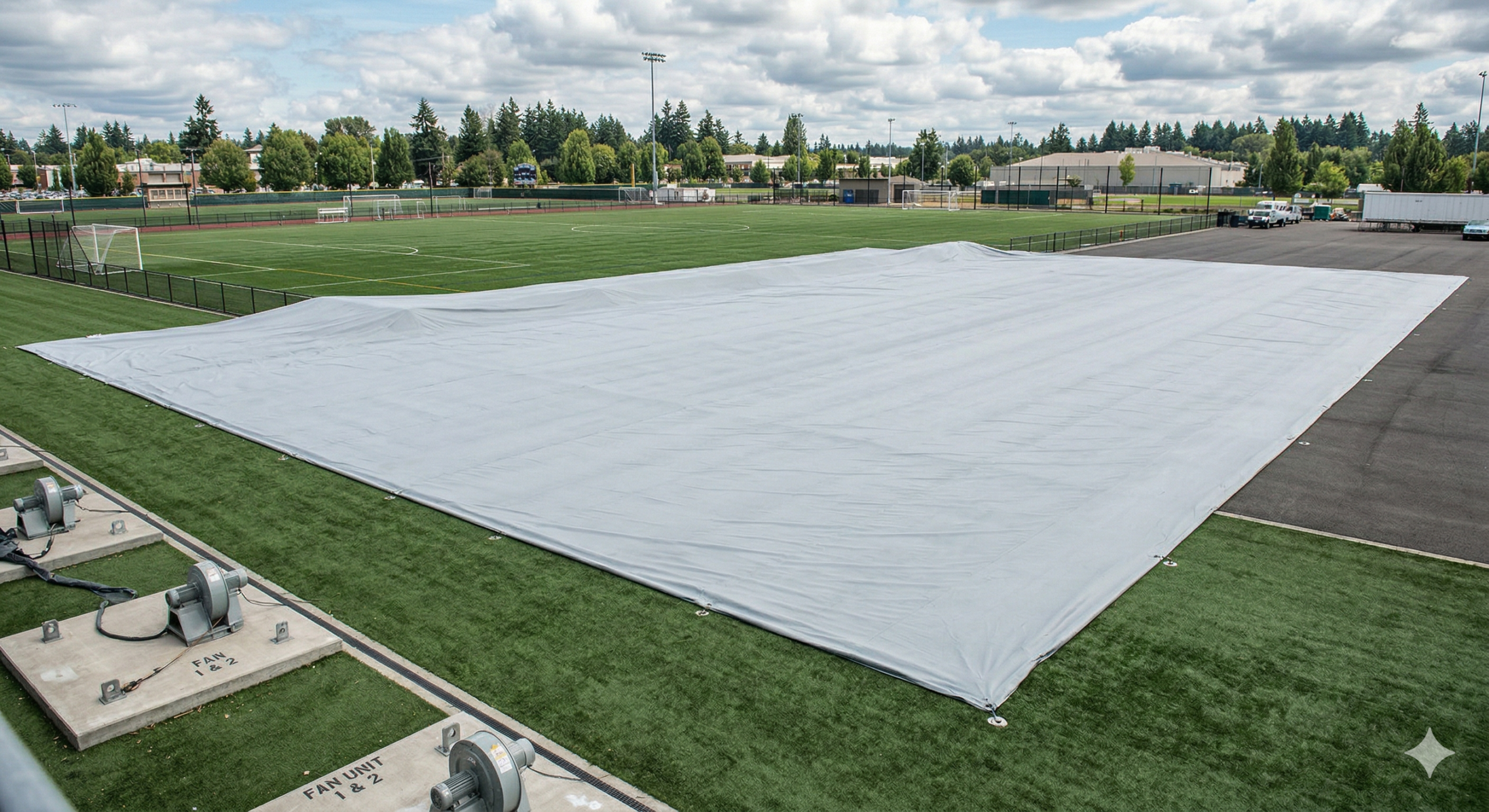
    You’ll pay $10,000 to $30,000 for small dome removal under 100 feet, while medium-sized facilities (100-300 feet) cost $30,000 to $100,000, and large domes exceed $1 million. Labor typically runs $8,000 to $15,000, with removal taking 1-4 days depending on complexity. Storage adds $0.50-$1.50 per square foot annually for climate control, plus transportation and equipment rental fees. However, several hidden expenses can dramatically impact your total project budget.

    Air Dome Removal Costs By Size And Diameter

    When you’re planning air dome removal, the size and diameter of your structure will dramatically impact both the complexity and cost of the project.

    Small domes under 100 feet typically cost $10,000 to $30,000 for removal, making them ideal for personal use or local businesses with minimal equipment needs.

    Medium-sized domes between 100-300 feet range from $30,000 to $100,000, requiring specialized equipment and extended timelines due to increased material volume.

    Large domes over 300 feet can exceed $1 million in air dome removal cost, demanding heavy machinery and experienced contractors.

    Your temporary dome expenses will also depend on fabric membrane weight, structural components, and HVAC disconnection complexity. For comparison, permanent steel dome structures with frames can cost anywhere from $4,490 to over $138,000 depending on structural requirements and size specifications.

    Consider seasonal sports dome storage requirements when budgeting for removal projects.

    What Factors Affect Air Dome Removal Pricing?

    Several key factors determine how much you’ll pay for air dome removal, with labor costs varying dramatically based on your geographic location.

    Regional wage standards and local economic conditions directly impact contractor rates, making tennis bubble deflation costs considerably higher in some states than others.

    Your project’s complexity depends on three critical considerations:

    1. Transportation logistics – Distance to storage facilities and specialized equipment requirements
    2. Seasonal timing – Off-season demand affects contractor availability and competitive pricing
    3. Professional expertise – Licensed specialists command premium rates but guarantee quality service

    Storage requirements add another expense layer, particularly if you need climate-controlled facilities. Professional installation teams with heavy equipment expertise can efficiently handle the technical aspects of dome deflation and component storage.

    Weather conditions during removal can increase labor requirements, while your dome’s usage patterns determine removal frequency.

    Consulting professional sports dome builders helps you understand air dome setup costs and develop accurate budgets for your specific situation.

    Air Dome Removal Timeline And Labor Requirements

    You’ll need to plan for 1-4 days of removal work depending on your air dome’s size and complexity, with a 20,000 square foot facility typically requiring 2-4 days to complete.

    Your project will require a specialized professional crew trained in proper membrane handling and disassembly procedures to prevent damage to reusable components. Just as installation requires careful planning for optimal performance, removal demands the same attention to detail to preserve equipment integrity.

    The workforce size and timeline directly impact your labor costs, which can range from $8,000 to $15,000 for standard seasonal removal operations.

    Removal Duration Factors

    Although most facility managers focus on installation timelines, understanding air dome removal duration factors proves equally critical for operational planning and budget management.

    You’ll find that standard dismantle operations require approximately one day with adequate crew size, but several variables affect this baseline.

    Your removal timeline depends on three primary factors:

    1. Membrane condition and age – Older domes require additional care during deflation to prevent damage for future installations.
    2. Site logistics planning – Access routes, equipment positioning, and weather conditions directly impact crew efficiency.
    3. Disassembly scope – Complete removal versus relocation to alternate sites affects labor requirements and timeline.

    Modular design systems facilitate faster disassembly, while detailed logistics planning guarantees your crew protects the membrane during repeat installations. Proper disassembly procedures for screw pile systems eliminate the invasive excavation typically required with permanent foundations.

    You’ll need extensive scheduling to coordinate these interconnected removal phases effectively.

    Workforce Size Requirements

    When planning air dome removal operations, crew size directly determines both project duration and total labor costs. For a standard 20,000 square foot facility, you’ll typically need a 4-6 person crew to complete removal within the 2-4 day timeframe. This workforce size balances efficiency with cost control, keeping total labor expenses between $8,000-$15,000.

    Your crew composition should include experienced technicians familiar with deflation procedures, fabric handling, and equipment disassembly. Smaller crews extend project duration considerably, while larger teams don’t proportionally reduce timeframes due to workspace limitations during deflation phases.

    Consider that inadequate workforce sizing often leads to rushed operations, potentially damaging expensive dome materials. Air movers may be needed to create circular airflow patterns that accelerate the deflation process and prevent fabric pooling during removal.

    You’ll need additional personnel for storage preparation, requiring climate-controlled space management and proper fabric folding techniques to prevent deterioration.

    Equipment Rental Costs For Dome Takedown

    Equipment rental costs for air dome takedown vary considerably based on your facility’s size and complexity.

    You’ll need specialized heavy equipment, with 10k forklifts being standard for most dome operations. The duration of your rental directly impacts total expenses, as charges accrue daily throughout the removal process.

    Your rental timeline depends on dome dimensions:

    1. Small domes (under 100 feet): 1-3 days rental duration with costs between $10,000-$30,000
    2. Medium domes (100-300 feet): Several weeks rental period with expenses ranging $30,000-$100,000
    3. Large domes (over 300 feet): Extended rental requirements with costs exceeding $1 million

    You can reduce overall expenses by procuring equipment independently rather than using full-service contractors.

    Site preparation equipment and operational power supplies add to your base rental requirements.

    Off-Season Storage Expenses And Container Needs

    You’ll need a climate-controlled storage space of approximately 10′ x 20′ to properly house your deflated air dome during off-season months.

    The storage environment must protect the membrane material from temperature extremes, moisture, and UV damage that could compromise the dome’s structural integrity.

    Your storage costs will vary notably based on whether you rent commercial space or invest in a dedicated storage container system.

    Container Storage Requirements

    Although air dome removal represents a significant expense, storing the deflated structure properly becomes equally critical for protecting your investment.

    You’ll need a climate-controlled storage area measuring approximately 10′ x 20′ (3m x 6m) for a 20,000 square foot facility. This specialized storage prevents moisture damage, UV degradation, and material deterioration during off-season periods.

    Your container storage requirements include:

    1. Climate control systems – Maintaining consistent temperature and humidity levels to prevent mold and material breakdown
    2. Adequate floor space – Properly folding and organizing membrane sections without creating stress points or creases
    3. Inventory management – Cataloging hardware, anchoring systems, and inflation equipment for efficient reinstallation

    Without proper storage conditions, you’ll face costly repairs or premature replacement, potentially doubling your annual air dome expenses beyond the standard $16,000-$30,000 inflation and deflation costs.

    Climate Control Considerations

    When storing your deflated air dome during off-season months, climate control expenses will consume $0.50–$1.50 per square foot annually in utility costs alone.

    You’ll face significant HVAC maintenance costs equivalent to commercial building standards, with total annual operating expenses reaching $3–6 per square foot covering electricity for blowers and heating systems.

    Your storage location’s climate conditions directly impact these expenses.

    Winter storage requires protection from cold weather and snow accumulation, while summer exposure demands resistance to constant sunlight and elevated temperatures.

    Temperature fluctuations necessitate ongoing climate regulation to prevent membrane degradation.

    Geographic location determines utility rate variations, making climate-related storage expenses highly variable.

    You’ll need continuous blower operation at low frequency to maintain proper storage pressure while minimizing energy consumption.

    Hidden Costs In Air Dome Removal Projects

    While basic air dome removal appears straightforward, the reality involves numerous unexpected expenses that can double your initial budget projections. You’ll face labor force mobilization costs requiring 10-20 personnel for extended periods, creating overhead complexity that standard quotes often underestimate.

    Extended removal timelines compound your financial burden through:

    1. Revenue loss – Facility downtime eliminates operational income during removal periods
    2. Equipment rental extensions – Longer projects accumulate proportional machinery costs
    3. Site remediation expenses – Foundation cleanup and ground restoration require specialized contractors

    Transportation logistics add fuel charges, permit fees for oversized loads, and multiple trip costs.

    Storage infrastructure demands climate-controlled environments protecting materials from UV degradation. Environmental compliance documentation and unforeseen site complications frequently exhaust contingency funds, making thorough budget planning essential.

    Annual Air Dome Removal Budget Planning

    Since air dome removal represents a recurring operational expense rather than a one-time capital investment, you’ll need thorough annual budget planning that accounts for predictable seasonal costs and unexpected complications.

    Your budget allocation should include removal labor expenses ranging from $10,000 for small domes to over $1 million for large structures. You’ll also need separate line items for storage facility rental, transportation costs, and inventory management of dome components.

    When creating multi-year projections, add a 10–15% contingency allocation for unexpected removal complications.

    Factor in your dome’s diameter classification during the design phase, as this determines cost categories more than square footage alone.

    Consider how removal costs distribute across your operational revenue to guarantee financial feasibility for seasonal operations.

    Money-Saving Tips For Dome Removal Projects

    Although dome removal represents a considerable annual expense, strategic cost-reduction approaches can substantially decrease your seasonal budget requirements.

    Leveraging volunteer labor from club members and staff dramatically reduces outsourcing costs, requiring 10-20 people working 8-hour shifts for proper execution.

    Consider these proven cost-cutting strategies:

    1. Procure equipment yourself – Purchasing or long-term renting a 10k forklift eliminates daily rental charges, especially beneficial for multiple seasonal projects.
    2. Coordinate shared resources – Partner with neighboring facilities to distribute equipment costs and volunteer labor across multiple removal projects.
    3. Optimize timing – Schedule removal during off-peak equipment availability periods when rental rates drop considerably.

    Advance planning allows efficient coordination of labor, equipment, and resources while phased removal approaches spread expenses across different budget periods.

    Frequently Asked Questions

    Can Air Dome Removal Be Done During Winter Weather Conditions?

    You shouldn’t attempt air dome removal during winter weather conditions.

    The process becomes extremely hazardous due to snow accumulation, wind displacement, and temperature fluctuations that reduce membrane strength by over 70%.

    Heavy snow loads up to 250kg per square meter create dangerous structural pressures, while active snowfall makes proper equipment handling impossible.

    Air domes are specifically engineered for continuous winter operation, making in-place use the industry standard approach.

    Do Removal Costs Include Disposal Fees for Damaged Dome Materials?

    Removal costs typically don’t include disposal fees for damaged dome materials – you’ll need to clarify this with your vendor.

    Most quotes cover labor for dismantling and storing reusable components, but damaged fabric or structural parts requiring disposal often incur separate charges.

    You should contractually define whether disposal of compromised materials is your responsibility or the contractor’s before removal begins, as this can greatly impact your total project costs.

    What Insurance Coverage Is Needed During the Dome Removal Process?

    You’ll need extensive liability insurance covering equipment damage, worker injuries, and third-party property damage during removal operations.

    Most contractors require $1-2 million in general liability coverage, plus worker’s compensation insurance for your removal crew.

    If you’re storing dome materials, secure separate coverage for the storage facility and stored components.

    Verify your contractor carries proper insurance before starting, as standard property insurance won’t cover removal-related incidents.

    Are There Environmental Permits Required Before Starting Dome Takedown?

    You’ll likely need environmental permits before starting dome takedown, though specific requirements vary by location.

    Check with your state’s environmental quality department and local building authorities about demolition permits, air quality monitoring requirements, and waste disposal regulations.

    Since the search results don’t provide dome-specific removal permit details, contact your jurisdiction directly to guarantee you’re compliant with all environmental regulations before beginning the takedown process.

    Can the Same Crew Handle Both Installation and Removal Services?

    Yes, you’ll find the same crew can handle both installation and removal services.

    Specialized dome companies offer integrated services using consistent teams throughout your dome’s lifecycle. The same 10-20 person crews who install your structure will return for takedown, bringing identical expertise, tools, and project management.

    This continuity guarantees efficient operations since they’re already familiar with your specific dome’s design, anchoring systems, and site requirements.

  • Air Dome Cost Per Square Foot 2026

    Air Dome Cost Per Square Foot 2026

    You’ll pay between $35 to $60 per square foot for a complete air dome installation in 2026, with costs varying considerably by region and project size. Northeast installations run $45-$60 per square foot, while Southern regions cost $35-$50. Large commercial domes over 10,000 square feet achieve the best per-square-foot value, offering 50-75% savings compared to permanent structures. Foundation work adds $4-$25 per square foot, plus $20,000 in engineering fees for code compliance and structural design requirements.

    Air Dome Costs: 2026 Price Ranges Per Square Foot

    Air dome costs in 2026 typically range from $35 to $60 per square foot when you factor in complete installation packages that include fabric materials, ventilation blowers, entry doors, and basic lighting systems.

    You’ll find significant regional variations affecting your air dome cost per square foot, with Northeast installations reaching $45-$60 per square foot, while Southern regions start at $35-$50 per square foot.

    When calculating sports dome price per sq ft, you’ll save 50-75% compared to permanent facilities.

    Your project size directly impacts pricing—larger domes cost less per square foot proportionally. Structural and mechanical engineering typically adds around $20,000 to your total project cost regardless of dome size.

    Premium materials like flame-retardant membranes add $10-$25 per square foot to baseline packages.

    Use an air dome pricing calculator to estimate your specific requirements, considering local building codes and soil conditions that influence foundation expenses.

    How Air Dome Size Impacts Your Total Budget

    When planning your air dome project, size becomes the most crucial factor determining your total investment, with costs dropping dramatically as square footage increases.

    Small domes ranging from 200-850 square feet cost $50,000-$200,000 total, while large commercial installations achieve economies of scale with per-square-foot costs as low as $10-12.

    Tennis bubble square foot cost benefits greatly from larger dimensions due to fixed overhead distribution.

    Here’s how size affects your budget:

    1. Small installations (under 1,000 sq ft): Higher per-square-foot costs due to fixed manufacturing expenses
    2. Medium projects (1,000-10,000 sq ft): Moderate cost reductions with improved efficiency
    3. Large commercial domes (10,000+ sq ft): Maximum savings achieving 50-75% less than permanent structures
    4. Foundation costs: Scale proportionally with site conditions rather than dome size alone. Foundation expenses can reach approximately $350,000 for large installations like 100,000 square foot facilities.

    Fabric, HVAC, and Design Features: Material Cost Breakdown

    Your fabric selection dramatically affects your air dome’s upfront investment, with premium materials like Ferrari or Sattler membranes pushing costs from $25 to $50 per square foot compared to standard options.

    You’ll face additional decisions between single and dual-membrane configurations, where dual-layer systems increase fabric expenses but deliver better insulation and longevity.

    Your HVAC system adds another $0.50 to $1.50 per square foot annually in operational costs, with pricing variables including your local climate conditions, utility rates, and the dome’s overall size. These systems work alongside high-performance air blowers that maintain optimal structural pressure and ventilation throughout the facility.

    Premium Fabric Cost Impact

    Premium fabric selection greatly impacts your air dome’s base pricing, with costs escalating from as low as $12 per square foot for standard materials to $50 per square foot for high-performance membranes.

    Your fabric choices directly influence both upfront costs and long-term performance. Leading manufacturers like Ferrari and Sattler offer premium options that command higher prices but deliver superior durability and safety compliance.

    Key premium fabric cost factors include:

    1. Flame-retardant treatments – Essential for safety compliance but increase material expenses considerably.
    2. High light-transmission fabrics – Premium pricing while maintaining 50-75% savings over permanent construction.
    3. Double-membrane systems – Range $25-$50 per square foot for specialized applications like tennis facilities.
    4. Custom color selection – Adds premium costs beyond standard fabric offerings.

    These upgrades guarantee your structure meets enhanced performance standards. The non-conductive materials used in premium fabric buildings help maintain consistent temperatures, reducing ongoing HVAC operational expenses.

    HVAC System Pricing Variables

    HVAC systems represent the most significant operational expense beyond your initial fabric investment, with pricing variables that dramatically affect both installation and long-term costs.

    You’ll face annual utility expenses ranging from $0.50–$1.50 per square foot for heating, cooling, and lighting combined. Your total costs depend heavily on climate conditions, usage patterns, and dome size efficiency factors.

    Regional energy rates and local weather patterns create substantial pricing variations across different markets.

    You’ll find that larger domes achieve better per-square-foot efficiency, while specialized fabric types can reduce overall HVAC demands. Advanced monitoring systems help identify potential issues before they trigger automated security responses that could disrupt system operations.

    Your lighting systems contribute variable costs within this utility spectrum, depending on your specific dome specifications and operational requirements.

    System efficiency directly correlates with your fabric selection and local energy pricing structures.

    Foundation and Installation: What to Budget Beyond the Dome

    While the dome itself represents the most visible cost in your air structure project, foundation and installation expenses often surprise first-time buyers with their substantial impact on the total budget.

    You’ll need to budget for several critical components beyond the dome structure:

    1. Foundation costs – Expect $4-$25 per square foot, with concrete slabs averaging $6-$14 per square foot.
    2. Professional installation – Small domes require 1-2 days, while larger projects span multiple weeks with specialized crews.
    3. Engineering fees – Structural and mechanical engineering typically costs around $20,000 for code compliance.
    4. Site preparation and permitting – Budget $30,000-$90,000 for mid-size domes, including ground leveling and permit drawings.

    Foundation design depends heavily on soil conditions, wind codes, and frost line depth in your area.

    Air Dome Pricing: US vs European Market Comparison

    You’ll find significant price differences when comparing US and European air dome markets, with American entry-level options starting around $10-12 per square foot versus Europe’s higher baseline of €50-250 per square meter ($46-232/sq ft).

    These variations stem largely from different regulatory requirements, particularly fire safety standards and HVAC specifications that can drive costs 30-50% higher in certain regions.

    Your final project cost will depend heavily on local building codes, energy requirements, and environmental conditions that vary dramatically between these markets.

    Regional Pricing Structure Differences

    Air dome pricing structures reveal stark differences between US and European markets, with American installations typically ranging from $35-$60 per square foot while European projects cost €50-€250 per square meter (roughly $54-$270 per square foot at current exchange rates).

    You’ll encounter distinct pricing drivers in each region that markedly impact your project costs.

    Key regional factors affecting your air dome investment:

    1. Fire safety standards – US and European regulations require different material specifications and compliance measures.
    2. Inflation systems – Regional standards mandate distinct blower technologies and backup systems.
    3. HVAC requirements – Energy efficiency standards and climate considerations vary dramatically between markets.
    4. Labor costs – Installation timeframes and skilled workforce availability differ markedly across regions.

    Understanding these regional variations helps you budget accurately for your specific location.

    Regulatory Impact On Costs

    Regulatory compliance costs form the backbone of pricing differences between US and European air dome markets, with fire safety standards alone adding $10-$25 per square foot to your project budget.

    You’ll face mandatory flame-retardant membrane requirements and premium fabric certifications from Ferrari or Sattler materials to meet code standards.

    Engineering documentation demands $20,000 baseline costs regardless of location, as licensed engineers must stamp every project element for IBC and ASCE 55-16 compliance.

    Your permit drawings require structural, mechanical, and often civil engineering involvement across all 50 US states and 42 international markets.

    European standards drive stricter energy efficiency mandates, while HVAC compliance adds $180,000-$420,000 to turnkey installations.

    Material certification requirements and fabric standards create the 50-250 euros per square meter pricing structure you’ll encounter overseas.

    Market-Specific Cost Factors

    While American air dome projects typically range from $10–$50 per square foot, European markets command €50–€250 per square meter due to fundamental differences in construction standards, labor costs, and regulatory frameworks.

    You’ll encounter distinct pricing structures across markets that reflect regional priorities:

    1. Material Standards – European projects require premium fabrics like Ferrari or Sattler membranes, while US installations include flame-retardant materials within standard $10–$25 pricing.
    2. Compliance Testing – Different fire safety regulations between markets create separate cost structures for material selection and certification processes.
    3. Foundation Requirements – Geological conditions vary greatly, with European projects potentially facing different site preparation challenges than North American grade beam systems.
    4. Labor Markets – Regional wage differences and specialized installation expertise affect total project expenses across continents.

    Annual Operating Costs: Utilities and Maintenance Per Square Foot

    Beyond the initial installation investment, you’ll face ongoing operational expenses that typically range from $3–$6 per square foot annually for your air dome facility.

    Your primary costs stem from utilities, averaging $0.50–$1.50 per square foot yearly for heating, cooling, and lighting systems. Climate notably impacts these expenses, with extreme weather conditions driving higher HVAC demands.

    Maintenance remains relatively minimal at $0.10–$0.20 per square foot annually. You’ll need standard HVAC servicing and occasional fabric inspections, but air domes require less upkeep than traditional buildings.

    Larger facilities typically achieve better per-square-foot efficiency rates.

    Your actual costs depend on usage frequency, local utility rates, fabric specifications, and geographic location.

    Preventive maintenance programs help reduce emergency repairs while predictable utility rate structures enhance cost planning accuracy.

    Frequently Asked Questions

    What Permits and Approvals Are Required Before Air Dome Construction Begins?

    You’ll need building permits from your local department, which requires structural and mechanical engineering stamps costing around $20,000.

    Contact your building department early to verify they’ll accept alternative materials with professional engineer approval.

    You’ll also need seismic zone verification using ASCE 7 tools, plus water and septic permits in most counties requiring soil tests and site plans.

    Zoning compliance verification’s mandatory before construction begins.

    How Long Does Typical Air Dome Construction Take From Start to Finish?

    You’ll complete your air dome project in just a few weeks from start to finish, which is dramatically faster than traditional construction that takes months or years.

    Your timeline includes concurrent site preparation and dome production phases, followed by installation that ranges from 2-4 days for small domes to several weeks for larger, complex installations.

    This multi-phase approach maximizes efficiency and gets you operating quickly.

    Are Air Domes Covered by Standard Commercial Property Insurance Policies?

    Yes, you can get standard commercial property insurance for your air dome.

    Most insurance providers will cover air-supported structures under standard policies, including protection against fire, wind, hail, vandalism, and water damage.

    However, you’ll likely need specialized underwriting since air domes require different risk assessment than conventional buildings.

    Insurance companies treat these structures as important business investments requiring thorough coverage comparable to traditional buildings.

    What Happens to Air Dome Costs During Winter Construction Seasons?

    You’ll face higher air dome costs during winter construction, typically seeing 10-20% price increases.

    Cold weather complicates installation, requiring specialized equipment and extended labor hours.

    You’re dealing with material handling challenges, potential weather delays, and contractor scheduling premiums.

    Northern regions like the Northeast already command $45-$60/sq ft, and winter conditions push these costs even higher.

    You’ll get better pricing if you schedule installation during spring or fall seasons instead.

    Can Existing Concrete Slabs Be Used as Air Dome Foundations?

    You can potentially use existing concrete slabs as air dome foundations, but they’ll need professional evaluation first.

    Your slab must meet specific thickness, reinforcement, and anchor point requirements to handle uplift pressures.

    Most air domes require a perimeter grade beam for proper anchoring, which you might need to add.

    While using existing concrete can reduce costs by $15-25/sq ft, you’ll still need structural modifications and compatibility assessments before installation.

  • Tension Fabric Structure vs Air Dome Cost

    Tension Fabric Structure vs Air Dome Cost

    You’ll pay 50-75% less upfront for an air dome ($80,000-$400,000) compared to a tension fabric structure ($150,000-$800,000), but the air dome’s annual operating costs of $300,000+ will quickly eliminate those initial savings. Air domes require constant blower operation costing $1,500-$3,500 monthly, while tension fabric structures need minimal maintenance with just standard inspections. Over ten years, you’re looking at potentially $2.85-$5.7 million in operational expenses for large air domes, making the total cost comparison more complex than initial pricing suggests.

    Initial Investment: Tension Fabric Vs Air Dome Construction Costs

    When comparing initial construction investments, tension fabric structures typically require $150,000-$800,000 upfront, while air domes cost considerably less at $80,000-$400,000.

    The tension fabric vs air dome cost difference stems from structural complexity and materials. Rigid frame vs inflatable cost variations reflect engineering requirements—tension systems need permanent steel frameworks, while air domes rely on continuous inflation systems.

    You’ll find tension fabric buildings range from $15-$35 per square foot installed, depending on features and complexity. Basic kits start around $10-$15 per square foot for materials only. These structures also save significantly on labor costs since fabric installation requires only 0.02-0.03 man-hours per square foot.

    Installation requires 8-20 weeks compared to air domes’ 2-6 weeks timeline.

    Permanent vs seasonal dome cost considerations affect your decision—tension structures offer long-term durability, while air domes provide cost-effective temporary solutions with lower upfront investment but higher operational dependencies.

    Why Air Domes Require $300K+ In Annual Operating Costs

    While the $300,000+ annual operating cost figure may seem intimidating, it’s important to understand this represents large-scale air dome facilities rather than a universal baseline. Your actual costs depend entirely on facility size, calculated at $3–$6 per square foot annually. A 100,000 square foot dome reaches this $300K+ threshold, but smaller facilities cost considerably less.

    In fabric structure vs bubble comparison, operating expenses differ dramatically. Air domes require continuous inflation ($0.10–$0.20 per square foot yearly) plus utilities ($0.50–$1.50 per square foot). Installation costs vary significantly, with small domes requiring as few as 4 days while larger structures may take several weeks.

    Meanwhile, tension fabric structures eliminate inflation costs entirely, reducing monthly operating expenses to $800–$2,000 versus air domes’ $1,500–$3,500.

    You’ll find smaller air dome projects, like three-court tennis facilities, typically incur $60,000–$80,000 annually when operating seasonally.

    Tension Fabric Maintenance Vs Air Dome Membrane Replacement

    Since tension fabric structures use permanent steel frameworks with replaceable membrane panels, you’ll face entirely different maintenance scenarios compared to air domes that rely on continuous pressurization and full membrane systems.

    Your tension fabric structure’s steel frame requires minimal maintenance beyond standard inspections and occasional hardware adjustments. When membrane panels need replacement, you can replace individual sections rather than entire coverings, keeping costs manageable.

    Air domes demand constant blower operation, creating $1,500-3,500 monthly operating costs versus tension fabric’s $800-2,000 range.

    You’ll face higher energy bills and mechanical system maintenance with air domes. Membrane replacement becomes more complex since the entire structure deflates during repairs. Fabric repair costs average $2 per square foot, making maintenance more predictable and affordable than traditional alternatives.

    Tension fabric structures offer superior long-term TCO through their permanent frameworks and selective panel replacement capabilities, eliminating continuous pressurization costs that plague air dome operations.

    When Air Domes Beat Tension Fabric (Size And Span Limits)

    Although tension fabric structures dominate most long-term comparisons, air domes excel in specific scenarios where maximum clear spans and rapid deployment matter more than permanent infrastructure.

    You’ll find air domes advantageous when you need immediate coverage for massive areas without structural constraints.

    Air-supported structures provide completely unobstructed interiors without internal columns or support beams, making them ideal for aircraft hangars, sports complexes, or temporary warehousing.

    You can scale height with minimal additional air supply, creating cost-effective volume expansion that’s harder to achieve with tension fabric.

    When you’re facing tight installation deadlines, air domes win with 2-6 week deployment versus 8-20 weeks for tension fabric.

    For projects requiring maximum open space with minimal structural interference, air domes deliver superior span capabilities despite higher operating costs. However, storm damage and maintenance expenses can significantly impact the total cost of ownership over time.

    Installation Speed: Why Tension Fabric Saves Months And Money

    You’ll cut your installation timeline dramatically when you choose tension fabric structures over air domes – we’re talking 8-20 weeks versus potentially longer timelines for more complex installations.

    The lightweight materials mean you won’t need heavy machinery or large crews, slashing your labor costs while crews can work efficiently in most weather conditions. Unlike air domes that require continuous inflation around the clock, tension fabric structures eliminate ongoing operational demands during construction.

    When you’re facing tight project deadlines, tension fabric’s pre-engineered components arrive ready for quick assembly, helping you open your facility months earlier than traditional construction methods.

    Lightweight Construction Advantages

    When comparing construction timelines, tension fabric structures deliver your facility in months rather than years, offering a compelling advantage over traditional building methods.

    You’ll benefit from dramatically reduced weight requirements that streamline every phase of construction.

    The lightweight design creates multiple cost-saving opportunities:

    1. Minimal foundation work – You’ll avoid extensive concrete pads and soil stabilization requirements.
    2. Reduced labor intensity – Installation requires only $0.02-$0.03 man-hours per square foot versus $0.04-$0.07 for steel sheeting.
    3. Simplified site preparation – Smaller construction footprints reduce overall site disruption and preparation costs.
    4. Faster equipment deployment – Pre-fabricated components arrive ready for assembly without heavy machinery needs.

    You’ll save thousands in equipment rental costs while meeting critical project deadlines through compressed schedules.

    Reduced Labor Requirements

    Since tension fabric structures require only $0.02 to $0.03 man-hours per square foot compared to steel sheeting’s $0.04 to $0.07 requirement, you’re looking at immediate labor cost reductions of 50-70%. This efficiency stems from prefabrication in controlled factory environments rather than extensive on-site assembly.

    Structure Type Installation Timeline Labor Requirements
    Tension Fabric 8-20 weeks Minimal on-site crew
    Air Domes 2-6 weeks 1-2 day installation
    Traditional Steel Months to years Extended skilled labor

    Air domes complete nearly all assembly off-site, requiring only days for final installation. You’ll eliminate extended construction crew management costs while generating revenue sooner. The Regis University Berce Athletic Center exemplifies this efficiency, completing construction in four months versus traditional facilities requiring years.

    Meeting Tight Deadlines

    Beyond labor savings, meeting aggressive project deadlines often determines whether your facility generates revenue this season or next year.

    While air domes appear faster with 2-6 week installation windows, you’re overlooking critical timeline factors that make tension fabric structures the smarter choice for deadline-driven projects.

    Here’s why fabric structures consistently deliver predictable completion dates:

    1. Weather resilience – No deflation cycles or storm-related reconstruction delays that plague air domes
    2. Permit efficiency – Streamlined approval process compared to air dome complications
    3. Year-round operation – Immediate revenue generation without seasonal weather closures
    4. Predictable scheduling – 6-8 month timeline includes design, manufacturing, and installation without weather interruptions

    You’ll generate revenue faster with a structure that operates continuously rather than one requiring expensive reconstruction after every major storm.

    Total 10-Year Ownership Costs For Both Structure Types

    When you’re evaluating fabric structures versus air domes, the initial price tag only tells part of the story.

    You’ll need to factor in a decade’s worth of operating expenses, maintenance costs, and potential storm damage repairs to understand the true financial impact.

    Your total cost of ownership analysis should compare upfront investments against long-term operational expenses to determine which structure delivers better value over ten years.

    Initial Investment Comparison

    While air domes present an attractive initial price point of $10-$25 per square foot compared to tension fabric structures at $25-$45 per square foot, this upfront advantage doesn’t tell the complete financial story.

    Your initial investment breakdown reveals significant differences:

    1. Air dome projects range from $100,000-$2,500,000, with basic facilities starting around $100,000-$200,000.
    2. Tension fabric structures span $250,000-$5,000,000+, with mid-range projects typically $250,000-$1,250,000.
    3. Air domes cost 50-75% less than permanent buildings initially, making them appear budget-friendly.
    4. Frame-supported fabric structures command premium pricing but offer superior long-term durability.

    You’ll find air domes cheaper upfront, but this initial savings creates a false economy when you factor in decade-long operational expenses and replacement cycles.

    Operational Cost Analysis

    The operational cost gap between these structures widens remarkably over time, turning air domes‘ initial savings into a financial liability. You’ll pay $3–$6 per square foot annually for air dome operations versus considerably lower expenses for tension fabric structures.

    Over ten years, this translates to $30–$60 per square foot in cumulative operational costs for air-supported buildings.

    Consider a 95,000-square-foot facility: you’re looking at $2.85–$5.7 million in total operational expenses over a decade for air domes. Continuous inflation requirements drive these costs through 24/7 blower electricity consumption and substantial energy losses during entry/exit cycles.

    Meanwhile, tension fabric structures offer superior thermal efficiency through custom insulation options and eliminate continuous pressurization costs, creating compound savings that increasingly favor frame-supported alternatives.

    Which Building Type Delivers Better Long-Term Value?

    Although air domes tempt buyers with their lower upfront costs of $100,000 to $2,500,000 compared to tension fabric structures at $250,000 to $5,000,000+, you’ll discover that initial savings quickly evaporate under the weight of relentless operational expenses.

    Over 10-20 year periods, tension fabric structures consistently deliver superior value through:

    1. Energy efficiency – Natural daylighting and superior insulation slash HVAC costs compared to single-skin air domes.
    2. Durability advantages – 25-year warranties versus frequent air dome replacements reduce lifecycle expenses.
    3. Operational stability – Fixed monthly costs of $800-$2,000 versus air domes’ escalating $1,500-$3,500 inflation expenses.
    4. Weather resistance – Hurricane-rated materials withstand extreme conditions without structural compromise.

    You’re investing in long-term financial performance when choosing tension fabric over short-term air dome savings.

    Frequently Asked Questions

    Can Tension Fabric Structures Withstand Extreme Weather Like Hurricanes and Heavy Snow?

    Yes, you can rely on tension fabric structures to withstand extreme weather when they’re properly engineered.

    You’ll find they handle Category III hurricane winds up to 150 mph with robust anchoring systems and tie-down cables.

    They’re designed to meet building codes for heavy snow loads through proper fabric tensioning and curvature distribution.

    You’ll need PTFE-coated materials and deep foundations, but they’ll provide reliable protection against hurricanes and snow when professionally installed.

    What Financing Options Are Available for Large-Scale Fabric Structure Projects?

    You’ll find several financing options for your large-scale fabric structure project.

    Traditional commercial real estate loans offer competitive rates with longer repayment terms.

    Lease-to-own programs provide tax-deductible payments with easier approval processes.

    You can access 100% financing coverage including installation costs with zero down payment options.

    SBA 7(a) loans deliver lower interest rates, while equipment financing uses your structure as collateral for faster approval and better terms.

    Do Building Codes Require Special Permits for Air Dome Installations?

    Yes, you’ll need special permits for air dome installations.

    Building codes classify air-supported structures under International Building Code Chapter 31 as Special Construction, requiring structural engineer approval and stamped drawings.

    You must demonstrate compliance with local wind, snow load, and seismic requirements.

    Additionally, you’ll need fire safety systems, emergency egress doors, mandatory airlocks with dual entry points, and smoke detection systems before permit approval.

    How Do Energy Costs Compare Between Fabric Structures and Air Domes?

    You’ll find fabric structures offer significant energy savings through natural daylighting that virtually eliminates artificial lighting during daytime hours.

    Air domes require continuous energy for maintaining inflation pressure, costing $3-6 per square foot annually.

    However, both structures provide superior insulation compared to metal buildings, reducing your HVAC costs year-round.

    Fabric structures don’t need ongoing structural energy expenses, while air domes require constant power for air supply systems throughout their operational lifespan.

    Can Existing Buildings Be Converted to Tension Fabric or Air Dome Systems?

    You can’t convert existing buildings to tension fabric systems since they require complete structural redesign from the ground up.

    However, you can retrofit air dome systems over existing structures like sports courts or pools, providing weather protection while preserving the original building.

    Air domes offer more conversion flexibility with their inflatable design, though you’ll still need structural assessments and proper anchoring systems to guarantee safety and code compliance.

  • Budget Air Dome Options Under $200K

    Budget Air Dome Options Under $200K

    You can find excellent air dome options well within your $200K budget, starting as low as $27,600 for DIY aircrete domes or $30,000 for small air structures from Broadwell Air Domes. Pre-owned units offer the best value, with discounts of 50-75% off retail prices – large structures that originally cost $418,500 can be found for around $200,000. These domes cost 50-75% less than traditional buildings and install in just 1-2 days. There’s much more to explore about maximizing your investment.

    Affordable Dome Options Under $50K

    While traditional sports facilities require substantial capital investment, several affordable dome options can fit within a $50,000 budget and provide year-round protection for your activities.

    You’ll find small air domes designed for personal use starting at $30,000 through companies like Broadwell Air Domes. These structures offer quality materials suitable for various applications at approximately $12 per square foot.

    For an even more budget-friendly approach, you can construct air-crete domes yourself. A complete 1,000-square-foot studio costs around $27,600 including plumbing, electrical, and fixtures.

    Basic materials alone run about $4,000 for the dome structure. This affordable sports dome solution uses lightweight air-crete that expands concrete five to seven times, dramatically reducing material costs while providing durable, insulated protection. These dome structures feature superior sound insulation that makes them ideal for containing noise from active sports and recreational activities.

    Small Air Domes: 100-Foot Structures

    Stepping up from personal-use domes brings you to 100-foot air dome structures that offer considerably more space for sports and recreational activities.

    These budget air dome options cost between $10,000–$30,000 for the dome structure alone, covering approximately 7,854 square feet. You’ll pay $10–$25 per square foot for the basic structure, with complete packages starting at $12 per square foot minimum.

    Installation takes just 1–2 days for small domes, making them highly cost-effective. Professional advice is recommended when determining the appropriate size and specifications for your specific project requirements.

    Your total project costs include structural engineering ($20,000 approximately) and foundation work that varies by soil conditions.

    Annual operating expenses remain reasonable at $0.50–$1.50 per square foot for utilities, plus basic maintenance costs of $0.10–$0.20 per square foot annually.

    DIY Dome Kits vs Ready-Made Units

    When choosing between DIY dome kits and professionally installed units, you’ll face a fundamental trade-off between cost savings and convenience.

    DIY options like aircrete domes cost around $27,600 complete, while geodesic kits offer even cheaper alternatives. You’ll handle most construction yourself, requiring minimal experience but accepting potential timeline delays spanning weeks or months.

    Ready-made units provide professional installation within one to two days, offering unlimited customization and reliable schedules. However, costs increase considerably with professional crews and equipment.

    If you’re seeking a cheap tennis bubble alternative, DIY prefabricated panels deliver the best compromise – you’ll get standardized components with manageable assembly requirements while maintaining budget control. These larger formed panels enable easy on-site assembly compared to complex geodesic frameworks.

    Professional services excel when you need complex designs or can’t afford construction delays.

    Pre-Owned Domes: Best Value Finds

    Beyond new installations, pre-owned air domes deliver exceptional value for budget-conscious buyers seeking proven structures at significant discounts.

    You’ll find used domes marketed at 50-75% off original retail prices, with large-scale structures like 42m x 42m domes dropping from $418,500 to $200,000.

    Pre-owned domes are graded on a 1-3 scale, with condition 1-2 indicating near-new status.

    “Like new” units often feature minimal use—sometimes just single 10-day deployments—with full functionality and waterproofing intact. Buyers report cost savings of 30-60% compared to purchasing new air domes from manufacturers.

    You can source these through Chinese manufacturers, certified resellers with warranty documentation, and marketplace aggregators listing 46,000+ products from 12,000+ suppliers.

    Setup remains efficient at 4 hours to one day, while emergency systems and wind ratings guarantee operational reliability.

    Air Dome Costs vs Traditional Buildings

    While pre-owned domes offer substantial savings, you’ll discover even greater value when comparing air dome costs against traditional building construction. A low cost air dome structure costs 50–75% less than conventional buildings, with prices ranging $10–$25 per square foot versus traditional facilities requiring $5–$10 million investments.

    Factor Air Dome Traditional Building
    Construction Cost $1–$3 million $5–$10 million
    Installation Time 1–2 days Months/years
    Annual Operations $3–$6/sq ft Considerably higher
    Energy Consumption 60% less Standard rates

    You’ll benefit from faster installation timelines and lower operational expenses. Air domes require minimal on-site construction since manufacturing occurs off-site, while traditional buildings demand extensive planning and labor-intensive procedures that dramatically increase your total investment. The inflatable structure can be easily relocated or resized to accommodate different seasonal needs or venue requirements.

    Frequently Asked Questions

    What Permits and Zoning Approvals Are Required for Air Dome Installation?

    You’ll need building permits in most U.S. jurisdictions before installing your air dome.

    Submit detailed plans and specifications to your local building department for approval. Licensed engineers must stamp all project elements, costing around $20,000.

    Check your local zoning laws since regulations vary considerably by municipality. Verify square footage thresholds and setback requirements with local authorities.

    Rural areas typically have more relaxed regulations than urban zones.

    How Long Does Typical Air Dome Installation Take From Start to Finish?

    You’ll need 1-3 days for a single-court air dome installation.

    Day one covers delivery, site prep, and positioning.

    Day two includes electrical work and ductwork installation.

    Day three involves testing and final inspection.

    Expert teams can complete smaller domes in just 1-2 days.

    However, if you’re adding custom features or dealing with complex site conditions, you might need additional time for proper setup and calibration.

    What Ongoing Maintenance Costs Should I Budget for Annually?

    You should budget 7-12% of your initial dome investment for annual maintenance costs. For a $130K installation, that’s roughly $9,000-$16,000 yearly. This covers routine inspections, repairs, and part replacements.

    Additionally, expect $0.10-0.20 per square foot for inflation unit operation and $0.50-1.50 per square foot for utilities like heating and lighting.

    Regular preventive maintenance will extend your dome’s lifespan and minimize costly emergency repairs.

    Can Air Domes Withstand Severe Weather Like Hurricanes or Heavy Snow?

    Yes, air domes can withstand severe weather. They’re engineered to handle hurricanes up to 67m/s (level 16 typhoons) and snow loads exceeding 250kg/sqm.

    The structures increase interior air pressure during storms, making walls more rigid. Steel cable harness systems provide reinforcement against high winds, while membrane tops actively shed snow to prevent dangerous accumulation.

    They’re designed to meet local building codes for your specific climate conditions.

    What Happens if the Power Goes Out During Operation?

    Your air dome’s equipped with emergency backup systems that automatically activate during power outages.

    Generator-driven systems maintain dome inflation when primary power fails, operating without manual intervention.

    However, you’ll need to evacuate everyone immediately upon power failure for safety.

    Your emergency plan should include designated evacuation routes, assembly areas, and trained personnel with flashlights to guide occupants safely out from under the dome edges.