You’re facing unique challenges when planning sports facilities in the Middle East that most architects never encounter elsewhere. Between 113°F summer temperatures, relentless UV exposure, and sand storms that can damage traditional structures, you’ll need specialized solutions that go far beyond standard construction approaches. Air domes have emerged as the preferred choice across Dubai, Abu Dhabi, and Doha, but the real question isn’t whether to use them—it’s how to maximize their potential while managing the substantial costs involved.
Why Middle East Sports Facilities Choose Air Domes
When temperatures soar beyond 45°C (113°F) and sandstorms sweep across the desert, you’ll find that traditional outdoor sports facilities become virtually unusable for months at a time.
That’s why you’re seeing rapid adoption of middle east air dome solutions across the region.
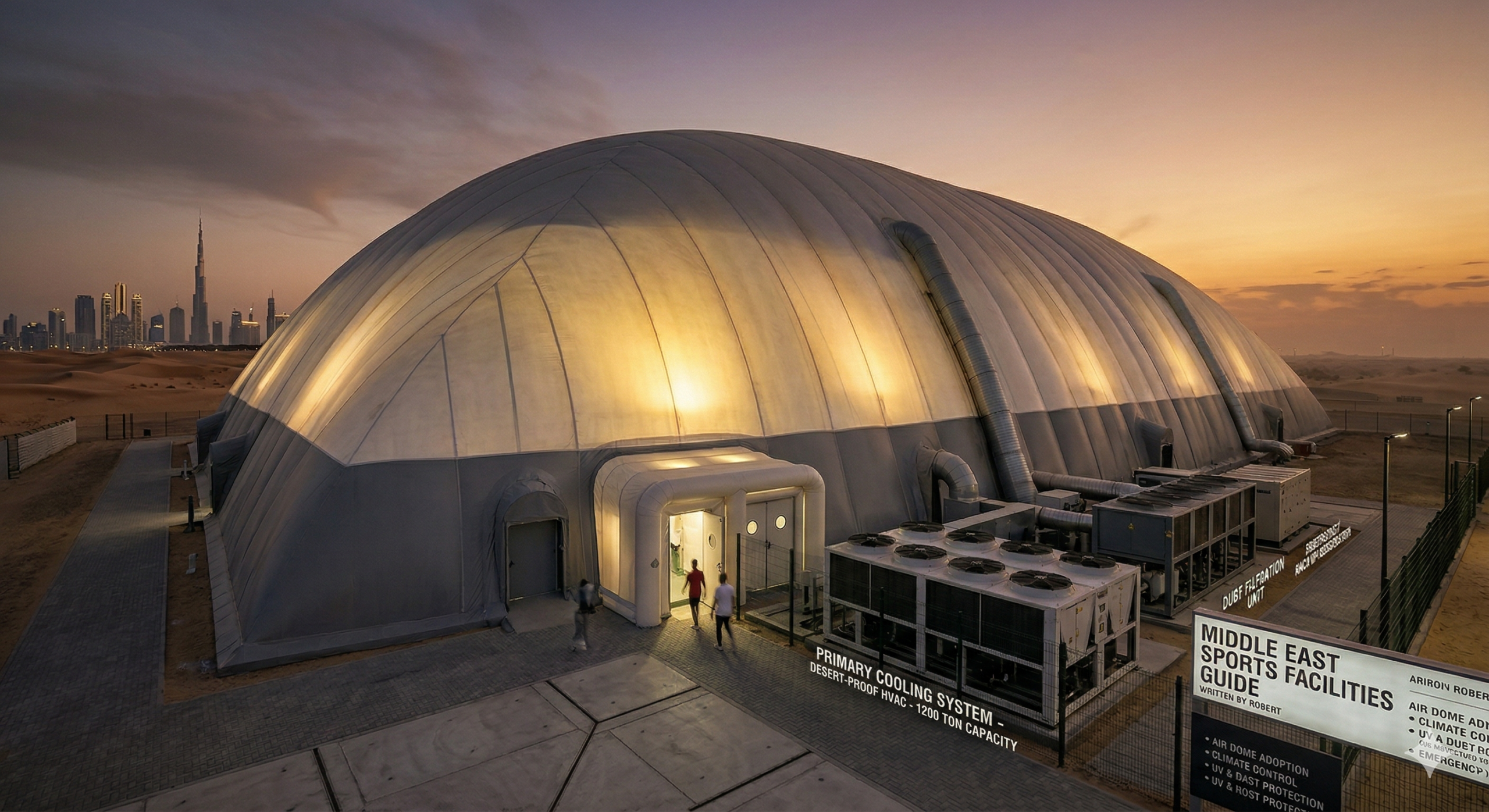
Your middle east sports dome provides extensive protection against UV radiation, dust infiltration, and extreme heat. You can maintain comfortable temperatures between 20-25°C (68-77°F) year-round, ensuring consistent playability regardless of external conditions.
Unlike permanent structures, you’ll benefit from faster installation and lower initial investment costs.
UAE indoor sports facilities in Dubai, Abu Dhabi, and Doha are leading this transformation.
You’ll discover that air domes offer the perfect balance of luxury amenities and practical climate control that Middle Eastern sports facilities demand.
Air Dome Costs: Import Fees and Installation Budgets
You’ll face significant import tariffs when bringing air dome materials into Middle East markets, with fees varying by country and equipment type.
Your installation costs will depend on several key factors including site preparation, specialized cooling systems, and local labor availability.
These combined expenses typically make Middle East air dome projects 20-30% more expensive than similar installations in other regions.
Import Tariff Breakdown
Since air dome systems require specialized materials and technology rarely manufactured locally, import tariffs considerably impact your total project budget in Middle East markets.
You’ll typically face 5-15% customs duties on structural components, with UAE and Qatar offering more favorable rates than other regional countries.
For your Dubai sports facility project, expect additional 5% VAT plus clearance fees ranging $2,000-8,000 depending on shipment size.
Steel framework components carry higher tariffs (10-15%) compared to membrane materials (5-8%).
Cooling systems face the steepest import costs at 15-20% due to luxury goods classification.
You can reduce expenses by sourcing through free trade zones in Dubai or Abu Dhabi, potentially saving 3-7% on total import costs while maintaining quality standards.
Installation Cost Factors
Beyond import duties, installation expenses represent your largest controllable cost variable when planning air dome construction in Middle Eastern markets.
Your foundation work costs increase 30-40% due to extreme temperature requirements and specialized concrete mixes that withstand thermal expansion. You’ll need climate-controlled staging areas for equipment and materials, adding $15,000-25,000 to project budgets.
Cooling system integration drives the highest installation premiums. Your HVAC infrastructure requires redundant systems, specialized ductwork, and emergency backup power – typically 60-80% more expensive than temperate climate installations.
Local labor shortages in specialized trades like membrane welding and pneumatic systems push hourly rates 25-35% above regional averages.
You’ll achieve cost control through pre-approved contractor networks, consolidated shipping schedules, and off-peak installation timing during cooler months when labor productivity peaks.
Desert-Proof HVAC: Cooling Systems for 113°F Heat
When temperatures soar past 113°F in desert climates, your sports facility’s HVAC system becomes the critical barrier between athletic performance and heat exhaustion. You’ll need specialized cooling solutions that go beyond standard air conditioning.
| System Type | Cooling Capacity |
|---|---|
| Evaporative Cooling | Limited in high humidity |
| Central Chiller Systems | 500-2000 tons typical |
| Hybrid Heat Pumps | Energy-efficient option |
Your air dome facility requires redundant cooling systems to prevent catastrophic failure. Install backup chillers and emergency generators—you can’t afford downtime when athletes are inside. Consider thermal zoning to cool active areas more aggressively while maintaining comfortable temperatures in spectator zones. Smart controls automatically adjust based on occupancy and external temperatures, reducing energy costs while maintaining safety standards.
UV and Dust Protection Technologies Explained
While your cooling system battles extreme temperatures, your facility’s envelope must simultaneously defend against two other desert enemies: ultraviolet radiation and airborne dust.
Air domes excel at both challenges, using specialized UV-resistant membranes that block harmful rays while maintaining interior lighting quality.
You’ll need multi-layered filtration systems at entry points to prevent dust infiltration. HEPA filters capture particles as small as 0.3 microns, while pre-filters handle larger debris.
Install positive air pressure systems to keep contaminants out during door openings.
For UV protection, choose membrane materials with built-in UV stabilizers and reflective coatings. These reduce solar heat gain by up to 30% while preventing material degradation.
Regular membrane inspections guarantee continued protection—desert conditions accelerate wear, making proactive maintenance essential for long-term facility performance.
Dubai vs Abu Dhabi vs Doha Sports Markets
You’ll find distinct approaches to sports facility development across these three major Gulf cities, each leveraging cutting-edge climate control technologies to combat extreme temperatures and environmental challenges.
Dubai leads with extravagant luxury investments in enclosed sports complexes, while Abu Dhabi focuses on sustainable cooling solutions.
Doha emphasizes tournament-ready venues with advanced air filtration systems.
These markets are experiencing unprecedented growth as each city competes to become the region’s premier sports destination through massive infrastructure spending and technological innovation.
Climate Control Technologies
Although Dubai, Abu Dhabi, and Doha all face similar extreme heat challenges, each city’s sports facility market has developed distinct climate control approaches that reflect their unique economic priorities and infrastructure capabilities.
You’ll find Dubai emphasizes luxury cooling systems with advanced air dome technology, targeting premium facilities that maintain 18-22°C year-round. Abu Dhabi focuses on energy-efficient solutions, leveraging renewable energy integration for sustainable temperature control. Doha prioritizes rapid deployment systems for major sporting events.
| Feature | Dubai | Abu Dhabi | Doha |
|---|---|---|---|
| Primary Focus | Luxury cooling | Energy efficiency | Event-ready systems |
| Temperature Range | 18-22°C | 20-25°C | 22-26°C |
| Cost Premium | 40-60% above standard | 25-35% above standard | 30-50% above standard |
| Technology | Advanced air domes | Solar-integrated HVAC | Modular cooling units |
| Market Position | Premium facilities | Sustainable venues | Tournament-grade infrastructure |
Luxury Facility Investments
Investment patterns across Dubai, Abu Dhabi, and Doha reveal dramatically different approaches to luxury sports facility development, with each emirate and city-state pursuing distinct strategies that reflect their broader economic visions.
Dubai leads with tourism-focused venues, attracting international events through world-class tennis stadiums and golf courses. You’ll find premium amenities targeting wealthy visitors who expect exceptional experiences.
Abu Dhabi emphasizes state-of-the-art Formula 1 circuits and cultural sports complexes, positioning itself as a sophisticated destination for elite competitions. Their investments prioritize long-term prestige over immediate returns.
Doha’s approach centers on FIFA World Cup infrastructure, creating multipurpose facilities that’ll serve local communities post-tournament.
You’re seeing smart investments in cooling technologies and adaptable spaces that maximize utility beyond major sporting events.
Market Growth Trends
These strategic investments have shaped three distinct market trajectories, each reflecting unique growth patterns and competitive advantages.
Dubai’s established itself as the premium sports destination, leveraging its tourism infrastructure to attract international events and high-end facilities. You’ll find the most diverse range of air-domed complexes here, catering to both residents and visitors.
Abu Dhabi’s taken a different approach, focusing on large-scale government-backed projects that emphasize cutting-edge technology and sustainability. Their facilities often feature the most advanced cooling systems and temperature control capabilities.
Doha’s emerged as the ambitious newcomer, rapidly expanding its sports infrastructure through significant World Cup investments.
You’ll notice their facilities prioritize dust control and UV protection more aggressively than their regional competitors, reflecting Qatar’s unique environmental challenges.
Premium Air Dome Features for Luxury Facilities
Luxury air dome facilities in the Middle East elevate the sports experience through cutting-edge climate control systems that maintain ideal temperatures even when outside conditions soar beyond 45°C (113°F). You’ll find these premium installations feature multi-zone cooling, advanced filtration systems, and smart humidity control that adapts to Dubai’s harsh desert environment.
| Premium Feature | Luxury Benefit |
|---|---|
| UV-blocking membrane | 99% harmful ray protection |
| HEPA air filtration | Removes dust and allergens |
| Zone-based cooling | Customizable temperature control |
| Smart automation | Energy-efficient operation |
These high-end facilities incorporate LED lighting systems, premium flooring materials, and acoustic dampening for enhanced comfort. You’ll also discover integrated sound systems, VIP viewing areas, and automated entry systems that justify the significant investment costs typical in Abu Dhabi and Doha’s luxury sports markets.
Year-Round Climate Control: Cooling and Heating Balance
While premium features define luxury air dome experiences, maintaining ideal temperatures throughout the Middle East’s extreme seasonal variations requires sophisticated balancing systems that go beyond basic cooling.
You’ll need dual-purpose HVAC systems that can efficiently handle temperatures ranging from 68°F to 113°F. During summer months, your primary focus shifts to aggressive cooling and dehumidification, while winter periods may require gentle heating in early morning sessions.
Smart climate control features include:
- Automated temperature zoning for different activity areas
- Predictive cooling that adjusts before peak heat hours
- Energy recovery ventilation to minimize cooling costs
- Humidity control maintaining 40-60% relative humidity levels
Your facility’s success depends on seamless shifts between heating and cooling modes, ensuring athletes perform comfortably regardless of external desert conditions while managing operational costs effectively.