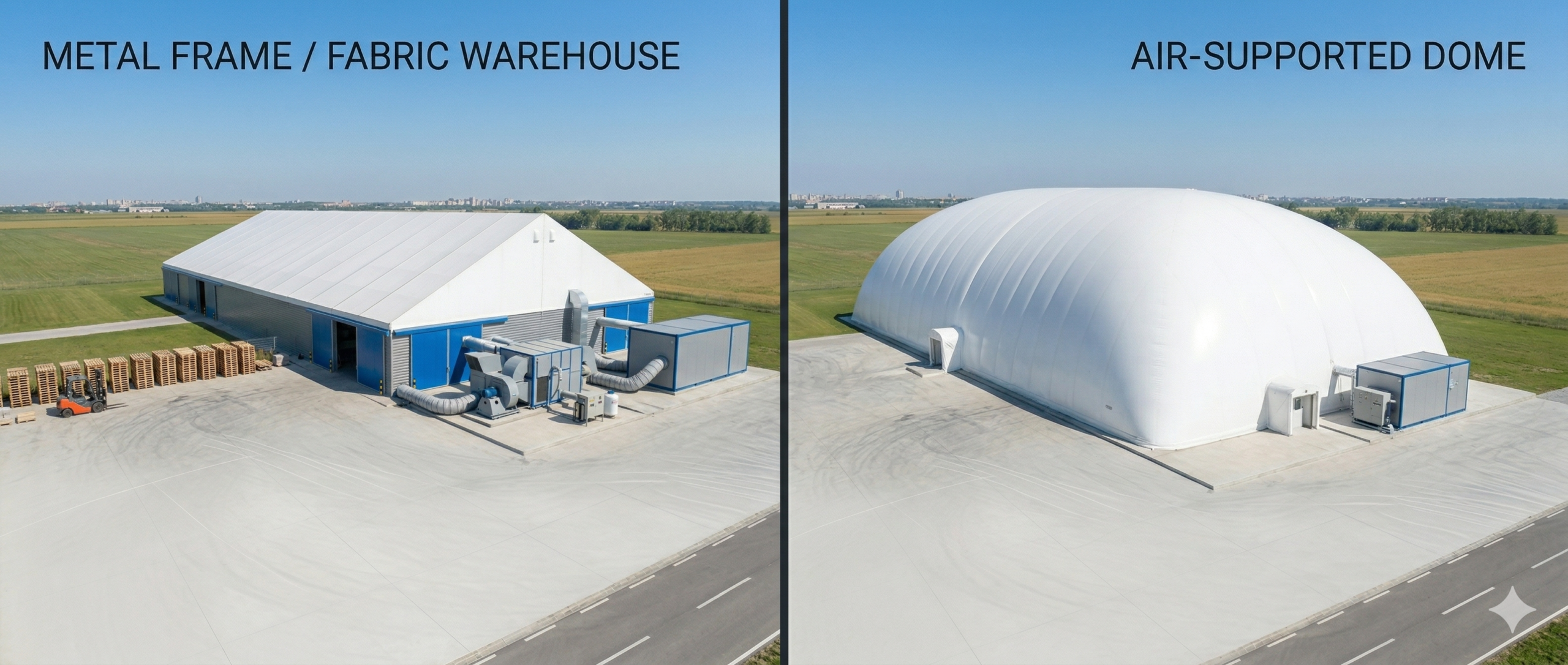
You’re facing a significant decision that’ll impact your sports facility’s budget for years to come. While temporary domes seem like the safer choice with their lower upfront costs of $700K to $1M, they’re quietly draining your resources through annual setup fees and maintenance. Permanent structures demand more initially—up to $1.2M—but here’s what most facility managers don’t realize about the hidden expenses that completely flip this equation.
Temporary vs Permanent Sports Domes: Investment Comparison
When you’re evaluating sports dome options for a 20,000 square foot facility, the financial picture shifts dramatically over time.
Your temporary sports dome cost appears lower initially at $700K-$1M, but you’ll face annual setup and removal expenses of $16K-$30K.
This seasonal vs permanent dome comparison reveals that temporary installations total $860K-$1.3M over ten years.
Permanent domes require higher upfront investment of $800K-$1.2M but eliminate recurring costs entirely.
You’ll reach the break-even point in just 3-4 years with permanent installations.
The removable dome vs fixed installation cost analysis clearly favors permanent structures for long-term use.
If you’re planning multi-year operations, permanent domes deliver superior value despite their steeper initial price tag.
Break-Even Analysis: When Permanent Domes Pay For Themselves
When you’re weighing temporary versus permanent dome options, the break-even point becomes your most critical decision factor.
You’ll find that permanent domes typically cost $100K-$200K more upfront, but they’ll save you $16K-$30K annually by eliminating setup and removal expenses.
The math works in your favor quickly—permanent installations usually pay for themselves within just three to four years through these ongoing operational savings.
Initial Investment Comparison
Although temporary sports domes require less money upfront, you’ll find that permanent structures become the more economical choice within just a few years.
When comparing temporary vs year-round facility cost for a 20,000 square foot dome, you’re looking at $700K-$1M initially for temporary structures versus $800K-$1.2M for permanent installations.
However, temporary domes carry hidden expenses that quickly erode their initial advantage. You’ll face $16K-$30K annually for setup and removal services, plus potential storage costs during off-seasons.
These recurring expenses mean you’ll spend $860K-$1.3M over ten years with temporary domes.
Permanent structures eliminate these ongoing costs entirely. While requiring higher upfront investment, they typically break even within 3-4 years, making them markedly more cost-effective for long-term operations.
Annual Operating Savings
Beyond the initial cost difference, permanent domes deliver substantial annual operating savings that accelerate your return on investment. You’ll eliminate the recurring setup and teardown expenses that plague temporary structures, creating immediate cost benefits.
| Cost Factor | Temporary Dome | Permanent Dome |
|---|---|---|
| Annual Setup/Removal | $16K-$30K | $0 |
| 5-Year Total Operating | $80K-$150K | $0 |
| 10-Year Total Cost | $860K-$1.3M | $800K-$1.2M |
| Break-Even Point | N/A | 3-4 years |
| Labor Requirements | High seasonal | Minimal |
Your permanent dome typically pays for itself within 3-4 years through these operational savings. After the break-even point, you’re saving $16K-$30K annually compared to temporary alternatives. These savings compound over time, making permanent installations increasingly cost-effective for long-term facility planning.
Three Year Payback
The math behind permanent dome investments reveals a compelling financial story that most facility owners find irresistible.
You’ll reach break-even on your permanent dome investment within just 3-4 years compared to temporary alternatives.
Here’s how it works: while you’re spending $16,000-$30,000 annually on setup and removal costs for temporary domes, permanent structures eliminate these recurring expenses entirely.
Your initial investment difference of $100,000-$200,000 gets recovered quickly through avoided annual costs.
After year four, you’re generating pure savings of $16,000-$30,000 annually.
Over a 10-year period, you’ll save $260,000-$500,000 by choosing permanent construction.
This accelerated payback period makes permanent domes one of the smartest long-term investments in sports facility infrastructure.
Upfront Sports Dome Costs: $700K-$1.2M Investment Breakdown
Major financial decisions require understanding every dollar you’ll invest upfront in a sports dome project.
You’re looking at a substantial initial investment ranging from $700,000 to $1.2 million for a 20,000 square foot facility, depending on your chosen approach.
Here’s how the upfront costs break down:
- Temporary seasonal domes: You’ll pay $700K-$1M initially, appearing more budget-friendly at first glance.
- Permanent structures: Higher upfront investment of $800K-$1.2M, but no recurring installation expenses.
- Additional considerations: Site preparation, permits, and utility connections add to both options.
While temporary domes seem cheaper initially, you’ll face annual setup and removal costs of $16K-$30K.
Permanent structures eliminate these recurring expenses, making the higher upfront investment more cost-effective long-term.
Annual Setup, Removal, And Maintenance Expenses
While upfront costs grab most attention during planning, recurring annual expenses can dramatically impact your sports dome’s total cost of ownership.
Temporary domes require significant annual setup and removal costs ranging from $16,000 to $30,000 each year. You’ll need specialized crews, transportation, and storage facilities during off-seasons. These expenses accumulate quickly—over ten years, you’re looking at $160,000 to $300,000 in setup costs alone.
Permanent domes eliminate these recurring expenses entirely.
You’ll only face standard maintenance costs like HVAC servicing, minor repairs, and cleaning. The math is compelling: permanent structures typically break even within 3-4 years when you factor in eliminated setup costs.
After that break-even point, you’re saving substantial money annually while enjoying year-round facility access without weather-related interruptions.
Seasonal vs Year-Round Sports Dome Usage Scenarios
Your facility’s usage pattern directly impacts whether temporary or permanent domes make financial sense.
If you’re only covering fields during peak winter months, temporary structures let you maximize space during busy spring and summer seasons without year-round obstruction.
However, if you need consistent indoor space regardless of weather—for leagues, training programs, or rental income—permanent domes eliminate recurring setup costs and storage headaches.
Peak Season Demand
Since most sports facilities experience dramatic usage fluctuations throughout the year, you’ll need to carefully analyze your peak season demand patterns before choosing between temporary and permanent dome solutions.
Understanding your facility’s usage peaks helps determine which option maximizes your investment. If you’re operating a football field that’s heavily used September through November but sits mostly empty in summer, temporary domes make financial sense.
Conversely, year-round facilities with consistent demand justify permanent installations.
Consider these peak season factors:
- Duration intensity – How many months do you experience maximum capacity usage versus minimal activity periods?
- Revenue concentration – What percentage of annual income comes from your busiest three-month period?
- Off-season alternatives – Can you generate revenue during traditionally slow periods with dome coverage?
Off-Season Storage Costs
Temporary domes require significant off-season storage space and associated costs that many facility owners overlook during initial planning. You’ll need climate-controlled warehouses to prevent fabric deterioration, plus specialized handling equipment for the massive structural components.
| Storage Component | Space Required | Annual Cost |
|---|---|---|
| Fabric membrane | 2,000 sq ft | $8,000-$12,000 |
| Steel framework | 3,500 sq ft | $14,000-$21,000 |
| Anchor systems | 500 sq ft | $2,000-$3,000 |
| Blower equipment | 200 sq ft | $800-$1,200 |
| Total Storage | 6,200 sq ft | $24,800-$37,200 |
These storage costs add $248,000-$372,000 over ten years to your temporary dome investment. Permanent structures eliminate these expenses entirely, making the long-term financial advantage even more compelling for year-round facilities.
20,000 Square Foot Sports Dome Capacity Planning
Planning capacity for a 20,000 square foot sports dome requires careful consideration of your intended activities and peak usage periods.
You’ll need to evaluate how many simultaneous events you can accommodate while maintaining safety and quality standards.
Your capacity planning should focus on these key areas:
- Court configurations – You can fit 2-3 full basketball courts, 4-6 volleyball courts, or multiple smaller training areas depending on your layout strategy.
- Peak hour scheduling – Plan for 150-250 active participants during busy periods, accounting for spectators and waiting areas.
- Multi-sport flexibility – Design zones that convert quickly between activities to maximize revenue per square foot.
Consider seasonal demand fluctuations when determining ideal capacity.
Winter months typically see 40-60% higher usage than summer periods, affecting your temporary versus permanent dome decision based on utilization rates.
10-Year Total Investment: $860K-$1.3M Cost Reality
Over a decade, your temporary sports dome investment will reach $860,000 to $1.3 million when you factor in both initial costs and recurring expenses. This total includes your initial $700,000-$1 million purchase price plus annual setup and removal costs of $16,000-$30,000.
You’ll face these recurring expenses every season because temporary domes require professional installation and dismantling. Weather delays, storage fees, and potential damage during handling can push costs higher.
Equipment wear from repeated assembly cycles may demand earlier replacement than anticipated.
Compare this to permanent domes costing $800,000-$1.2 million upfront with minimal ongoing expenses. Your temporary dome’s financial disadvantage becomes clear after year three or four, when permanent structures break even.
Consider your long-term facility needs carefully before committing to the seemingly lower-cost temporary option.
Location, Permits, And Insurance: Beyond Purchase Price
While dome costs dominate budget discussions, you’ll encounter significant expenses that extend far beyond the structure itself. Location selection, permitting processes, and insurance requirements create substantial financial obligations that can derail your project if you’re unprepared.
These hidden costs vary dramatically between temporary and permanent installations:
- Permits and zoning compliance – Temporary structures need annual permits ($2K-$8K), while permanent domes require thorough building permits, environmental assessments, and zoning approvals ($15K-$50K upfront).
- Site preparation and utilities – Temporary setups need basic leveling and temporary power connections, but permanent installations require foundations, permanent electrical, plumbing, and HVAC infrastructure ($100K-$300K).
- Insurance premiums – Coverage costs increase 15-25% for permanent structures due to higher replacement values and extended liability exposure.