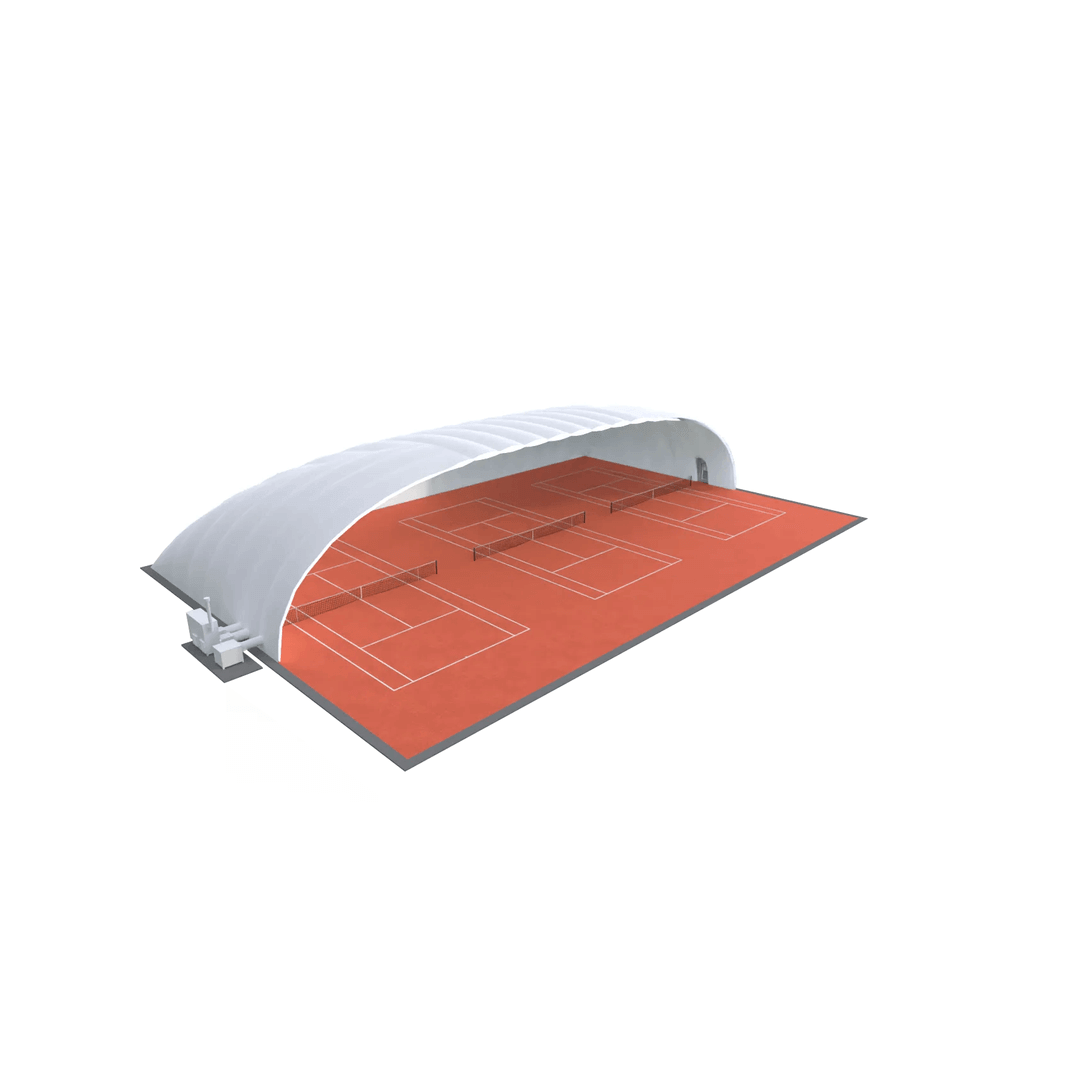
You’ll spend between $50,000 and $350,000 on your air dome project in 2026, depending on size, materials, and site requirements. Dome packages cost $10-$25 per square foot, while complete installations run $25-$50 per square foot including materials and labor. Annual operating expenses range from $3-$6 per square foot for blowers, HVAC, and maintenance. Larger domes offer markedly better value, with costs up to 400% lower per square foot than smaller facilities. This thorough breakdown reveals exactly where your investment goes.
Total Air Dome Project Costs: $50,000 to $350,000 Budget Breakdown
Air dome investments span a significant range, with complete projects typically falling between $50,000 and $350,000 depending on your facility’s size and specifications.
Your air dome installation cost breaks down into several key components that determine your total investment.
The dome package itself costs $10-$25 per square foot ($108-$269 per square meter), with mid-sized tennis facilities requiring mid-six-figure investments.
You’ll need approximately $20,000 for structural and mechanical engineering to guarantee code compliance.
Foundation expenses vary dramatically based on soil conditions and local requirements.
Larger domes deliver better per-square-foot value, while premium materials and custom features increase costs. These premium upgrades include flame-retardant membranes and high light-transmission covers for enhanced safety and performance.
You can reduce expenses by providing volunteer labor for manual installation tasks and procuring heavy equipment independently, achieving 50-75% savings compared to permanent construction.
Construction and Installation: Material, Labor, and Foundation Expenses
Construction represents the largest expense category in your air dome project, with material costs ranging from $25-50 per square foot ($269-538 per square meter) for complete installations.
Premium membrane materials with flame-retardant properties and high light transmission cost $10-25 per square foot ($108-269 per square meter), while basic structures start at $12 per square foot ($129 per square meter).
Labor expenses reach approximately $74,000 for seven-day installations, including specialized HVAC and electrical technicians.
You’ll achieve 50% faster installation times compared to permanent buildings, reducing overall labor requirements. Small domes can be installed in 1-2 days, while larger installations may require several weeks depending on complexity.
Foundation systems represent significant additional costs, with hybrid grade beam and earth anchor systems costing around $350,000 for 100,000-square-foot installations.
Air dome cost calculations must include engineering fees of approximately $20,000 for structural design and permit compliance.
Air Dome Operating Costs: Annual Maintenance and Utilities by Size
Operating expenses consume $3-6 per square foot ($32-65 per square meter) annually across all air dome sizes, with utility costs representing your largest ongoing financial commitment. Your sports bubble operating costs break down into four primary categories: blower inflation, HVAC systems, routine maintenance, and fabric replacement reserves.
| Cost Category | Annual Rate | Description |
|---|---|---|
| Blower Operations | $0.10-0.20/sq ft ($1.08-2.15/sq m) | Continuous inflation system electricity |
| Climate Control | $0.50-1.50/sq ft ($5.38-16.15/sq m) | Heating, cooling, and ventilation utilities |
| Maintenance | 7-12% of initial investment | Inspections, repairs, and component upkeep |
| Fabric Replacement | Every 10-15 years | $10,000-$1M+ depending on dome diameter |
Three tennis courts generate $60,000-$80,000 in annual operational expenses, delivering 50-75% savings compared to permanent structures. HVAC maintenance follows commercial building standards with minimal additional requirements for dome-specific components.
Small vs Large Air Dome Economics: When Size Saves Money
Scale transforms air dome economics greatly, with larger installations delivering per-square-foot costs up to 400% lower than smaller facilities.
You’ll find dome packages starting at $12 per square foot for large installations, while smaller domes can cost $50 per square foot. This dramatic difference stems from fixed costs spreading across greater surface area.
Your foundation expenses demonstrate this principle clearly—a 100,000-square-foot dome’s foundation costs just $3.50 per square foot, while smaller installations face proportionally higher foundation expenses. Acceptable substrates require poured-in-place concrete with minimum 25 MPa compressive strength to handle anchor loads of 12-18 kN per anchor point.
Air supported structure cost efficiency improves markedly with scale because installation complexity remains constant regardless of size.
Large domes also offer superior maintenance economics, with annual per-square-foot maintenance costs of $0.10-0.20 plus utilities at $0.50-$1.50, making bigger installations increasingly cost-effective over time.
Air Dome ROI: 10-Year Cost Comparison vs Traditional Buildings
When evaluating long-term facility investments, air domes deliver compelling financial advantages that become increasingly pronounced over a decade. You’ll save 50–75% on initial construction costs compared to traditional buildings, with air dome roi calculations showing breakeven within 3–5 years through operational efficiencies.
Your ten-year operational expenses run $3–$6 per square foot annually, including energy-efficient LED lighting and high-performance air blowers. For tennis bubble cost comparisons, you’re looking at $10–$25 per square foot versus $100–$250 for conventional structures.
The sealed envelope design reduces thermal loss while integrated HVAC systems maintain consistent climate control.
Material efficiency delivers additional savings, requiring 25% fewer materials than equivalent traditional buildings. Your disaster-proof design withstands hurricanes and earthquakes, reducing emergency repair costs throughout the facility’s lifespan. Advanced security solutions now protect facility management systems from online threats that could potentially disrupt operations or compromise sensitive cost data.
Frequently Asked Questions
Can Air Domes Withstand Extreme Weather Like Hurricanes and Heavy Snow Loads?
Yes, you’ll find air domes are engineered to handle extreme weather conditions. They withstand winds up to 150 mph (241 km/h) and snow loads of 51 psf (244 kg/m²).
You’ll benefit from increased air pressure that stiffens walls during storms, plus TEDLAR fabric that sheds snow automatically.
The triple redundancy inflation system with backup generators guarantees you’re protected even during power outages, while the patented anchoring system secures everything against hurricane-force conditions.
What Permits and Zoning Approvals Are Required Before Installing an Air Dome?
You’ll need building permits stamped by licensed engineers, costing approximately $20,000 for structural and mechanical documentation.
Check with your local building department first—some jurisdictions classify air domes as temporary structures, potentially exempting them from standard permits.
Rural counties often have relaxed requirements, while urban areas require full IBC and ASCE 55-16 compliance.
Start permit research early since approval processes can take weeks to months depending on your location’s complexity.
How Long Do Air Dome Membranes Typically Last Before Requiring Replacement?
You’ll get 10-15 years from standard fabric membranes under normal conditions, though well-maintained air-supported domes can last 10-20 years.
Higher-end models reach 30+ years, while double-membrane systems extend life to 40+ years.
Rigid-frame domes with membrane covers typically last 20-30 years.
Your dome’s lifespan depends on UV exposure, climate conditions, installation quality, and maintenance practices.
Regular cleaning and prompt repairs greatly extend membrane life beyond standard expectations.
Are Air Domes Suitable for Year-Round Use in Sub-Zero Winter Climates?
Yes, you’ll find air domes are excellent for year-round use in sub-zero climates.
They’re engineered to handle temperatures from -30°C to +70°C (-22°F to +158°F) with snow loads exceeding 75 kg/sq m (15 lb/sq ft).
The curved design naturally sheds snow while advanced heating systems maintain comfortable interior conditions.
You can expect reliable operation even in extreme cold, as documented in northern Canada installations that extended sports seasons from three to twelve months.
What Happens if the Air Dome Deflates During an Emergency or Power Outage?
If your air dome deflates during an emergency, you’ll have several minutes to evacuate safely through normal doorways. You can lift the dome fabric overhead and push it toward the fan side, or crawl under the edges away from the fan.
Backup generators prevent immediate deflation during power outages. For rapid evacuation, supervisors can cut emergency exits in the plastic membrane using scissors, though this accelerates deflation.