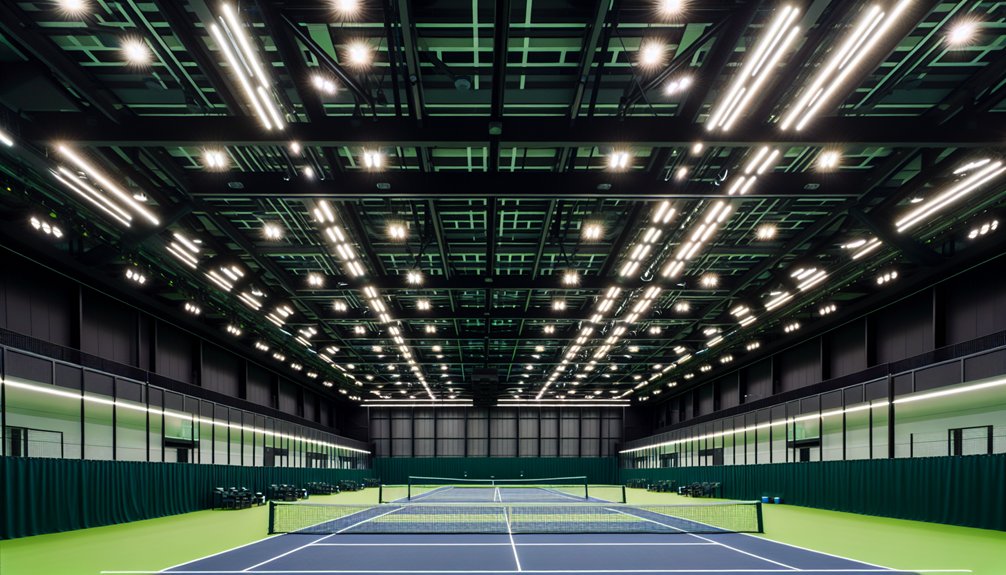
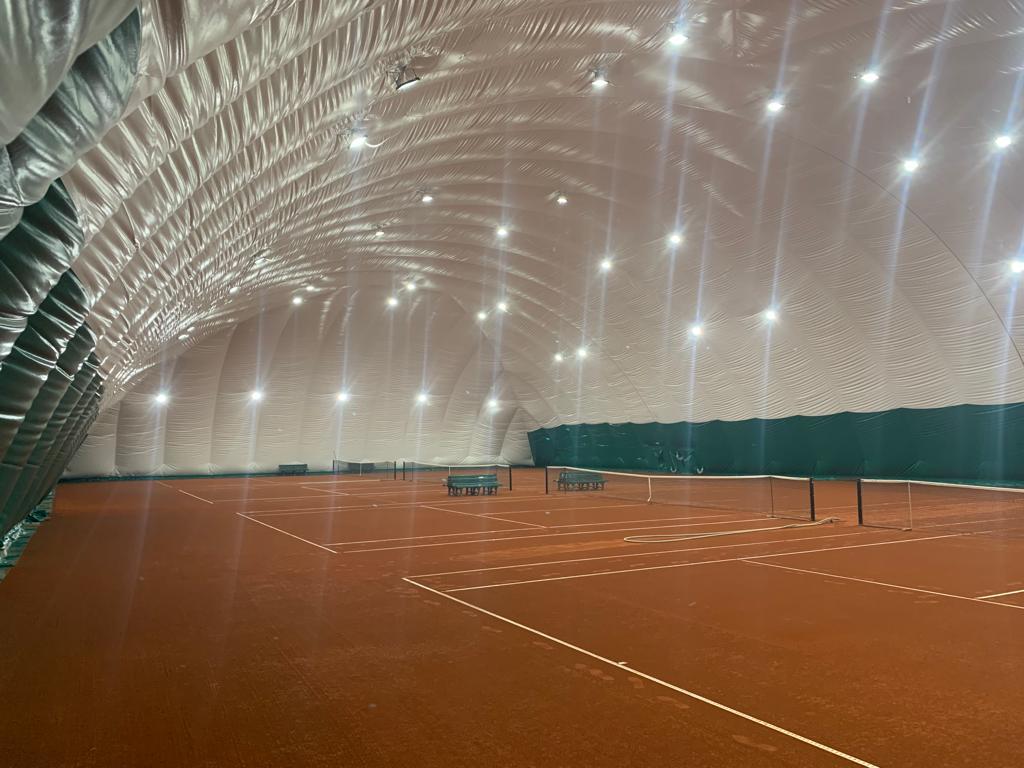
You’ll spend between $330,000 and $620,000 per court for a complete indoor tennis facility in 2026, including construction ($250,000-$500,000), site preparation ($10,000-$25,000), and professional installation ($40,000-$100,000). Your surface choice considerably impacts costs—clay runs $45,000-$110,000, concrete $60,000-$115,000, and asphalt $45,000-$60,000. Don’t forget permits, electrical, and fencing expenses ranging $6,600-$20,000. The structure type you choose will determine your total investment and ongoing operational expenses.
How Much Does An Indoor Tennis Court Really Cost?
When you’re planning an indoor tennis facility, expect to invest $250,000 to $500,000+ per court for construction. Your indoor tennis facility cost depends heavily on materials, site conditions, and structural complexity. Premium finishes and custom features push prices toward the upper range.
You’ll need essential infrastructure including structural framing, permanent roofing, heating systems, insulation, ventilation, and professional lighting.
Each court requires 78′ x 120′ (23.8m x 36.6m) minimum space with high ceilings for proper playability.
Consider alternative construction methods to reduce your indoor tennis building price. Air-supported domes offer lower upfront investment, though they require annual setup costs.
For budget-conscious projects, tennis dome cost ranges from $80,000 to $400,000, considerably less than permanent structures costing $500,000 to $2M+. Plan for ongoing annual maintenance costs of $1,500 to $3,000 per court to ensure your facility remains in optimal playing condition.
Site Prep And Foundation Costs For Tennis Courts
Before construction begins, proper site preparation forms the foundation of your indoor tennis facility project, typically costing $10,000 to $25,000 for standard installations. Your tennis court covering cost depends heavily on thorough groundwork that prevents future structural issues.
Site preparation involves several critical phases that directly impact your covered tennis court pricing:
- Site clearing and grading – $1,000 to $10,000 depending on terrain complexity and vegetation density
- Professional surveying – $400 to $800 for property line verification and baseline measurements
- Foundation materials – $1 to $12+ per square foot for compacted gravel, asphalt, or concrete bases
- Drainage systems – Essential for moisture management in areas with heavy rainfall or poor soil conditions
- Soil stabilization – Prevents settling and cracking that compromises long-term court performance
Proper preparation guarantees your indoor facility’s structural integrity and longevity. Indoor courts generally cost more due to structural requirements that must accommodate overhead coverage and climate control systems.
Clay Vs Asphalt Vs Concrete Court Surfaces
After completing site preparation, you’ll face an essential decision that greatly impacts both your initial investment and long-term operational costs: selecting the right court surface.
| Surface Type |
Construction Cost |
Lifespan |
| Clay |
$25,000–$90,000 |
Decades |
| Asphalt |
$40,000–$100,000 |
20–25 years |
| Concrete |
$60,000–$115,000 |
25–40 years |
Clay courts offer the longest lifespan but require high ongoing maintenance, including daily grooming and frequent watering. You’ll spend $2,500–$2,975 annually on resurfacing. Asphalt courts need crack repairs in freeze-thaw climates and resurfacing every 3–5 years. Concrete provides the best durability but demands proper excavation and drainage systems. Professional facilities should choose acrylic or clay surfaces, while synthetic turf works well for amateur use due to lower maintenance requirements.
When planning your budget, remember that building permits are typically required for tennis court construction, adding $100 to $750 to your total project costs.
Bubble Domes Vs Pole Barns For Indoor Courts
When you’re choosing between bubble domes and pole barns for your indoor tennis facility, you’ll face significant differences in upfront costs, with air-supported domes running $1.4-$2.9 million compared to pole barns that typically exceed these prices as permanent structures.
Your installation timeline will vary dramatically, as bubble domes offer rapid setup while rigid frame pole barns require extended construction periods.
You’ll also need to weigh long-term durability against operating expenses, since domes have lower initial costs but higher ongoing energy requirements, while pole barns demand greater upfront investment but offer permanent structural stability. Bubble domes create a more open playing space without the beams and columns found in traditional pole barn structures.
Cost Comparison Analysis
While both bubble domes and pole barns can house your indoor tennis courts, the financial implications differ dramatically between these two approaches.
You’ll find bubble domes cost $85,000–$200,000 for complete single-court projects, while pole barns require $110,000–$300,000. This represents 36–57% savings with bubble installations. The housing alone costs $45,000–$100,000 for bubbles versus $70,000–$200,000 for pole barns.
Key financial differences include:
- Bubble domes require minimal site preparation over existing courts.
- Pole barns demand extensive foundation work and structural framing.
- Bubble systems include integrated climate control within inflatable structure.
- Pole barns need thorough HVAC, insulation, and professional lighting.
- Bubble installations offer seasonal flexibility without permanent modifications.
Both construction approaches typically require permits from local authorities before installation can begin.
Durability And Longevity
Though initial costs favor bubble domes, you’ll need to evaluate long-term durability when choosing between air-supported structures and traditional pole barns for your indoor tennis facility.
Traditional pole barns built with concrete, steel, and glass frameworks can function as long-lasting community icons when properly constructed, requiring less regular maintenance than air domes.
Air-supported structures face several durability challenges. You’ll deal with susceptibility to tears from sharp objects, potential snow damage, and structural collapse risks during power outages.
While PVC fabric carries a 25-year prorated warranty and air domes are rated for 50 years, you’ll need continuous maintenance and 24/7 inflation systems.
Traditional structures guarantee long-term safety through damage-resistant construction, supporting mounted equipment without inflation limitations while reducing lifetime maintenance expenditures.
Installation Time Requirements
Installation timelines represent one of the most dramatic differences between bubble domes and pole barns for indoor tennis courts.
You’ll have your bubble dome facility operational within 1-3 days, while traditional pole barn construction stretches across months or even years. This massive time difference directly impacts your revenue generation and scheduling capabilities.
Key Installation Timeline Differences:
- Bubble domes: Complete setup in just a few weeks with minimal site preparation
- Pole barns: Require extensive foundation work, structural framing, and interior finishing phases
- Seasonal flexibility: You can relocate bubble domes in approximately two days
- Operational readiness: Sports activities commence immediately with bubble domes versus delayed starts with traditional structures
- Disruption levels: Bubble installations cause negligible interruption compared to complex construction sequences
Coordinating Court Surfaces With Housing Structures
You’ll need to match your court surface choice with your building structure’s capabilities, as different surfaces require specific foundation depths and structural support systems.
Your climate control system must integrate seamlessly with surface materials—hard courts handle temperature fluctuations better than clay, while synthetic surfaces need consistent humidity levels.
Consider how your chosen surface’s installation timeline coordinates with your building’s construction schedule, since some surfaces can’t be installed until the structure reaches specific completion milestones.
Surface Material Compatibility Analysis
When planning your indoor tennis facility, coordinating your court surface with the structural system determines both upfront costs and long-term operational success.
Each surface type requires specific base requirements and maintenance considerations that directly impact your facility’s operational efficiency.
- Acrylic hard courts work best with permanent buildings ($500K-$2M+) due to their concrete base requirements and long-term durability.
- Modular tile systems suit tension fabric structures ($150K-$800K) in mild climates but avoid freeze-thaw environments.
- Carpet surfaces match air dome budgets ($80K-$400K) for temporary installations with 5-8 year replacement cycles.
- Clay courts need permanent facilities with dedicated maintenance areas for daily watering and rolling operations.
- Artificial grass requires climate-controlled permanent structures to maximize its 10-15 year lifespan.
Climate Control Integration Requirements
Because your court surface directly influences climate control requirements, selecting the right HVAC system becomes critical for both player comfort and surface longevity.
You’ll need to maintain temperatures between 65-72°F (18-22°C) and humidity levels at 50-60% to prevent surface degradation and guarantee ideal playing conditions.
Infrared heating systems work best for sports halls, delivering consistent heat distribution to court areas while operating quietly to avoid disrupting play.
Your ventilation system must provide robust air circulation to prevent moisture buildup that leads to slick surfaces and premature cracking.
Consider automated climate control systems with zoning capabilities – they’ll reduce operational costs while maintaining precise environmental conditions.
Smart building integration with LED lighting and real-time monitoring guarantees efficient energy consumption and prevents costly HVAC failures during events.
Foundation Depth Considerations
Proper foundation design extends beyond climate considerations to address the structural coordination between your court surface and the building that houses it.
Your concrete foundation requires precise depth planning to integrate with drainage systems and accommodate structural loads from your facility’s framework.
Key foundation depth specifications include:
- Concrete slab minimum: 150mm (5.9″) depth using 20 MPa concrete strength
- Base layer requirements: 90mm (3.5″) compacted depth with 25mm Scoria Minus material
- Drainage integration: Longitudinal trenches 100mm (3.9″) width, pipes positioned 50mm (2″) below subgrade
- Post-tensioned option: Steel cable reinforcement reduces temperature-related cracking for heavy-use courts
- Structural coordination: Foundation layout must align with 35-foot (10.7m) minimum ceiling height requirements
Post-tensioned concrete costs more initially but provides superior long-term durability for competitive facilities.
What Professional Tennis Court Installation Costs
Professional tennis court installation requires a considerable investment, with standard courts typically costing $40,000 to $100,000 for a regulation 120′ x 60′ (36.6m x 18.3m) playing surface.
You’ll pay $5 to $14 per square foot for professional installation, which includes extensive site preparation, materials, and labor.
Surface material greatly impacts your total costs.
Clay surfaces range $45,000 to $110,000, while concrete courts cost $60,000 to $115,000.
Asphalt installations run $45,000 to $60,000, and rubber surfaces range $65,000 to $110,000.
Professional contractors charge 10% to 20% of total project costs for management services.
You’ll need landscape architect consultation at $70 to $150 per hour and surveyor services costing $400 to $800 for property verification.
Permits, Electrical, And Fencing Expenses
Beyond the court surface installation, you’ll face additional expenses for permits, electrical systems, and perimeter fencing that can add $6,600 to $20,000 to your total project budget.
Your permit costs will range from $100 to $2,000, covering zoning approvals, construction permits, and environmental clearances.
The electrical installation for your indoor facility’s lighting system requires $1,500 to $6,000, with electrician labor running $50 to $130 per hour.
Complete perimeter fencing and gates will cost $5,000 to $12,000 for your regulation-sized court.
- Urban locations increase labor and material costs greatly
- Permit approval takes 2 weeks to several months
- Indoor facilities need more extensive electrical infrastructure
- Professional installation guarantees safety compliance and durability
- Early permit applications prevent construction delays
Complete Tennis Court Budget Guide By Facility Type
Understanding these additional costs helps you prepare for the complete financial picture, but your total investment depends heavily on which type of indoor facility you choose.
Air domes offer the most economical entry point at $80K-$400K, requiring minimum dimensions of 78′ x 120′ (23.8m x 36.6m) for single courts.
Tension fabric structures cost $150K-$800K and provide better durability than basic bubbles.
For permanent solutions, you’ll invest $500K-$2M+ in traditional buildings with superior longevity.
Bubble structures over existing courts range $85K-$200K installed, while pole barn solutions cost $110K-$300K total.
Large-scale air domes reach $1.25-$1.56 million for 62,500 square feet.
Each option carries different installation timelines, operating expenses, and lifespans that’ll impact your long-term budget planning.
Frequently Asked Questions
How Long Does It Take to Construct an Indoor Tennis Facility?
You’ll need 8-18 months to construct an indoor tennis facility, depending on size and complexity.
Single-court air domes take 2-4 months, while tension fabric structures require 4-8 months. Permanent buildings need 12-18 months or more.
Weather won’t affect your timeline since you’re building indoors, but site preparation, permits, and customization features like lighting and viewing areas will extend construction time.
Larger facilities with multiple courts take considerably longer.
What Are the Annual Maintenance Costs for Indoor Tennis Courts?
You’ll spend $500-$2,000 annually per court for basic maintenance, with hard courts being least expensive and clay courts most costly.
Professional maintenance services range from $1,500-$5,000 yearly depending on your facility size.
You’ll need $300-$800 for post-resurfacing upkeep and should budget $21,428 annually for eventual resurfacing reserves.
Monthly overhead typically runs $2,000-$6,000, including utilities at $4,000 for climate control and lighting in indoor facilities.
Can Existing Outdoor Courts Be Converted to Indoor Facilities?
Yes, you can convert existing outdoor courts to indoor facilities, but it’s complex and expensive.
You’ll need to assess your current foundation’s structural capacity, as it may require reinforcement to support indoor infrastructure.
You’ll add steel framework, roofing, ventilation, lighting, and climate control systems.
Conversion costs typically range from $200K-$600K per court beyond the original outdoor investment, making it 3-5 times more expensive than building new indoor facilities.
What Financing Options Are Available for Tennis Facility Construction?
You’ll find several financing options for tennis facility construction.
USTA offers competitive grants up to $35k per court for new construction and $50k per court for indoor structures, covering up to 50% of total project costs.
You can access utility rebates through LED lighting installations, with rebates functioning as down payments.
Direct commercial financing provides flexible terms for municipal, educational, and private entities with streamlined documentation and competitive rates.
How Much Space Is Needed Around the Court Inside the Building?
You’ll need different clearances depending on your facility’s purpose.
For recreational play, plan for 120′ x 60′ (36.6m x 18.3m) total space per court with 12′ (3.7m) side clearances and 18′ (5.5m) behind baselines.
Tournament-level courts require 130′ x 70′ (39.6m x 21.3m) with 21′ (6.4m) side clearances.
You can use minimum dimensions of 114′ x 56′ (34.8m x 17.1m) but it’ll limit player movement and rally quality.