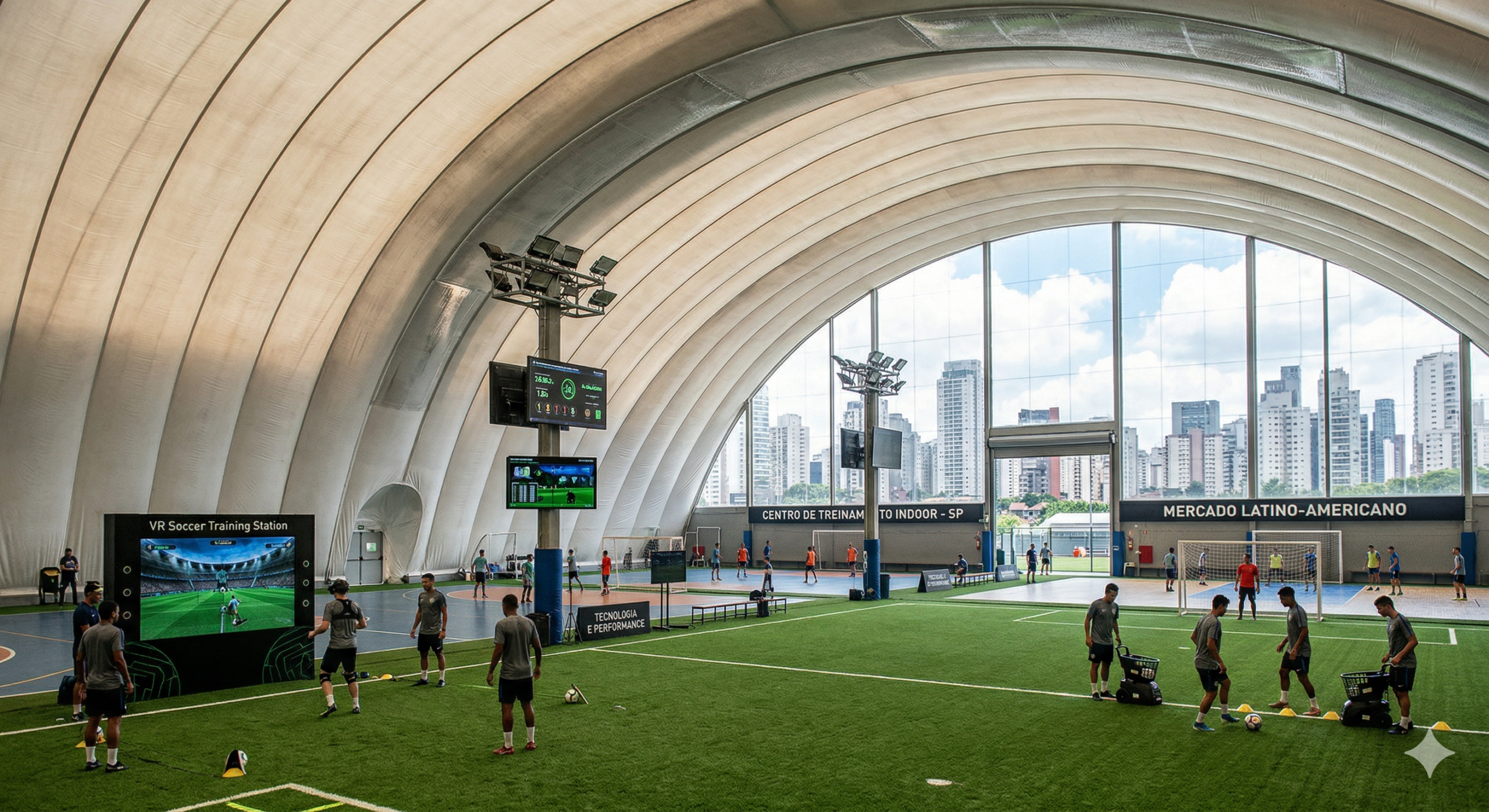
You’re looking at a $2.3 billion market that’s quietly reshaping how Latin America approaches indoor sports infrastructure. While Brazil and Mexico capture most headlines with their massive facility expansions, you’ll find the real story lies in the operational advantages that make this region 10-30% cheaper than US markets. But there’s a catch that could derail your investment plans—one that most analysts aren’t discussing yet.
Brazil and Mexico Drive $2.3B Indoor Sports Market Growth
Two powerhouse economies are reshaping Latin America’s indoor sports landscape, with Brazil and Mexico commanding the lion’s share of a $2.3 billion market that’s expanding rapidly across the region.
You’ll find Brazil’s indoor facility infrastructure leading the charge, driven by the country’s massive population and established sports culture. Soccer training centers and multi-sport complexes are proliferating in major cities like São Paulo and Rio de Janeiro.
Meanwhile, Mexico’s sports dome installations are experiencing unprecedented growth, particularly in northern states where cross-border business opportunities flourish.
The south america air dome segment represents the fastest-growing category, offering cost-effective solutions for year-round training despite varied climates.
You’re witnessing 10-30% lower operational costs compared to US markets, making indoor sports facilities increasingly attractive investments throughout the region.
Climate Demands Create Year-Round Indoor Sports Facility Needs
While temperatures across Latin America range dramatically from 15-35°C (59-95°F), you’re seeing indoor sports facilities become essential infrastructure rather than luxury amenities.
In tropical regions, you’ll need robust cooling systems and humidity control to protect athletes from oppressive heat and sudden downpours. Southern countries require adaptable climate systems managing both seasonal temperature swings and unpredictable weather patterns.
You’re witnessing increased demand for Latin America sports dome facilities that provide consistent training environments year-round. These controlled spaces eliminate weather-related cancellations and offer reliable conditions for professional development.
Whether you’re dealing with Brazil’s humid summers or Argentina’s variable seasons, indoor facilities guarantee uninterrupted athletic programs. The climate variability isn’t just inconvenient—it’s driving fundamental infrastructure needs across the region’s expanding sports industry.
Soccer Training Centers Lead Infrastructure Investment Wave
You’ll find that soccer training centers across Latin America are driving the largest wave of indoor sports facility construction, with Brazil and Mexico leading massive infrastructure projects.
Your facility design choices now focus on multi-purpose synthetic turf systems, advanced ventilation for tropical climates, and modular spaces that accommodate both youth academies and professional training.
When you’re planning equipment investments, you’re prioritizing climate-controlled environments, high-quality artificial surfaces, and video analysis technology that can withstand the region’s humidity and temperature variations.
Modern Facility Design Trends
Several cutting-edge soccer training centers across Latin America are setting new benchmarks for indoor sports facility design, with Brazil’s São Paulo and Mexico City leading a $2.3 billion infrastructure investment wave.
You’ll find these modern facilities incorporating climate-adaptive features that address the region’s diverse weather conditions, from tropical humidity to temperate variations. Smart ventilation systems maintain ideal temperatures between 20-24°C while reducing energy costs by 25%.
Key design trends transforming Latin American indoor sports facilities include:
- Multi-surface training areas with convertible artificial turf systems
- Advanced LED lighting refined for broadcast and player performance
- Integrated recovery zones featuring hydrotherapy and cryotherapy equipment
- Digital performance tracking with embedded sensor technology
These innovations position Latin America’s facilities competitively against European standards while leveraging 15-20% lower construction costs.
Equipment Investment Priorities
Beyond architectural innovations, Latin American soccer training centers are channeling significant capital into specialized equipment that maximizes training efficiency and athlete development.
You’ll find priority investments focusing on high-tech ball machines, precision passing systems, and goalkeeper training apparatus that simulate match conditions. Speed and agility equipment dominates purchasing decisions, with ladder systems, cone sets, and reaction training tools leading the way.
Video analysis systems receive substantial budget allocations, enabling coaches to provide real-time feedback and tactical instruction.
You’re seeing increased demand for portable goals, rebounders, and specialized turf surfaces that withstand intensive daily use. Weather-resistant equipment proves essential given the region’s varied climate conditions.
Smart investment strategies emphasize durability and multi-functionality, helping facilities maximize their equipment ROI while delivering professional-grade training experiences.
Equipment Costs Drop 30% Below US Market Rates
While US indoor sports facilities grapple with rising equipment costs, Latin American markets offer compelling alternatives with prices running 10-30% below North American rates.
You’ll discover significant savings across essential equipment categories, though you must factor in import duties and currency fluctuations that can impact your bottom line.
Brazil’s manufacturing capabilities drive down costs for basic training equipment, while Mexico’s proximity to US suppliers creates competitive pricing structures.
Consider these cost-saving opportunities:
- Basic training equipment – 25-30% savings on mats, weights, and fitness machines
- Soccer/football gear – 20-25% reductions due to local manufacturing
- Court surfaces – 15-20% lower installation costs
- Climate control systems – Regional suppliers offer 10-15% savings
You’ll maximize returns by partnering with established local distributors who understand regulatory requirements.
Currency Shifts and Import Taxes Squeeze Profit Margins
Although equipment costs appear attractive in Latin American markets, currency volatility and import duties can quickly erode your expected savings.
You’ll face unpredictable exchange rate fluctuations that can swing 10-20% within months, turning profitable deals into losses overnight. Import taxes compound these challenges, with some countries imposing duties ranging from 15-35% on sports equipment.
Brazil’s complex tax structure includes federal, state, and municipal levies that stack up quickly.
Mexico’s NAFTA benefits help reduce some import costs, but peso volatility remains a concern.
Argentina’s currency controls and high inflation create additional complications for equipment procurement.
You’ll need to factor hedging costs and longer payment terms into your pricing strategy.
Consider partnering with local distributors who understand regulatory requirements and can navigate customs procedures more efficiently than direct imports.
Virtual Reality and Biometrics Upgrade Training Programs
You’ll find VR soccer training systems transforming how Latin American facilities develop player skills, offering immersive experiences that simulate real match conditions without requiring full-sized fields.
Your training programs can now integrate biometric performance analytics to track heart rate, movement patterns, and decision-making speed in real-time.
You’re able to implement these advanced technologies at a fraction of traditional costs, making cutting-edge training accessible to smaller facilities across the region.
VR Soccer Training Systems
Several Latin American countries are implementing VR soccer training systems that combine virtual reality environments with biometric monitoring to enhance player development.
You’ll find these technologies particularly valuable in Brazil, Mexico, and Argentina where football culture drives innovation adoption.
These systems offer significant advantages for your training programs:
- Real-time performance analytics – Track player movements, reaction times, and decision-making patterns.
- Climate-independent training – Practice effectively regardless of extreme heat or tropical weather conditions.
- Cost-effective scalability – Reduce facility overhead while training multiple players simultaneously.
- Injury prevention monitoring – Use biometric data to identify fatigue levels and prevent overexertion.
You’ll benefit from lower implementation costs compared to US markets, though you should prepare for potential import duty challenges when sourcing VR equipment internationally.
Biometric Performance Analytics
While traditional coaching relies on observation and intuition, biometric performance analytics transform how you evaluate and develop athletes across Latin America’s diverse sporting landscape.
You’ll capture real-time data on heart rate variability, movement patterns, and muscle activation through wearable sensors that cost 10-30% less than US equivalents in countries like Brazil and Mexico.
These systems help you optimize training intensity for Latin America’s challenging climate conditions, monitoring hydration levels and core temperature in 15-35°C environments.
You can identify injury risks before they occur and customize recovery protocols for individual athletes.
However, you’ll face import duties on specialized equipment and currency fluctuations affecting technology costs.
The growing soccer markets in Mexico and established programs in Argentina present significant opportunities for implementing thorough biometric monitoring systems.
Cost-Effective Technology Integration
Since budget constraints often limit Latin American sports facilities from adopting cutting-edge technology, integrating virtual reality with existing biometric systems creates a powerful yet affordable training enhancement.
You’ll find that combining these technologies maximizes your investment while delivering professional-grade training experiences.
Smart integration strategies help you overcome financial barriers:
- Phased Implementation – Start with basic VR headsets and gradually add biometric sensors as budgets allow.
- Shared Equipment Programs – Partner with neighboring facilities to split costs and maintenance expenses.
- Local Developer Partnerships – Collaborate with regional tech companies for customized, cost-effective solutions.
- Government Sports Grants – Access available funding programs specifically designed for athletic facility modernization.
This approach lets you compete with world-class training standards without breaking your budget.