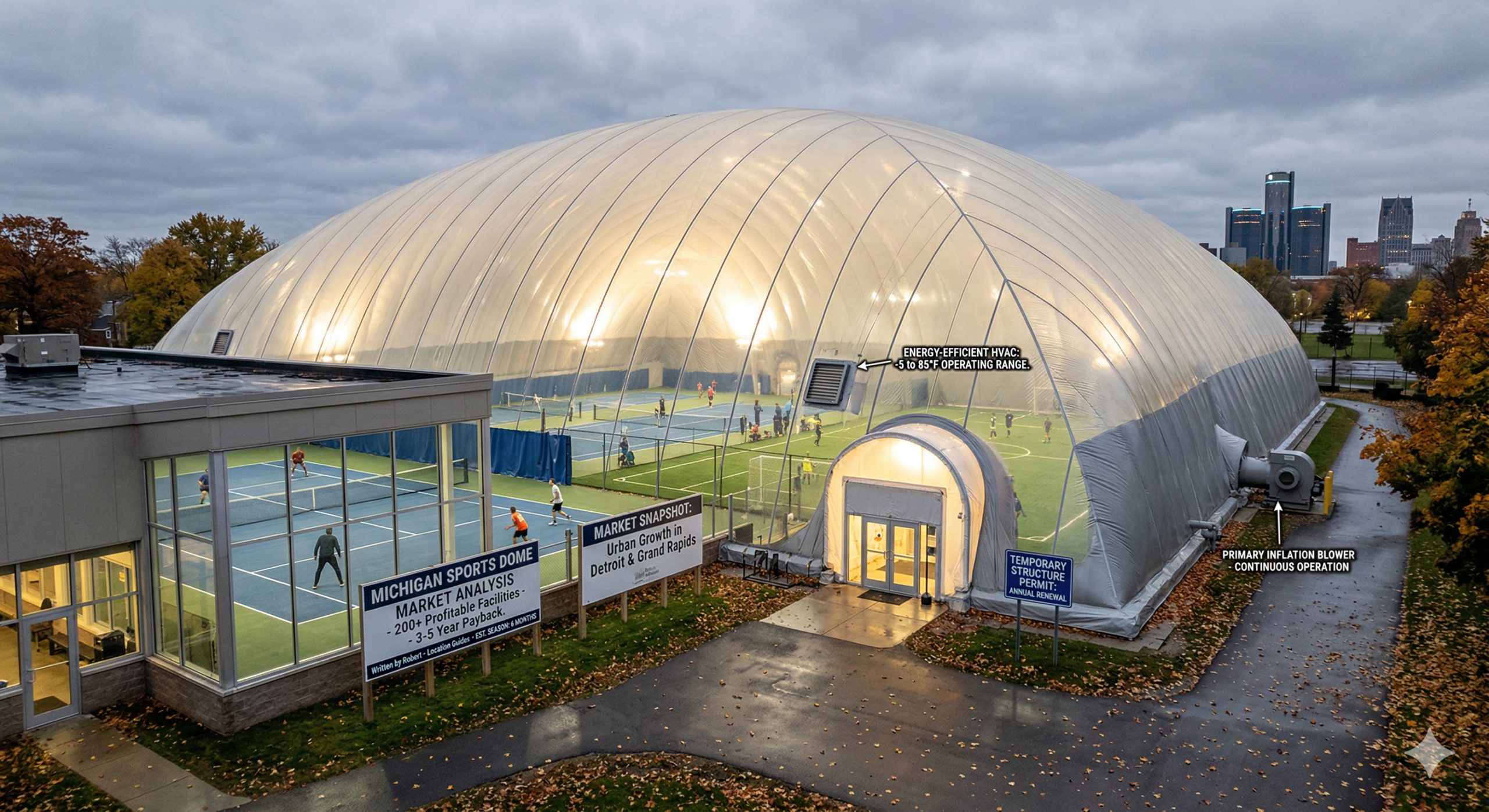
You’ll find Michigan’s sports dome market offers compelling investment potential that most entrepreneurs overlook. With over 200 profitable facilities already operating across the state, there’s proven demand driving consistent returns in urban markets like Detroit and Grand Rapids. The numbers tell a story of six-month operational seasons generating substantial revenue, but the real opportunity lies in understanding why these investments deliver 3-5 year payback periods while others struggle to break even.
Michigan Sports Dome Market: 200+ Facilities Drive Strong ROI
Michigan’s sports dome landscape showcases remarkable growth potential, with over 200 facilities already establishing profitable operations across the state.
You’ll find these structures dominating markets in Detroit and Grand Rapids, where demand for year-round sports facilities drives consistent revenue streams.
When you’re considering a Michigan air dome investment, you’re looking at proven financial returns. A typical 20,000 square foot facility generates ROI within 3-5 years, supported by the state’s six-month dome season that extends from late fall through early spring.
You’ll benefit from strong demand in tennis and soccer markets, where athletes need climate-controlled environments during Michigan’s harsh winters.
Most municipalities classify these as temporary structures, streamlining your permitting process and reducing regulatory barriers for faster market entry.
Why Michigan Dome Investments Return 3-5 Year Payback?
Three key factors drive Michigan’s exceptional sports dome ROI performance, creating investment returns that consistently outpace national averages.
First, you’ll benefit from Michigan’s extended six-month dome season, maximizing revenue potential when outdoor facilities can’t operate. Your Michigan sports facility will generate consistent income from November through April, capturing peak demand periods.
Second, strong market fundamentals support profitability. With 200+ existing facilities and concentrated demand in Detroit and Grand Rapids, you’re entering a proven market where tennis and soccer programs drive year-round bookings.
Third, favorable municipal regulations work in your favor. Most Michigan jurisdictions classify domes as temporary structures, reducing permitting costs and construction timelines.
These combined advantages create the foundation for your 3-5 year payback period on 20,000 square foot facilities.
Michigan’s 6-Month Dome Season Operating Requirements
Operating successfully during Michigan’s extended dome season requires specific preparation for challenging temperature swings and energy management.
You’ll need proper insulation designed for -5 to 85°F (-21 to 29°C) temperature variations throughout your six-month operational period. Your facility must maintain comfortable interior conditions while minimizing heating costs during harsh winter months.
Energy-efficient HVAC systems become essential for profitability in Michigan indoor sports facilities.
You’ll want to install programmable thermostats and consider radiant heating options that work effectively in large dome spaces. Proper ventilation prevents condensation issues that can damage equipment and create unsafe playing conditions.
Schedule maintenance during off-season months to avoid disruptions.
You’ll maximize revenue by planning tournaments and leagues during peak demand periods, typically October through March when outdoor alternatives aren’t available.
Municipal Permits: Why Most Michigan Domes Qualify As Temporary?
Because air-supported structures don’t require permanent foundations, most Michigan municipalities classify sports dome Michigan installations as temporary rather than permanent buildings. This classification notably simplifies your permitting process and reduces regulatory hurdles.
You’ll typically need basic temporary structure permits instead of complex building permits required for permanent construction. Most Michigan cities allow temporary installations for extended periods, often renewable annually. This means you won’t face the extensive architectural reviews, structural engineering requirements, or zoning complications associated with permanent buildings.
The temporary classification also offers flexibility for relocation if needed. You’ll save considerable time and money on permits, making your sports dome Michigan project more cost-effective.
However, you should verify specific municipal requirements, as some larger cities may have stricter regulations for commercial temporary structures.