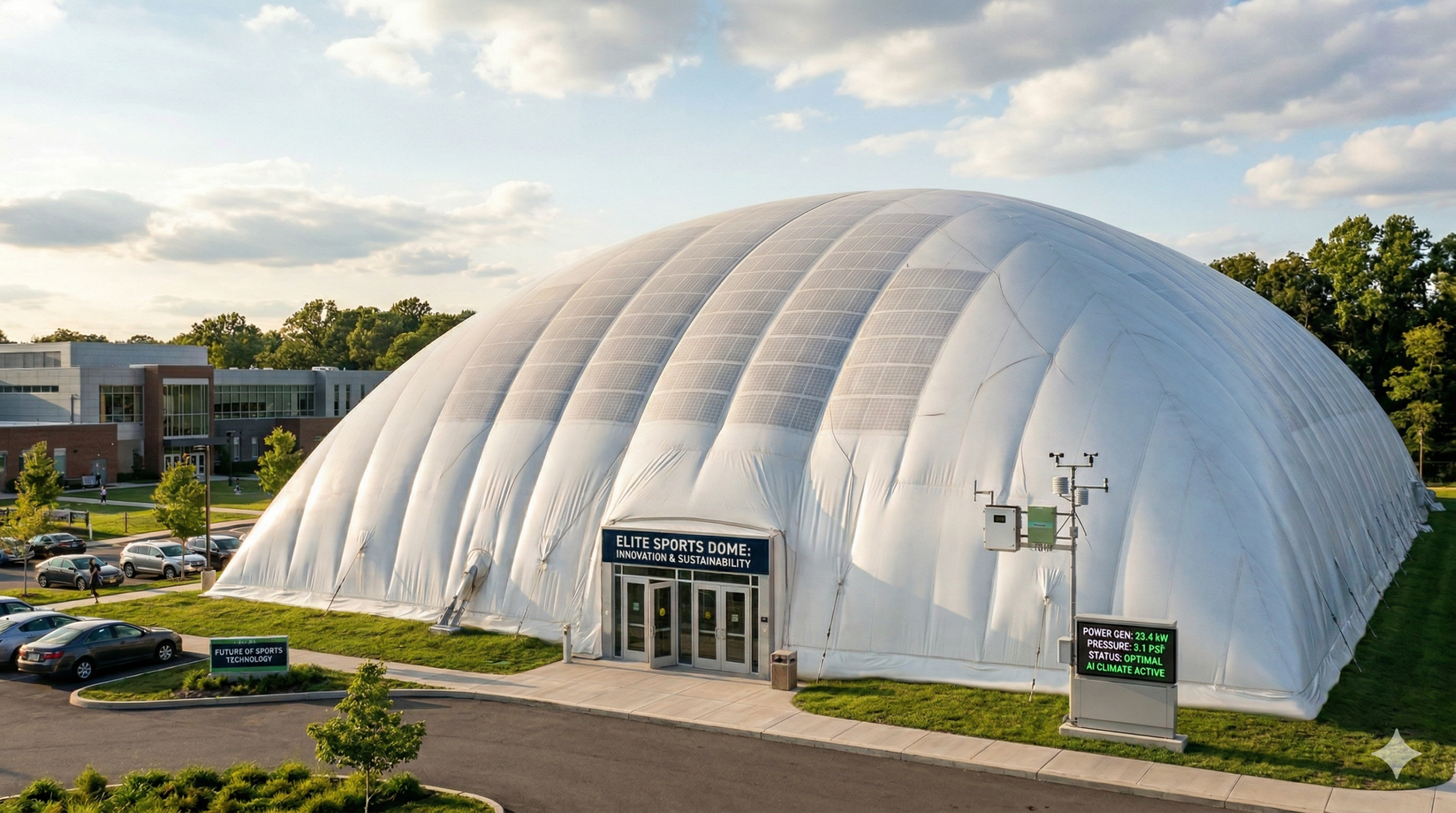
When you’re considering a multi-court tennis dome, you’ll face decisions that’ll determine your facility’s success for decades. The choice between a 2-court setup for intimate community play or a 6-court complex capable of hosting tournaments isn’t just about space—it’s about understanding your market’s needs and growth potential. But before you can finalize court layouts, there’s a critical foundation issue that most planners overlook, and it could dramatically impact your construction timeline and budget.
Tennis Dome Size Options: 2-Court, 4-Court, and 6-Court Layouts
Three primary dome configurations dominate tennis facility planning, each offering distinct advantages based on your operational goals and available space.
A 2-court multi court tennis dome requires 78′ x 200′ (15,600 sq ft), making it ideal for smaller communities or private clubs seeking cost-effective indoor play.
The 4-court layout expands to 120′ x 200′ (24,000 sq ft), providing better operational efficiency and revenue potential through increased court utilization.
For maximum capacity, 6-court facilities measure 120′ x 260′, accommodating tournaments and high-volume programs.
Each configuration should include a pro shop ranging from 400-800 sq ft for equipment sales and administrative functions.
Consider your membership size, budget constraints, and long-term growth projections when selecting your best multi court tennis dome configuration.
Tennis Dome Construction Costs and Budget Planning
Construction costs for multi-court tennis domes vary considerably based on size, materials, and regional factors.
2-court facilities typically range from $200,000-$350,000, while 6-court complexes can exceed $600,000-$900,000.
You’ll need to budget beyond the initial multiple tennis court bubble structure itself.
Site preparation, including excavation and foundation work, typically adds $15,000-$40,000 depending on soil conditions.
Electrical systems for lighting and HVAC require $20,000-$50,000, while proper ventilation systems cost another $25,000-$60,000.
Don’t overlook ongoing operational expenses when planning your budget.
Monthly utility costs range from $800-$2,500 depending on dome size and climate.
Annual maintenance, including fabric repairs and equipment servicing, typically runs $5,000-$15,000.
Factor in insurance premiums of $3,000-$8,000 annually for extensive coverage.
Foundation, Electrical, and HVAC Requirements
While tennis dome structures appear straightforward from the outside, you’ll need robust infrastructure systems to guarantee year-round playability and safety.
Your foundation must handle both the building’s weight and wind uplift forces, requiring engineered concrete footings that extend below frost lines.
For electrical systems, plan 200-amp service minimum for a 2-court tennis facility dome, scaling to 400-amp for 6-court layouts. You’ll need adequate lighting with 50-75 foot-candles uniformly distributed across playing surfaces.
HVAC systems prove critical for maintaining ideal playing conditions.
Design for 65-75°F temperatures with 45-55% humidity levels. Calculate one air change per hour minimum, with proper ventilation preventing condensation on dome surfaces.
Include emergency backup systems for power outages, ensuring your facility remains operational during extreme weather when indoor tennis becomes most valuable.
Heating and Ventilation Systems for Indoor Tennis Courts
Proper heating and ventilation systems form the backbone of successful indoor tennis operations, directly impacting player comfort, court conditions, and your facility’s energy costs. Your large tennis air dome requires specialized HVAC systems that maintain consistent temperatures while managing humidity levels and air circulation patterns.
| System Component | Specification | Benefits |
|---|---|---|
| Air Exchange Rate | 4-6 changes/hour | Prevents condensation, maintains air quality |
| Temperature Control | 60-70°F playing surface | Ideal player comfort, equipment protection |
| Humidity Management | 40-60% relative humidity | Prevents court damage, reduces injury risk |
You’ll need to install multiple air handling units with variable speed controls to accommodate different occupancy levels. Position intake and exhaust vents strategically to eliminate dead air zones while preventing drafts that could affect ball trajectory during play.