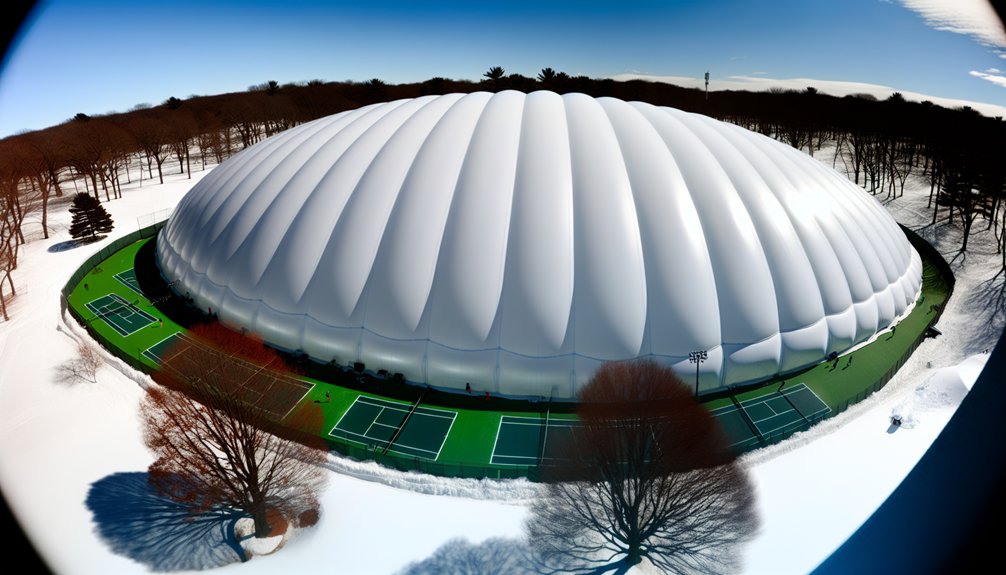
You’ve probably watched your tennis facility’s revenue plummet during winter months, forcing you to close courts and cancel programs when weather turns harsh. Tennis air domes offer a game-changing solution that can extend your playing season by 6-8 months while generating an additional $120K to $250K per court annually. But here’s what most facility owners don’t realize about the true costs, ideal climate zones, and specific features that determine whether your air dome investment will succeed or fail.
How Tennis Air Domes Work: Extending Your Season 6-8 Months
When winter temperatures drop below freezing, tennis air domes create a controlled environment that transforms outdoor courts into year-round facilities.
Your year round tennis air dome uses pressurized air to maintain structural integrity, with fabric membranes designed to withstand winds up to 90 mph and snow loads exceeding 30 pounds per square foot.
The indoor tennis dome operates in climates from -10°F to 90°F, making it ideal for northern regions in zones 5-7.
You’ll maintain consistent playing conditions regardless of external weather through automated climate control systems that regulate temperature, humidity, and air circulation.
Your winter tennis facility extends the playing season by 6-8 months, enabling continuous operation when outdoor courts become unusable.
This technology eliminates weather-related cancellations while protecting players from harsh conditions.
Climate Zones Perfect for Tennis Air Dome Installation
If you’re located in northern climate zones 5-7, you’ve found the sweet spot for tennis air dome installation.
These regions experience temperature ranges from -10°F to 90°F (-23°C to 32°C), creating the perfect conditions where domes provide maximum seasonal extension without excessive energy costs.
You’ll get the most value from your investment in these climates since they offer distinct seasons that naturally limit outdoor play for several months.
Northern Zone Temperature Ranges
As temperatures plummet in northern climates, tennis air domes become essential infrastructure for maintaining year-round play.
You’ll find these structures most beneficial in USDA hardiness zones 5-7, where winter temperatures drop to -10°F (-23°C) and summer peaks reach 90°F (32°C). This dramatic temperature swing makes outdoor tennis impossible for 6-8 months annually without protection.
Your all season tennis dome creates a controlled environment that maintains ideal playing conditions regardless of external weather.
These temperature extremes define the sweet spot where air dome investment pays off dramatically. Southern regions don’t experience enough cold months to justify costs, while far northern zones face heating expenses that reduce profitability.
You’re targeting the perfect climate zone where seasonal limitations create maximum demand for covered court solutions.
Optimal Installation Climate Conditions
Beyond temperature ranges, you’ll maximize your air dome investment by selecting locations with specific climate patterns that create sustained demand.
Target areas where outdoor tennis becomes impossible for 4-6 consecutive months, creating desperate players yearning for indoor alternatives.
Prime installation zones feature:
- Harsh winters with heavy snow – Players can’t access outdoor courts from December through March, forcing them to abandon their tennis routines or pay premium rates for your covered facility.
- Unpredictable spring weather – Late freezes and persistent rain create frustrated tennis enthusiasts who’ll gladly pay for guaranteed court time.
- Short outdoor seasons – Limited playing months mean concentrated demand when you’re the only game in town.
You’ll capture maximum revenue where climate creates genuine necessity, not mere convenience.
Revenue Boost: $120K to $250K Additional Income Per Court
A single court air dome covering 7,200 square feet can generate between $120,000 and $250,000 in additional annual revenue for your tennis facility.
This substantial income boost comes from extending your operational season by 6-8 months in northern climates where temperatures drop as low as -10°F.
You’ll capture revenue through winter lessons, which alone can increase your earnings by 60%.
Year-round leagues provide consistent monthly income, while tournament hosting brings in substantial weekend revenues.
Your facility becomes a regional destination when competitors shut down for winter months.
The dome transforms dead winter months into profitable periods.
Members who’d normally cancel memberships stay active, and you’ll attract new players seeking indoor courts during harsh weather conditions.
Air Dome Installation Costs vs. Long-Term ROI
You’ll need to weigh the upfront air dome installation costs against the substantial long-term returns on your investment.
The initial expense includes the dome structure, foundation work, and mechanical systems, but revenue starts flowing immediately once you’re operational.
Most facilities see full payback within 3-5 years, after which the additional $120K-$250K annually becomes pure profit enhancement.
Initial Investment Breakdown
While the upfront costs of air dome installation might seem substantial, the long-term financial returns make this investment increasingly attractive for tennis facility owners. You’re looking at several key components that determine your total investment.
The primary expenses include:
- Dome structure and materials – High-quality fabric, anchoring systems, and weather-resistant components that’ll withstand harsh northern winters.
- Installation and site preparation – Professional setup, ground work, and utility connections that guarantee proper functionality.
- Heating and ventilation systems – Energy-efficient equipment that maintains ideal playing conditions year-round.
For a single court covering 7,200 square feet, you’ll typically invest between $80,000-$150,000 total.
However, with potential additional revenue of $120K-$250K annually, most facilities recover their investment within 12-18 months while extending their season by 6-8 months.
Revenue Generation Timeline
Breaking down the revenue generation timeline reveals how quickly your air dome investment pays for itself through multiple income streams.
You’ll see immediate returns once installation’s complete, typically generating $120K-$250K additional revenue annually from a single covered court.
Your winter lesson programs launch immediately, capturing that essential 60% revenue boost during previously dormant months.
Year-round leagues start within weeks, filling evening and weekend slots that weather once canceled.
Tournament hosting becomes viable throughout extended seasons, attracting regional events and their associated fees.
Most operators achieve break-even within 2-3 years, depending on local market conditions and pricing strategies.
The 6-8 month season extension in northern climates transforms your facility from seasonal operation into consistent revenue generator, maximizing return on every square foot of court space.
Payback Period Analysis
Three key factors determine your air dome’s payback period: initial installation costs, annual revenue increases, and operational expenses.
Most tennis facility owners see complete cost recovery within 3-5 years, with single-court installations averaging $80,000-$150,000 upfront investment.
Your revenue calculations should include:
- Winter lesson programs – capturing 60% more annual income during previously dead months
- Year-round league fees – consistent membership retention instead of seasonal dropoffs
- Tournament hosting revenue – becoming the go-to venue when outdoor courts aren’t viable
Smart financing options reduce immediate cash flow impact.
You’ll typically break even by year four, then enjoy pure profit for the dome’s 15-20 year lifespan.
Consider maintenance costs, heating expenses, and insurance adjustments when calculating your specific ROI projections.
High-Revenue Winter Programs: Leagues, Lessons, and Tournaments
Transform your enclosed tennis facility into a revenue powerhouse during winter months by launching strategic programming that capitalizes on increased demand for indoor play.
You’ll discover that winter lessons generate the highest profit margins, with players enthusiastic to maintain skills during off-season. Adult leagues become particularly lucrative as outdoor courts close, creating captive audiences willing to pay premium rates for consistent playing opportunities.
Tournament hosting provides additional revenue streams through entry fees, concessions, and equipment sales. You can schedule weekend tournaments that attract players from surrounding regions seeking competitive indoor venues.
Private lessons command higher rates during winter months due to limited facility availability. Corporate groups and clinics fill weekday slots, while junior programs expand as parents seek structured indoor activities.
These diverse programming options maximize court utilization and revenue potential.
Single vs. Multi-Court Air Domes: Sizing for Maximum Profit
While single-court air domes require lower upfront investment, multi-court facilities deliver exponentially higher profits through economies of scale and programming flexibility.
You’ll maximize revenue density with multi-court configurations. A single 7,200 sq ft dome generates $120K-$250K annually, but two courts sharing infrastructure costs dramatically improve your profit margins.
Multi-court facilities enable simultaneous programming—leagues, lessons, and tournaments running concurrently.
Consider these profit multipliers:
- Shared operational costs – One heating/cooling system, single entrance, reduced staffing per court
- Premium tournament hosting – Multi-court events command higher facility fees and attract sponsors
- Flexible scheduling – Different skill levels, age groups, and programs operating simultaneously without conflicts
Single-court domes work for smaller operations, but multi-court facilities typically achieve 40-60% better profit per square foot through operational efficiency and programming versatility.
Tennis Air Dome Features That Maximize Year-Round Play
Beyond choosing the right size configuration, specific air dome features determine whether your facility truly delivers profitable year-round operation or becomes a seasonal headache.
Your dome’s foundation system must handle extreme temperature swings without compromising structural integrity. Look for reinforced concrete foundations with proper drainage systems that prevent ice damage and water pooling.
Climate control systems separate successful operations from failed investments. You’ll need redundant heating units, automated ventilation, and humidity controls that maintain 65-75°F playing temperatures regardless of outside conditions.
| Essential Feature | Revenue Impact |
|---|---|
| LED lighting system | Extends daily hours 4-6 |
| Emergency backup power | Prevents costly shutdowns |
| Automated entry systems | Reduces staffing costs 30% |
| Court surface heating | Eliminates condensation issues |
| Sound dampening panels | Enables simultaneous bookings |
These investments directly translate into consistent year-round bookings and premium pricing during winter months.