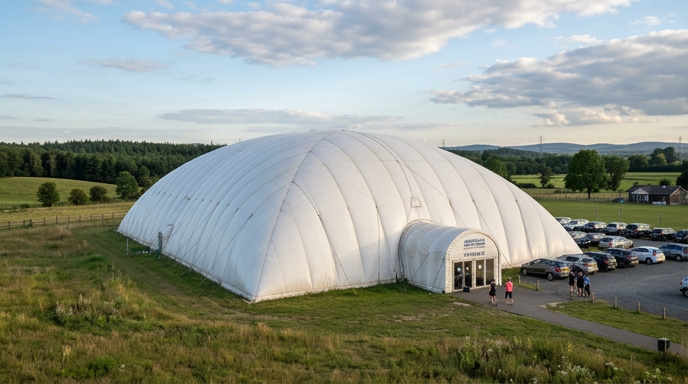
You can expect a complete return on your air dome investment within 2-5 years, with proven facilities generating $560,000 in revenue during just eight months of operation. Construction costs range from $1-4.6 million depending on your sport, while annual operating expenses stay low at $3-6 per square foot. You’ll benefit from 30% membership growth through year-round programming, plus additional income of $150K-$300K annually. The specifics of financing options and break-even calculations will help you maximize your facility’s profit potential.
Air Dome ROI Basics: Investment Returns for Sports Facilities
When you’re evaluating air dome investments for your sports facility, the financial returns consistently demonstrate compelling value across multiple revenue streams.
Your air dome ROI calculations should factor in the proven $560,000 revenue generation achieved by single facilities in just eight months, alongside 30% membership growth from shifting seasonal operations to year-round programming.
You’ll find comparable facilities consistently double their total revenue through expanded programming capabilities.
The investment threshold sits in the mid-six-figure range, but you’re looking at construction costs 50-75% lower than permanent structures. The quick installation process of 2-14 days means your facility can begin generating revenue almost immediately after project approval.
With $93,600 annualized profit potential and payback periods of 2-3 years for clubs, your facility gains 1,800 additional operational hours annually while eliminating weather-related cancellations that previously impacted revenue.
Construction Costs by Sport: Tennis, Baseball, Soccer, and More
Construction costs vary dramatically across sports, with your investment ranging from $1,000,000 for basic pickleball facilities to $4,600,000 for premium football domes. Understanding these variations helps you calculate accurate sports dome return on investment projections for your specific facility needs.
| Sport | Construction Cost Range |
|---|---|
| Pickleball | $1,000,000 – $2,600,000 |
| Tennis | $1,400,000 – $2,900,000 |
| Soccer | $2,100,000 – $4,200,000 |
| Baseball | $1,600,000 – $4,200,000 |
| Football | $2,200,000 – $4,600,000 |
Tennis and pickleball represent the most cost-effective entry points, while football commands premium pricing due to field size requirements. All costs include foundations, flooring, air-supported structures, lighting, and amenities. You’ll save 50-75% compared to traditional permanent structures while achieving faster installation timelines. Short lead times allow for functional buildings to be completed within months, significantly accelerating your facility’s revenue generation timeline.
Financing and Revenue Strategies for Year-Round Facilities
Smart financing transforms your air dome project from concept to profitable reality. You’ll access indoor facility revenue potential through diverse funding approaches that match your specific situation and goals.
Traditional financing options include:
- Bank loans and specialized lenders – Grenke Leasing and LED.Finance offer tailored solutions for business facility projects.
- Government grant programs – UPARR assessments, CDBG funding, and NRPA grants provide public funding opportunities.
- Revenue-sharing partnerships – Private investors fund construction in exchange for revenue splits during contract periods.
- Community-based funding – Professional fundraising campaigns, crowdfunding platforms, and donor networks with naming rights incentives.
For individuals pursuing smaller-scale projects, personal financing options are available up to $100,000 through specialized providers.
You can also generate immediate revenue through multi-year team agreements, corporate sponsorships, advertising sales, and general community rentals to accelerate your payback timeline.
Operating Expenses: Electricity, Maintenance, and Hidden Costs
Understanding your air dome’s true operating costs prevents budget surprises and guarantees long-term profitability.
You’ll face annual operating expenses of $3-$6 per square foot, with electricity comprising the largest component. A two-court dome consumes 83.2kW daily, costing approximately £12.48 for blowers and lighting combined.
Your three-court facility operating four months annually averages $60,000-$80,000 in expenses. Air dome structures deliver electricity consumption that is 10%-25% of traditional structures, creating substantial savings compared to conventional buildings.
Beyond electricity, you’ll encounter maintenance costs for air blower systems, LED lighting assemblies, HVAC equipment, and sports flooring replacement.
Regional electricity rates and seasonal usage patterns greatly impact your bottom line. Winter heating demands increase energy consumption, while summer cooling affects HVAC costs.
Sports dome profitability improves through motion-sensing lighting systems and intelligent climate controls that adjust operations based on weather conditions.
Break-Even Timeline: When Air Domes Start Paying Off
With operating expenses mapped out, you’ll want to know exactly when your air dome investment starts generating profit. The tennis bubble payback period typically ranges from 2-3 years for private clubs and 3-5 years for schools, depending on your facility’s utilization rates and local market conditions.
Your break-even timeline depends on four critical factors:
- Initial investment size – Mid-six-figure investments require higher annual revenues to achieve quicker payback.
- Seasonal revenue boost – Year-round programming generates $150K-$300K additional annual income.
- Hourly rental rates – Tennis courts earning $60-$120/hour notably impact recovery speed.
- Operational efficiency – Lower operating costs at $3-$6 per square foot accelerate profitability.
Most facilities reach profitability faster than traditional permanent structures due to lower construction costs and immediate revenue generation capabilities. Air domes offer quick setup advantages that allow facilities to start earning revenue almost immediately after installation.
Frequently Asked Questions
What Insurance Coverage Is Required for Air-Supported Dome Facilities?
You’ll need liability, property, and casualty insurance for your air dome facility.
Specialized coverage should include damage assessment for structural and mechanical equipment failure, plus weather-related protection against wind, snow, and storms.
Your facility must comply with IBC Type II-B construction standards and A-4 occupancy classification.
You’re required to conduct annual NFPA 102 inspections and biennial professional assessments to maintain insurance eligibility and favorable premium rates.
How Do Extreme Weather Conditions Affect Dome Structural Integrity and Operations?
You’ll find extreme weather considerably impacts your dome’s operations.
High winds up to 120 mph are manageable with proper engineering, but you’ll need emergency deflation protocols for severe conditions.
Snow loads can cause catastrophic collapse if your cable systems aren’t adequate.
Temperature extremes require robust climate control – you’ll spend more on heating/cooling during harsh weather.
Regular maintenance becomes critical, and you’ll need backup pressure systems to prevent complete deflation from membrane tears.
Can Existing Outdoor Courts Be Converted to Air Dome Facilities?
Yes, you can convert your existing outdoor courts to air dome facilities within just 5 days from foundation completion.
You’ll need proper anchoring systems based on soil conditions and local wind codes, plus professional engineering assessment.
The installation’s labor-intensive, requiring 20-30 workers, but you’ll transform your outdoor space into a weatherproof, all-season venue without extended delays.
Your courts become climate-controlled with unobstructed interior space through continuous overpressure.
What Permits and Zoning Approvals Are Needed for Dome Installation?
You’ll need building permits with structural engineer-stamped designs as the primary requirement.
Contact your building department first to confirm their specific requirements beyond engineer approval.
You’ll also need zoning compliance verification, plus water and septic permits in most counties.
Soil testing and site plans are mandatory.
Your structural design must address local seismic zones, wind resistance, and snow loads based on your region’s extreme weather factors.
How Does Dome Collapse Risk Impact Liability and Safety Protocols?
You’ll face significant liability exposure during deflation events, requiring thorough safety protocols.
Power loss creates immediate collapse risk, so you must install backup systems and real-time pressure monitoring.
You’ll need emergency evacuation procedures since deflation, while gradual, can injure occupants.
Insurance costs increase due to weather vulnerability and equipment damage risks.
You must establish weather monitoring protocols, staff training programs, and structured assembly/disassembly procedures to minimize liability exposure.