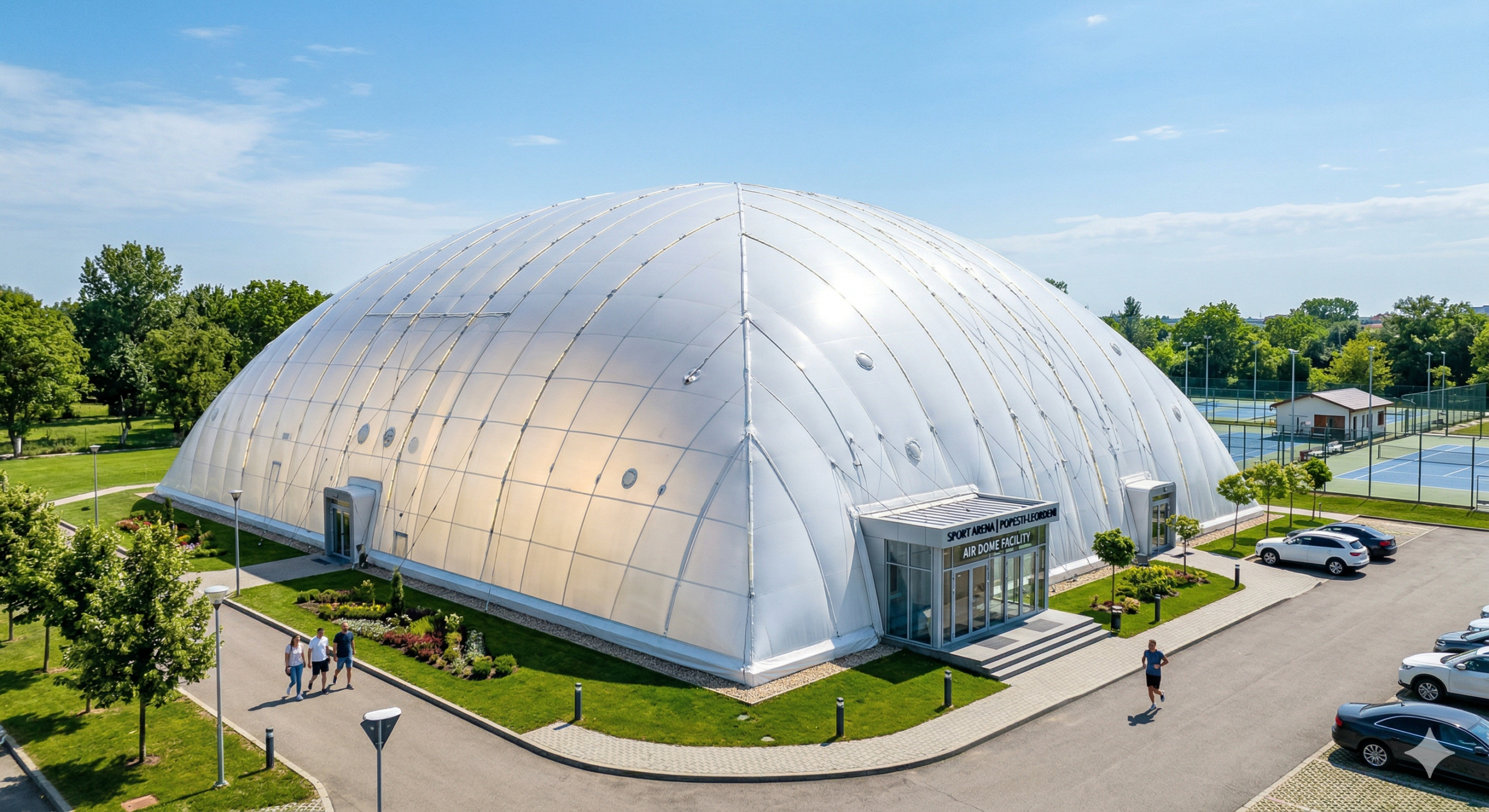
You’re considering a commercial sports dome, but the financial landscape is more complex than you might expect. While construction costs can range from $1.5M to $4M depending on your vision, that’s just the beginning of your investment journey. The real challenge lies in understanding how site preparation, revenue potential, and ongoing operating expenses will impact your bottom line. What you don’t know about financing options and profit margins could make or break your entire project.
Sports Dome Construction Costs By Size And Features
Three primary factors determine your commercial sports dome’s total construction cost: facility size, structural complexity, and interior features. A standard 50,000-square-foot facility typically costs $1.5M-$2.5M, while larger 100,000-square-foot complexes reach $3M-$4M installed.
Your commercial sports dome cost increases with premium features like specialized flooring systems, advanced HVAC, and LED lighting packages.
Multi sport complex cost varies markedly based on court configurations. Basketball, volleyball, and tennis courts require different subflooring and net systems.
You’ll pay more for facilities accommodating football, soccer, or baseball due to ceiling height requirements and specialized turf systems.
Your commercial indoor facility cost also includes essential amenities like locker rooms, concession areas, and pro shops.
These revenue-generating spaces add 15-25% to base construction costs but greatly boost your facility’s earning potential and customer satisfaction.
Revenue Potential And Profit Margins For Indoor Sports Facilities
While construction costs represent your largest upfront investment, commercial sports domes generate substantial revenue through diverse income streams. Your 50,000-100,000 sq ft facility can produce $400K-$800K annually through court rentals, league fees, tournaments, camps, and retail sales from your pro shop.
Revenue sources include hourly court rentals ($50-150), seasonal league registrations ($100-300 per player), birthday parties ($200-500), corporate events, and equipment sales.
Peak hours command premium pricing, while off-peak slots maintain steady cash flow.
Profit margins typically range 15-25% after operating expenses including utilities, staff, insurance, and maintenance.
Large sports facility pricing strategies should balance competitive rates with premium services. Your multi-sport capability maximizes utilization year-round, as different sports peak during various seasons, ensuring consistent revenue generation.
Financing Options And Loan Terms For Sports Dome Projects
You’ll find commercial lending programs specifically designed for sports facility projects that understand the unique revenue streams and operational requirements of indoor sports complexes.
Most lenders offer 15-20 year loan terms for sports dome financing, allowing you to spread the $1.5M-$4M investment across manageable monthly payments.
These specialized loan structures typically consider your projected annual revenue of $400K-$800K when determining qualification criteria and payment schedules.
Commercial Lending Programs
Since commercial sports dome projects require substantial upfront capital, specialized lending programs have emerged to serve this growing market segment. You’ll find traditional banks, SBA lenders, and equipment financing companies offering tailored solutions for dome construction.
These programs typically recognize the unique revenue potential of multi-sport facilities and structure loans accordingly.
Most commercial lending programs for sports domes offer:
- 15-20 year terms with competitive interest rates based on your creditworthiness
- 80-90% financing covering construction, equipment, and initial working capital needs
- Revenue-based qualification considering projected annual income of $400K-$800K
- Flexible structures including construction-to-permanent loans and equipment financing options
You’ll need thorough business plans, market analysis, and financial projections to qualify.
Many lenders require personal guarantees and down payments of 10-20% for projects in this $1.5M-$4M range.
Loan Term Structures
Traditional term loans provide predictable payments over 15-20 years, making budgeting straightforward.
Construction-to-permanent loans reduce closing costs by combining two loans into one while allowing you to pay only interest during the construction phase.
Equipment financing enables you to spread costs across different loan terms based on asset depreciation schedules, potentially lowering your overall borrowing costs.
Site Preparation And Foundation Costs For Sports Domes
You’ll need thorough soil testing before breaking ground to determine load-bearing capacity and drainage requirements for your sports dome foundation.
Excavation and grading costs vary considerably based on your site’s topography, existing utilities, and soil conditions that may require special handling.
Your foundation system choice—whether concrete slab, pier and beam, or specialized dome anchoring—directly impacts both upfront costs and long-term structural integrity.
Soil Testing Requirements
Before construction begins on your commercial sports dome, thorough soil testing determines the foundation requirements and potential site challenges that’ll impact your overall project budget.
Professional geotechnical engineers conduct detailed soil analysis to evaluate bearing capacity, drainage characteristics, and potential settlement issues. This testing typically costs $3,000-$8,000 but prevents costly surprises during construction that could add tens of thousands to your project.
Key soil testing components include:
- Boring samples – Core samples taken at various depths to analyze soil composition and stability
- Percolation tests – Measure drainage rates to determine if additional drainage systems are needed
- Bearing capacity analysis – Calculates maximum load the soil can support for your dome’s foundation design
- Contamination screening – Identifies any environmental hazards requiring remediation before construction
Poor soil conditions may require specialized foundations, increasing your site preparation costs considerably.
Excavation And Grading
Once soil testing confirms your site conditions, excavation and grading work begins to prepare the foundation area for your commercial sports dome.
You’ll need to excavate 2-4 feet deep for most dome foundations, with deeper excavation required for areas with poor soil conditions or frost lines.
Excavation costs range from $3-8 per cubic yard, depending on soil type and accessibility. Rocky or clay soils increase costs considerably.
You’ll also need proper grading to guarantee adequate drainage away from the structure.
Expect to pay $15,000-$45,000 for excavation and grading on a 50,000-100,000 sq ft dome project.
Additional costs include hauling away excess soil, importing fill material if needed, and creating access roads for construction equipment.
Proper site preparation prevents costly foundation issues later.
Foundation System Options
After completing excavation and grading, you’ll need to choose the right foundation system for your commercial sports dome. The foundation type directly impacts your project’s structural integrity and long-term costs. Your choice depends on soil conditions, local climate, and dome specifications.
Most commercial sports domes use these foundation options:
- Concrete slab foundation – Most common for stable soil conditions, costs $8-12 per square foot
- Stem wall foundation – Better for frost-prone areas, includes perimeter walls above grade level
- Pile foundation – Required for poor soil conditions or high water tables, increases costs considerably
- Heated slab system – Prevents frost heave in cold climates, adds radiant heating elements
Your structural engineer will recommend the appropriate system based on geotechnical reports and local building codes.
Indoor Court Layouts And Multi-Sport Configuration Options
When planning your commercial sports dome, you’ll need to maximize every square foot through strategic court layouts that accommodate multiple sports simultaneously.
| Court Configuration | Sports Accommodated |
|---|---|
| 4 Basketball Courts | Basketball, volleyball, badminton, futsal |
| 2 Tennis + 2 Basketball | Tennis, pickleball, basketball, volleyball |
| Open Field Layout | Soccer, lacrosse, field hockey, football |
You can optimize revenue by designing convertible spaces with removable nets and adjustable court markings. Basketball courts work perfectly for volleyball when you lower the nets. Tennis courts double as pickleball venues with temporary net adjustments.
Consider installing retractable divider curtains to create separate rental zones during peak hours. This flexibility allows you to host tournaments while maintaining regular programming in adjacent areas, greatly boosting your facility’s earning potential.
Annual Operating And Maintenance Costs For Sports Domes
Three major expense categories will shape your sports dome’s annual operating budget: utilities, staffing, and facility maintenance.
Your heating and cooling systems will consume the largest portion of utility costs, typically ranging from $40,000-$80,000 annually for facilities between 50,000-100,000 square feet.
Staff wages for managers, maintenance personnel, and part-time court attendants will add another $120,000-$200,000 yearly.
Key annual maintenance expenses include:
- HVAC system servicing – $8,000-$15,000 for regular tune-ups and repairs
- Dome membrane inspection – $5,000-$12,000 for structural assessments and minor repairs
- Court surface maintenance – $10,000-$25,000 for resurfacing and line painting
- Equipment replacement – $15,000-$30,000 for nets, goals, and recreational equipment
Plan for total operating costs between $200,000-$350,000 annually.
Permits And Legal Requirements For Sports Dome Construction
Building a commercial sports dome requires overcoming several regulatory hurdles before you can break ground on your project. You’ll need building permits, zoning approvals, and structural engineering certifications for your dome’s unique design. Environmental impact assessments may be required depending on your location and size.
| Permit Type | Timeline |
|---|---|
| Building Permit | 4-8 weeks |
| Zoning Approval | 6-12 weeks |
| Environmental Review | 8-16 weeks |
Fire safety compliance is essential since domes house large crowds. You’ll need sprinkler systems, emergency exits, and accessibility features meeting ADA standards. Electrical permits cover lighting systems and HVAC installations. Some municipalities require special use permits for commercial recreation facilities. Budget $15,000-$50,000 for permit fees and consultant costs. Start the permitting process 6-12 months before construction.