Tag: sports domes

  • Scandinavia Sports Dome Market

    Scandinavia Sports Dome Market

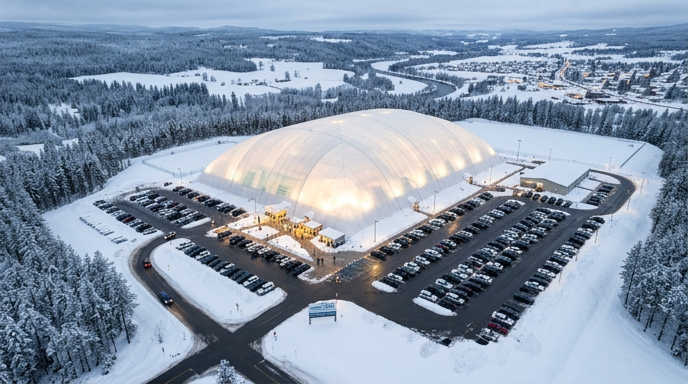
    You’ve likely noticed the surge in dome-shaped sports facilities across Sweden, Norway, and Denmark—and there’s a compelling reason behind this architectural shift. These aren’t just trendy buildings; they’re strategic investments that solve a fundamental Nordic challenge: maintaining athletic performance when winter temperatures plummet to -30°C and snow loads threaten traditional structures. What’s driving this 15-20% annual market growth isn’t just weather resistance, but something far more profitable.

    Why Scandinavian Sports Domes Are Essential for Year-Round Training

    When temperatures plummet to -30°F and snow blankets the ground for months, you can’t rely on outdoor facilities to maintain consistent training schedules. A Scandinavia air dome solves this challenge by providing controlled environments that operate efficiently across extreme temperature ranges from -34°C to 21°C.

    You’ll find Sweden sports dome facilities leading the market with over 100 installations, demonstrating their proven effectiveness for athletic development. These structures handle massive 50+ PSF snow loads while maintaining ideal interior conditions for football, tennis, and multi-sport training.

    Norway indoor facility demand continues growing as coaches recognize the competitive advantage of uninterrupted training cycles.

    You’re investing in athlete performance when harsh weather would otherwise force cancellations or less-than-ideal outdoor conditions that limit skill development.

    Extreme Weather Requirements: Snow Loads and Arctic Temperature Design

    Building successful sports domes in Scandinavia demands engineering solutions that withstand nature’s most punishing conditions. Your nordic sports facility must handle extreme temperature swings from -30°F to 70°F (-34°C to 21°C) while supporting massive snow loads exceeding 50 PSF (2.39 kPa).

    Critical design requirements include:

    1. Maximum insulation systems – Multi-layer thermal barriers prevent heat loss and structural damage from freeze-thaw cycles.
    2. Reinforced structural frameworks – Heavy-duty support systems distribute snow weight evenly across the dome surface.
    3. Advanced heating integration – Efficient climate control maintains consistent interior temperatures despite arctic exterior conditions.

    These specifications aren’t optional luxuries—they’re survival necessities.

    Without proper engineering, your facility risks catastrophic collapse under snow accumulation or prohibitive heating costs that’ll drain your budget throughout Scandinavia’s brutal winters.

    Sports Dome Construction Costs in Sweden, Norway, and Denmark

    You’ll face construction costs that are 20-30% higher than typical US projects when building sports domes across Scandinavia.

    Sweden’s established market of 100+ facilities creates competitive pricing, while Norway’s growing demand and Denmark’s strict building codes each present unique cost structures.

    Your biggest expense drivers won’t just be materials and labor – the extreme climate requirements for insulation, heating systems, and snow load engineering greatly impact your total project budget.

    Climate Impact on Costs

    Since Scandinavian winters deliver extreme temperatures as low as -30°F (-34°C) and snow loads exceeding 50 PSF, you’ll face construction costs that run 20-30% higher than typical US projects.

    These harsh conditions demand specialized engineering solutions that greatly impact your budget.

    The extreme climate forces three major cost increases:

    1. Enhanced insulation systems – You’ll need premium materials and thicker wall assemblies to maintain interior temperatures efficiently.
    2. Reinforced structural design – Heavy snow loads require stronger steel frameworks and enhanced foundation systems.
    3. Advanced heating infrastructure – High-capacity HVAC systems must handle the massive temperature differential from -30°F to 70°F.

    Your investment pays off through year-round operation capabilities, making these facilities profitable despite higher upfront costs in Sweden’s 100+ dome market.

    Regional Price Variations

    Construction costs vary considerably across Scandinavian countries, with Sweden leading at $45-65 per square foot, followed by Norway at $40-60, and Denmark at $35-55 per square foot for sports dome projects.

    Country Cost Range ($/sq ft) Key Factors
    Sweden $45-65 High labor costs, strict building codes
    Norway $40-60 Oil economy wages, remote logistics
    Denmark $35-55 Moderate regulations, better access
    Finland $38-58 Harsh climate requirements
    Iceland $50-70 Extreme isolation, material imports

    You’ll find Sweden’s premium pricing stems from stringent environmental regulations and Europe’s highest construction wages. Norway’s costs reflect oil-driven labor markets, while Denmark offers the most competitive pricing due to efficient supply chains and moderate building requirements. Finland balances affordability with extreme weather demands.

    Material and Labor Expenses

    While regional pricing differences tell part of the story, breaking down material and labor expenses reveals the true cost drivers behind Scandinavian sports dome construction.

    You’ll face premium costs for specialized materials that withstand extreme weather conditions. High-grade insulation systems, reinforced structural components, and cold-weather concrete additives typically cost 25-40% more than standard alternatives.

    Labor expenses further inflate your budget, with skilled construction workers commanding higher wages due to harsh working conditions and specialized expertise requirements.

    Your primary expense categories include:

    1. Structural materials – Reinforced steel and engineered lumber designed for 50+ PSF snow loads
    2. Advanced insulation systems – Multi-layer thermal barriers for -30°F temperature resistance
    3. Specialized labor – Cold-weather construction expertise and extended project timelines

    These factors combine to create the 20-30% cost premium you’ll encounter compared to standard dome construction.

    Top Scandinavian Sports Dome Manufacturers Worth Considering

    Several established manufacturers dominate Scandinavia’s sports dome market, each bringing unique expertise to tackle the region’s demanding climate conditions. You’ll find these companies specialize in extreme weather engineering, delivering structures that withstand brutal winters while maintaining energy efficiency.

    Manufacturer Strength Your Benefit
    Advanced insulation systems 40% lower heating costs
    Reinforced frame engineering Survives 60+ PSF snow loads
    Local service networks 24-hour emergency support

    When you’re evaluating manufacturers, prioritize those with proven Scandinavian installations. Look for companies offering extensive warranties covering harsh climate performance. Sweden’s market leaders typically provide turnkey solutions including foundation design, heating integration, and ongoing maintenance contracts. You’ll want manufacturers who understand local building codes and can navigate complex permitting processes efficiently.

    When you’re investing in Nordic sports domes, you’ll find ice hockey leads the market due to Scandinavia’s deep cultural connection to the sport.

    However, you can’t ignore the growing trend toward multi-sport facilities that maximize year-round usage and revenue potential.

    These versatile domes allow you to accommodate everything from soccer and tennis to track and field events under one climate-controlled structure.

    Ice Hockey Dominance

    As temperatures plummet across Scandinavia each winter, ice hockey emerges as the undisputed champion driving sports dome investments throughout the Nordic region.

    You’ll find that this sport’s massive popularity creates year-round demand for enclosed facilities, especially when outdoor rinks become unusable during extreme weather conditions.

    The ice hockey boom translates into substantial infrastructure requirements that you can’t ignore:

    1. Multiple rink configurations – Full-size competition rinks alongside practice areas maximize facility utilization.
    2. Specialized climate control – Maintaining ice quality while providing comfortable spectator zones requires advanced HVAC systems.
    3. Premium viewing amenities – Heated concourses, restaurants, and corporate boxes generate additional revenue streams.

    Sweden’s 100+ sports domes primarily serve hockey communities, while Norway’s expanding market follows similar patterns.

    You’re witnessing unprecedented investment levels as municipalities recognize hockey’s economic impact on local development.

    While ice hockey drives initial dome construction across Nordic markets, you’ll discover that successful facilities increasingly diversify beyond single-sport models to maximize year-round revenue potential.

    You can transform traditional ice rinks into multi-purpose venues by installing removable flooring systems that accommodate soccer, basketball, volleyball, and tennis during off-seasons.

    You’ll find that Sweden’s most profitable domes generate 40% more revenue through multi-sport programming compared to hockey-only facilities.

    Norwegian operators are following this trend, adding indoor track surfaces and climbing walls to attract broader demographics.

    You can optimize your investment by designing flexible spaces that convert quickly between sports configurations.

    The key lies in planning electrical, lighting, and HVAC systems that support diverse athletic requirements while maintaining the robust structural integrity needed for Scandinavian climate conditions.

    Government Funding and Financing Options for Sports Dome Projects

    Since Scandinavian governments prioritize public health and recreational infrastructure, they’ve established robust funding mechanisms that can greatly reduce your sports dome project costs.

    You’ll find substantial support through municipal bonds, regional development funds, and EU structural investments that specifically target year-round sports facilities.

    Your financing options include:

    1. Municipal Co-Investment Programs – Local governments contribute 40-60% of construction costs for public-access facilities.
    2. Nordic Development Bank Loans – Specialized low-interest financing for sustainable infrastructure projects across Sweden, Norway, and Denmark.
    3. EU Regional Development Funds – Grants covering up to 50% of eligible expenses for facilities serving multiple communities.

    You can also leverage public-private partnerships where municipalities provide land and partial funding while you maintain operational control.

    These arrangements typically reduce your initial capital requirements by 30-50%.

    Scandinavian Sports Dome Market Growth and Opportunities

    Because Scandinavia’s sports dome market continues expanding at an unprecedented rate, you’re positioned to capitalize on a sector that’s projected to grow 15-20% annually through 2028.

    Sweden’s established market of 100+ facilities creates lucrative maintenance and upgrade opportunities, while Norway’s emerging market offers greenfield development potential.

    You’ll find the strongest demand in municipalities seeking year-round athletic facilities for football, hockey, and multi-sport training.

    Corporate partnerships with energy companies and sports equipment manufacturers are driving additional investments.

    Denmark and Finland present untapped markets where harsh winters create similar facility needs.

    The region’s commitment to sustainable construction and energy efficiency opens opportunities for innovative dome technologies.

    You can leverage government incentives promoting sports infrastructure while meeting strict environmental standards that’ll differentiate your projects internationally.

    Emerging Sports Dome Technologies Transforming Nordic Facilities

    As Nordic sports facilities embrace cutting-edge innovations, you’ll discover revolutionary dome technologies that address the region’s extreme climate challenges while maximizing energy efficiency.

    Advanced insulation systems now incorporate aerogel materials and triple-layer membrane designs that maintain structural integrity under 50+ PSF snow loads while reducing heating costs by up to 40%.

    Smart climate control systems automatically adjust to temperature swings from -30°F to 70°F, ensuring ideal playing conditions year-round.

    You’re seeing facilities integrate:

    1. Solar-reflective membranes that reduce summer cooling demands while maintaining winter heat retention
    2. Automated snow removal systems that prevent dangerous load accumulation during harsh storms
    3. LED lighting arrays with circadian rhythm programming to combat seasonal darkness effects

    These innovations transform traditional dome concepts into intelligent, self-regulating environments perfectly suited for Scandinavian conditions.
  • Michigan Sports Dome Market Analysis

    Michigan Sports Dome Market Analysis

    You’ll find Michigan’s sports dome market offers compelling investment potential that most entrepreneurs overlook. With over 200 profitable facilities already operating across the state, there’s proven demand driving consistent returns in urban markets like Detroit and Grand Rapids. The numbers tell a story of six-month operational seasons generating substantial revenue, but the real opportunity lies in understanding why these investments deliver 3-5 year payback periods while others struggle to break even.

    Michigan Sports Dome Market: 200+ Facilities Drive Strong ROI

    Michigan’s sports dome landscape showcases remarkable growth potential, with over 200 facilities already establishing profitable operations across the state.

    You’ll find these structures dominating markets in Detroit and Grand Rapids, where demand for year-round sports facilities drives consistent revenue streams.

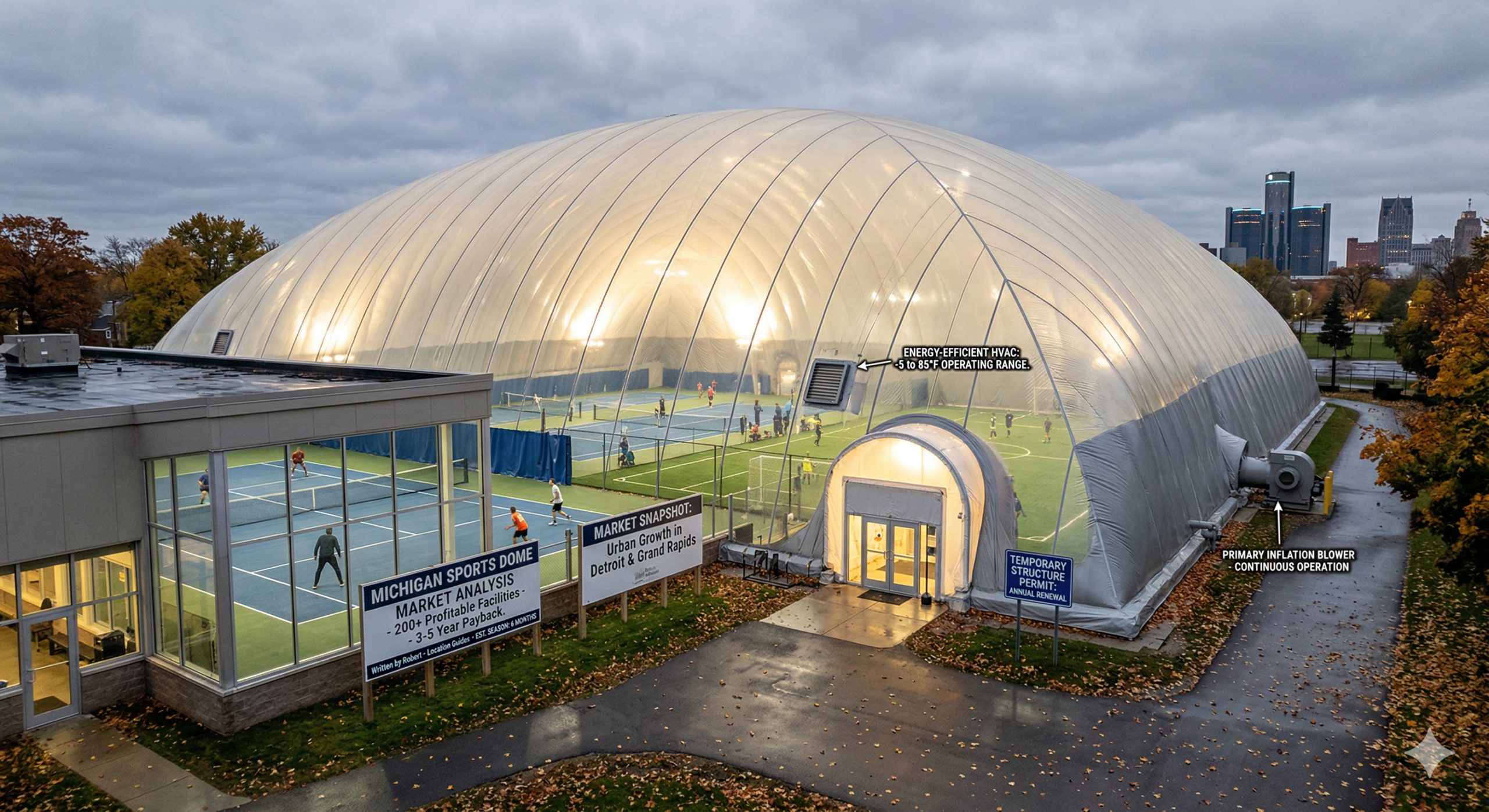
    When you’re considering a Michigan air dome investment, you’re looking at proven financial returns. A typical 20,000 square foot facility generates ROI within 3-5 years, supported by the state’s six-month dome season that extends from late fall through early spring.

    You’ll benefit from strong demand in tennis and soccer markets, where athletes need climate-controlled environments during Michigan’s harsh winters.

    Most municipalities classify these as temporary structures, streamlining your permitting process and reducing regulatory barriers for faster market entry.

    Why Michigan Dome Investments Return 3-5 Year Payback?

    Three key factors drive Michigan’s exceptional sports dome ROI performance, creating investment returns that consistently outpace national averages.

    First, you’ll benefit from Michigan’s extended six-month dome season, maximizing revenue potential when outdoor facilities can’t operate. Your Michigan sports facility will generate consistent income from November through April, capturing peak demand periods.

    Second, strong market fundamentals support profitability. With 200+ existing facilities and concentrated demand in Detroit and Grand Rapids, you’re entering a proven market where tennis and soccer programs drive year-round bookings.

    Third, favorable municipal regulations work in your favor. Most Michigan jurisdictions classify domes as temporary structures, reducing permitting costs and construction timelines.

    These combined advantages create the foundation for your 3-5 year payback period on 20,000 square foot facilities.

    Michigan’s 6-Month Dome Season Operating Requirements

    Operating successfully during Michigan’s extended dome season requires specific preparation for challenging temperature swings and energy management.

    You’ll need proper insulation designed for -5 to 85°F (-21 to 29°C) temperature variations throughout your six-month operational period. Your facility must maintain comfortable interior conditions while minimizing heating costs during harsh winter months.

    Energy-efficient HVAC systems become essential for profitability in Michigan indoor sports facilities.

    You’ll want to install programmable thermostats and consider radiant heating options that work effectively in large dome spaces. Proper ventilation prevents condensation issues that can damage equipment and create unsafe playing conditions.

    Schedule maintenance during off-season months to avoid disruptions.

    You’ll maximize revenue by planning tournaments and leagues during peak demand periods, typically October through March when outdoor alternatives aren’t available.

    Municipal Permits: Why Most Michigan Domes Qualify As Temporary?

    Because air-supported structures don’t require permanent foundations, most Michigan municipalities classify sports dome Michigan installations as temporary rather than permanent buildings. This classification notably simplifies your permitting process and reduces regulatory hurdles.

    You’ll typically need basic temporary structure permits instead of complex building permits required for permanent construction. Most Michigan cities allow temporary installations for extended periods, often renewable annually. This means you won’t face the extensive architectural reviews, structural engineering requirements, or zoning complications associated with permanent buildings.

    The temporary classification also offers flexibility for relocation if needed. You’ll save considerable time and money on permits, making your sports dome Michigan project more cost-effective.

    However, you should verify specific municipal requirements, as some larger cities may have stricter regulations for commercial temporary structures.

  • Winter Sports Domes Cold Climate

    Winter Sports Domes Cold Climate

    You’re facing a critical decision that could determine whether your winter sports facility thrives or struggles through harsh cold seasons. While traditional buildings demand enormous heating budgets and lengthy construction timelines, modern air domes engineered for extreme climates are reshaping how communities approach winter athletics. The temperature differential between success and failure often comes down to understanding one essential factor that most facility planners completely overlook when evaluating their options.

    Why Cold Climate Air Domes Beat Traditional Winter Sports Buildings

    When winter temperatures plummet to -20°F, you’ll discover that cold climate air dome outperforms traditional winter sports buildings in nearly every metric that matters.

    Your insulated sports dome operates efficiently from -20 to 90°F with double-layer fabric construction that handles snow loads up to 50 PSF. You’ll save considerably on construction costs—no foundations, steel frames, or lengthy permits required. Installation takes weeks, not years.

    Your northern climate sports facility maintains consistent interior temperatures while traditional buildings struggle with heat loss through concrete and steel.

    Emergency backup systems guarantee you’re never caught off-guard during blizzards. The vestibule entry system retains heat effectively, reducing operating costs.

    In Minnesota, you’ll spend $2,500-$3,500 monthly heating 20,000 square feet—markedly less than comparable permanent structures.

    Heating Costs and Energy Efficiency in Extreme Cold Conditions

    You’ll face significant heating costs when operating air domes in extreme cold, with typical Minnesota facilities spending $2,500-$3,500 monthly for 20,000 square feet during winter months.

    Your energy expenses directly impact profitability, making it essential to understand both the operational cost breakdown and proven strategies for reducing consumption.

    Smart energy management can cut your heating bills by 20-30% while maintaining ideal playing conditions throughout the coldest months.

    Operating Cost Analysis

    Operating costs for winter sports domes in extreme cold conditions represent a significant portion of your total facility expenses, with heating dominating the budget during harsh winter months.

    Your winter sports dome in Minnesota will typically cost $2,500-$3,500 monthly for a 20,000 square foot facility during peak winter operations.

    Understanding these financial realities helps you prepare for three major cost drivers:

    1. Heating system operation – Running continuously at -20°F temperatures doubles your energy consumption.
    2. Emergency backup systems – Redundant blowers and heating units increase operational expenses by 15-25%.
    3. Insulation maintenance – Double-layer fabric requires regular inspection and replacement, adding $500-$800 annually.

    Your vestibule entry system reduces heat loss but adds structural complexity.

    Snow load management and consistent temperature control make cold-climate operations substantially more expensive than moderate climate facilities.

    Energy Saving Strategies

    Since energy costs can consume up to 70% of your winter sports dome’s operating budget, implementing strategic efficiency measures becomes critical for financial sustainability.

    You’ll maximize heat retention by maintaining proper fabric tension and sealing air leaks around entry points and equipment penetrations.

    Installing programmable thermostats with zone controls lets you reduce heating in unused areas during off-peak hours.

    Consider upgrading to high-efficiency heating units with variable-speed fans that adjust output based on actual demand rather than running at full capacity continuously.

    Adding thermal curtains or barriers around entrance vestibules prevents heat loss during frequent door openings.

    Regular maintenance of your heating system, including filter changes and ductwork cleaning, guarantees peak performance.

    These combined strategies can reduce winter operating costs by 25-40%.

    Snow Load Capacity and Winter Weather Performance Standards

    When winter storms dump heavy snow on your air dome, the structure’s ability to handle substantial loads becomes critical for safe operation.

    You’ll need a dome rated for 35-50 PSF snow loads to withstand Minnesota’s harshest conditions. The double-layer insulated fabric provides structural integrity while maintaining ideal pressure differentials.

    Your dome’s performance standards must include:

    1. Emergency backup blower systems – Because power failures during blizzards can’t shut down your facility
    2. Vestibule entry design – Protecting your investment from heat loss that costs thousands monthly
    3. Temperature resilience from -20 to 90°F – Ensuring year-round functionality regardless of weather extremes

    Proper engineering prevents catastrophic collapse, protects athletes, and maintains the $2,500-$3,500 monthly operating investment you’re making in Minnesota’s challenging winter climate.

    Emergency Systems and Temperature Range Capabilities

    During catastrophic weather events, your air dome’s emergency backup blower system becomes the difference between continued operations and potential structural failure. These redundant systems automatically activate when primary blowers fail, maintaining critical air pressure within seconds. You’ll need systems rated for your dome’s cubic footage with 24-hour fuel capacity minimum.

    Temperature capabilities determine your facility’s year-round viability. Quality cold climate domes operate from -20°F to 90°F (-29°C to 32°C), handling Minnesota’s extreme temperature swings effectively.

    System Component Specification
    Backup Blower Response 15-30 seconds
    Fuel Reserve Capacity 24-48 hours
    Operating Temperature Range -20°F to 90°F
    Emergency Generator Size 125% of total load
    Backup Communication Cellular/satellite monitoring

    Your emergency preparedness directly impacts insurance rates and operational continuity during severe weather events.

    Site Preparation and Installation in Sub-Zero Conditions

    Although winter installation presents unique challenges, proper site preparation guarantees your air dome’s structural integrity and longevity in harsh climates.

    You’ll need to excavate and level your foundation before ground freezing occurs, making certain proper drainage systems are installed below the frost line.

    Critical preparation steps include:

    1. Foundation heating cables – Install these beneath your perimeter to prevent frost heaving that could damage your dome’s anchoring system.
    2. Insulated utility trenches – Protect electrical and heating lines from freezing, preventing costly repairs and system failures.
    3. Emergency access routes – Clear multiple pathways for maintenance crews during blizzards when your dome needs immediate attention.

    Your installation crew must work in temperatures as low as -20°F, so schedule accordingly.

    Pre-warming materials and using cold-weather adhesives makes certain proper sealing of your double-layer insulated fabric system.

    Operating Cost Breakdown and Return on Investment Analysis

    After completing your winter sports dome installation, you’ll face ongoing operational expenses that directly impact your facility’s profitability.

    Heating costs dominate winter operations, ranging from $2,500-$3,500 monthly for a 20,000 square foot facility in Minnesota’s harsh climate. Your double-layer insulated fabric and high-efficiency heating systems help minimize these expenses, but you’ll still need budgeting for electricity, maintenance, and backup blower operations.

    Calculate your ROI by projecting revenue from membership fees, hourly rentals, and programs against these operational costs.

    Most facilities break even within 18-24 months when properly marketed. You’ll maximize profitability by maintaining consistent indoor temperatures, scheduling regular equipment maintenance, and utilizing your dome’s extended season capabilities to generate year-round income streams that traditional outdoor facilities can’t match.

  • Temporary vs Permanent Sports Dome Costs

    Temporary vs Permanent Sports Dome Costs

    You’re facing a significant decision that’ll impact your sports facility’s budget for years to come. While temporary domes seem like the safer choice with their lower upfront costs of $700K to $1M, they’re quietly draining your resources through annual setup fees and maintenance. Permanent structures demand more initially—up to $1.2M—but here’s what most facility managers don’t realize about the hidden expenses that completely flip this equation.

    Temporary vs Permanent Sports Domes: Investment Comparison

    When you’re evaluating sports dome options for a 20,000 square foot facility, the financial picture shifts dramatically over time.

    Your temporary sports dome cost appears lower initially at $700K-$1M, but you’ll face annual setup and removal expenses of $16K-$30K.

    This seasonal vs permanent dome comparison reveals that temporary installations total $860K-$1.3M over ten years.

    Permanent domes require higher upfront investment of $800K-$1.2M but eliminate recurring costs entirely.

    You’ll reach the break-even point in just 3-4 years with permanent installations.

    The removable dome vs fixed installation cost analysis clearly favors permanent structures for long-term use.

    If you’re planning multi-year operations, permanent domes deliver superior value despite their steeper initial price tag.

    Break-Even Analysis: When Permanent Domes Pay For Themselves

    When you’re weighing temporary versus permanent dome options, the break-even point becomes your most critical decision factor.

    You’ll find that permanent domes typically cost $100K-$200K more upfront, but they’ll save you $16K-$30K annually by eliminating setup and removal expenses.

    The math works in your favor quickly—permanent installations usually pay for themselves within just three to four years through these ongoing operational savings.

    Initial Investment Comparison

    Although temporary sports domes require less money upfront, you’ll find that permanent structures become the more economical choice within just a few years.

    When comparing temporary vs year-round facility cost for a 20,000 square foot dome, you’re looking at $700K-$1M initially for temporary structures versus $800K-$1.2M for permanent installations.

    However, temporary domes carry hidden expenses that quickly erode their initial advantage. You’ll face $16K-$30K annually for setup and removal services, plus potential storage costs during off-seasons.

    These recurring expenses mean you’ll spend $860K-$1.3M over ten years with temporary domes.

    Permanent structures eliminate these ongoing costs entirely. While requiring higher upfront investment, they typically break even within 3-4 years, making them markedly more cost-effective for long-term operations.

    Annual Operating Savings

    Beyond the initial cost difference, permanent domes deliver substantial annual operating savings that accelerate your return on investment. You’ll eliminate the recurring setup and teardown expenses that plague temporary structures, creating immediate cost benefits.

    Cost Factor Temporary Dome Permanent Dome
    Annual Setup/Removal $16K-$30K $0
    5-Year Total Operating $80K-$150K $0
    10-Year Total Cost $860K-$1.3M $800K-$1.2M
    Break-Even Point N/A 3-4 years
    Labor Requirements High seasonal Minimal

    Your permanent dome typically pays for itself within 3-4 years through these operational savings. After the break-even point, you’re saving $16K-$30K annually compared to temporary alternatives. These savings compound over time, making permanent installations increasingly cost-effective for long-term facility planning.

    Three Year Payback

    The math behind permanent dome investments reveals a compelling financial story that most facility owners find irresistible.

    You’ll reach break-even on your permanent dome investment within just 3-4 years compared to temporary alternatives.

    Here’s how it works: while you’re spending $16,000-$30,000 annually on setup and removal costs for temporary domes, permanent structures eliminate these recurring expenses entirely.

    Your initial investment difference of $100,000-$200,000 gets recovered quickly through avoided annual costs.

    After year four, you’re generating pure savings of $16,000-$30,000 annually.

    Over a 10-year period, you’ll save $260,000-$500,000 by choosing permanent construction.

    This accelerated payback period makes permanent domes one of the smartest long-term investments in sports facility infrastructure.

    Upfront Sports Dome Costs: $700K-$1.2M Investment Breakdown

    Major financial decisions require understanding every dollar you’ll invest upfront in a sports dome project.

    You’re looking at a substantial initial investment ranging from $700,000 to $1.2 million for a 20,000 square foot facility, depending on your chosen approach.

    Here’s how the upfront costs break down:

    1. Temporary seasonal domes: You’ll pay $700K-$1M initially, appearing more budget-friendly at first glance.
    2. Permanent structures: Higher upfront investment of $800K-$1.2M, but no recurring installation expenses.
    3. Additional considerations: Site preparation, permits, and utility connections add to both options.

    While temporary domes seem cheaper initially, you’ll face annual setup and removal costs of $16K-$30K.

    Permanent structures eliminate these recurring expenses, making the higher upfront investment more cost-effective long-term.

    Annual Setup, Removal, And Maintenance Expenses

    While upfront costs grab most attention during planning, recurring annual expenses can dramatically impact your sports dome’s total cost of ownership.

    Temporary domes require significant annual setup and removal costs ranging from $16,000 to $30,000 each year. You’ll need specialized crews, transportation, and storage facilities during off-seasons. These expenses accumulate quickly—over ten years, you’re looking at $160,000 to $300,000 in setup costs alone.

    Permanent domes eliminate these recurring expenses entirely.

    You’ll only face standard maintenance costs like HVAC servicing, minor repairs, and cleaning. The math is compelling: permanent structures typically break even within 3-4 years when you factor in eliminated setup costs.

    After that break-even point, you’re saving substantial money annually while enjoying year-round facility access without weather-related interruptions.

    Seasonal vs Year-Round Sports Dome Usage Scenarios

    Your facility’s usage pattern directly impacts whether temporary or permanent domes make financial sense.

    If you’re only covering fields during peak winter months, temporary structures let you maximize space during busy spring and summer seasons without year-round obstruction.

    However, if you need consistent indoor space regardless of weather—for leagues, training programs, or rental income—permanent domes eliminate recurring setup costs and storage headaches.

    Peak Season Demand

    Since most sports facilities experience dramatic usage fluctuations throughout the year, you’ll need to carefully analyze your peak season demand patterns before choosing between temporary and permanent dome solutions.

    Understanding your facility’s usage peaks helps determine which option maximizes your investment. If you’re operating a football field that’s heavily used September through November but sits mostly empty in summer, temporary domes make financial sense.

    Conversely, year-round facilities with consistent demand justify permanent installations.

    Consider these peak season factors:

    1. Duration intensity – How many months do you experience maximum capacity usage versus minimal activity periods?
    2. Revenue concentration – What percentage of annual income comes from your busiest three-month period?
    3. Off-season alternatives – Can you generate revenue during traditionally slow periods with dome coverage?

    Off-Season Storage Costs

    Temporary domes require significant off-season storage space and associated costs that many facility owners overlook during initial planning. You’ll need climate-controlled warehouses to prevent fabric deterioration, plus specialized handling equipment for the massive structural components.

    Storage Component Space Required Annual Cost
    Fabric membrane 2,000 sq ft $8,000-$12,000
    Steel framework 3,500 sq ft $14,000-$21,000
    Anchor systems 500 sq ft $2,000-$3,000
    Blower equipment 200 sq ft $800-$1,200
    Total Storage 6,200 sq ft $24,800-$37,200

    These storage costs add $248,000-$372,000 over ten years to your temporary dome investment. Permanent structures eliminate these expenses entirely, making the long-term financial advantage even more compelling for year-round facilities.

    20,000 Square Foot Sports Dome Capacity Planning

    Planning capacity for a 20,000 square foot sports dome requires careful consideration of your intended activities and peak usage periods.

    You’ll need to evaluate how many simultaneous events you can accommodate while maintaining safety and quality standards.

    Your capacity planning should focus on these key areas:

    1. Court configurations – You can fit 2-3 full basketball courts, 4-6 volleyball courts, or multiple smaller training areas depending on your layout strategy.
    2. Peak hour scheduling – Plan for 150-250 active participants during busy periods, accounting for spectators and waiting areas.
    3. Multi-sport flexibility – Design zones that convert quickly between activities to maximize revenue per square foot.

    Consider seasonal demand fluctuations when determining ideal capacity.

    Winter months typically see 40-60% higher usage than summer periods, affecting your temporary versus permanent dome decision based on utilization rates.

    10-Year Total Investment: $860K-$1.3M Cost Reality

    Over a decade, your temporary sports dome investment will reach $860,000 to $1.3 million when you factor in both initial costs and recurring expenses. This total includes your initial $700,000-$1 million purchase price plus annual setup and removal costs of $16,000-$30,000.

    You’ll face these recurring expenses every season because temporary domes require professional installation and dismantling. Weather delays, storage fees, and potential damage during handling can push costs higher.

    Equipment wear from repeated assembly cycles may demand earlier replacement than anticipated.

    Compare this to permanent domes costing $800,000-$1.2 million upfront with minimal ongoing expenses. Your temporary dome’s financial disadvantage becomes clear after year three or four, when permanent structures break even.

    Consider your long-term facility needs carefully before committing to the seemingly lower-cost temporary option.

    Location, Permits, And Insurance: Beyond Purchase Price

    While dome costs dominate budget discussions, you’ll encounter significant expenses that extend far beyond the structure itself. Location selection, permitting processes, and insurance requirements create substantial financial obligations that can derail your project if you’re unprepared.

    These hidden costs vary dramatically between temporary and permanent installations:

    1. Permits and zoning compliance – Temporary structures need annual permits ($2K-$8K), while permanent domes require thorough building permits, environmental assessments, and zoning approvals ($15K-$50K upfront).
    2. Site preparation and utilities – Temporary setups need basic leveling and temporary power connections, but permanent installations require foundations, permanent electrical, plumbing, and HVAC infrastructure ($100K-$300K).
    3. Insurance premiums – Coverage costs increase 15-25% for permanent structures due to higher replacement values and extended liability exposure.
  • Sports Dome Cost vs Permanent Building

    Sports Dome Cost vs Permanent Building

    You’ll save 50-75% on upfront costs choosing a sports dome over a permanent building—a 20,000 sq ft air dome costs around $200,000 versus $800,000 for traditional construction. However, permanent buildings last 35+ years compared to domes’ 15-20 year lifespan. Annual operating costs are similar at $3-6 per square foot, though domes install in just 2-6 weeks versus 12-18 months for permanent structures. Understanding these trade-offs will help you make the smartest investment decision.

    Sports Dome vs Permanent Building: Upfront Investment Breakdown

    When you’re weighing the financial commitment between sports domes and permanent buildings, the upfront investment difference is striking.

    Air dome vs building cost analysis shows you’ll spend $10-$25 per square foot for dome structures, while permanent buildings require two to three times more capital expenditure. For a 20,000 square foot (1,858 square meter) facility, you’re looking at $200,000 for an air dome versus $800,000 for a traditional building—that’s 50-75% in savings.

    Temporary vs permanent facility cost comparisons reveal dome packages starting as low as $12 per square foot, with costs decreasing as size increases. Sports domes also offer faster installation times compared to permanent structures, reducing labor costs and allowing you to start generating revenue sooner.

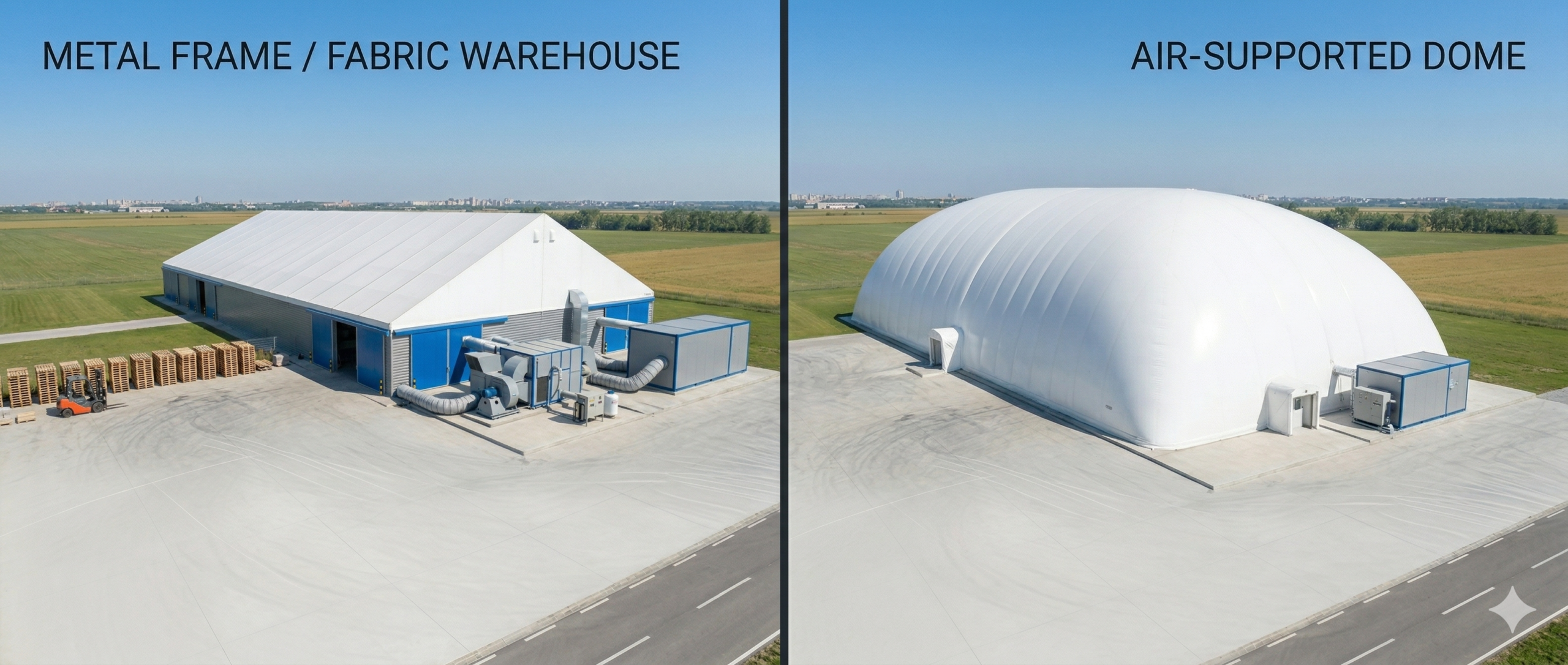
    The inflatable vs traditional building price gap widens further when you factor in material requirements, as air domes use economical synthetic textiles while permanent structures demand substantial investments in concrete, steel, and glass.

    Operating Costs: What You’ll Pay Each Year

    Beyond the initial investment, your annual operating expenses will determine the true cost of facility ownership. For a 20,000 sq ft (1,858 sq m) facility, you’ll face several key expense categories that impact the sports dome vs permanent structure decision.

    Maintenance costs range from $3–$6 per square foot annually, with inflation systems adding $0.10–$0.20 per square foot yearly for air domes.

    Utility expenses typically run $0.50–$1.50 per square foot, though permanent buildings often achieve better energy efficiency long-term.

    Staffing represents your largest expense at approximately $500,000 annually for full operations.

    Insurance averages $36,000 yearly, while security costs around $30,000.

    Total operating budgets range from $336,000 for basic facilities to $1.6 million for extensive complexes. Rental hours constitute over 57% of most facilities’ total revenue, making scheduling optimization critical for covering these substantial operating expenses.

    How Long Does Each Structure Actually Last?

    While upfront costs grab immediate attention, the lifespan of your facility determines its true long-term value. You’ll typically get 15-20 years from a well-constructed air dome, though high-end models can reach 30 years under ideal conditions.

    PVC fabric offers superior durability with 25-year warranties, while lighter PE materials last 15-20 years.

    Permanent buildings greatly outlast air domes. You’re looking at 35+ years for standard stadiums, with historic concrete structures operating for over 100 years.

    The Cinerama Dome has functioned for 61+ years, while Wrigley Field hit its 100-year milestone.

    Your maintenance commitment directly impacts longevity. Proper installation, regular inspections, and following manufacturer guidelines can maximize your structure’s operational life, regardless of the type you choose. Modern air pressure technology continuously maintains inflation to minimize structural stress and preserve dome integrity.

    Construction Speed: Sports Domes vs Traditional Buildings

    Your facility’s construction timeline can make or break your project’s success, especially when you’re working with tight deadlines or seasonal demands. Sports domes offer dramatically faster installation compared to traditional buildings, allowing you to start operations in weeks rather than months.

    Aspect Sports Domes Traditional Buildings
    Installation Time 2-6 weeks 12-18 months
    Setup Process Inflation in days Multiple construction phases
    Labor Requirements 20-30 workers Extensive workforce teams

    You’ll find that dome construction eliminates complex foundation work and structural framing that permanent buildings require. While traditional facilities need site preparation, governmental permits, and extensive planning phases, air-supported structures use simplified air pressure systems for rapid assembly. This speed advantage means you can capture revenue opportunities immediately rather than waiting through lengthy construction delays.

    The flexible usage capabilities of sports domes also allow for quick adaptation to different sports and events without the extensive renovations that traditional structures would require.

    Which Option Delivers Better ROI?

    When comparing return on investment, the numbers tell a compelling story that favors air domes for most scenarios.

    You’ll save $600,000 upfront with a $200K air dome versus an $800K permanent building for the same 20,000 sq ft (1,858 sq m) space. That’s 50-75% less initial capital investment.

    Your operational costs remain competitive at $3-6 per square foot annually, while permanent buildings carry higher year-round expenses.

    If you’re operating seasonally for 5-6 months, you’ll reduce costs further compared to 12-month traditional facility operations. Air domes offer additional savings through direct-cooling ice systems that can reduce energy consumption by 60%.

    The faster 2-6 week installation versus 12-18 months means you’ll generate revenue sooner.

    With proper maintenance, your air dome can last 15-50 years, delivering strong returns on that lower initial investment.

    Frequently Asked Questions

    Can Air Domes Withstand Extreme Weather Like Hurricanes and Heavy Snow Loads?

    Yes, you’ll find air domes exceptionally resilient against extreme weather.

    They’ll withstand hurricane-force winds up to 252 km/h (157 mph) and even meet Nuclear Regulatory Commission standards for 482+ kph winds. You can rely on them supporting snow loads exceeding 250 kg/m² without failure.

    Their curved design actually reduces wind resistance compared to traditional buildings, while the reinforced membrane maintains structural integrity from -30°C to +70°C temperatures.

    What Permits and Zoning Approvals Are Needed for Sports Dome Installation?

    You’ll need local government permits before construction begins, with requirements varying by jurisdiction.

    Your site must comply with zoning classifications, building codes like IBC and ASCE 55-16, plus setback and height restrictions.

    Licensed engineers must create stamped permit drawings (costing around $20,000).

    Multiple city departments review applications including Planning, Building Code Enforcement, and Fire Department.

    Plan approval typically takes 2-6 weeks, followed by final inspections before receiving your Certificate of Occupancy.

    How Much Does It Cost to Relocate an Air Dome Facility?

    Relocation costs depend on your dome’s size.

    You’ll pay $10,000-$30,000 for small domes under 100 feet (30.5 meters) in diameter, $30,000-$100,000 for medium domes 100-300 feet (30.5-91.4 meters), and over $1 million for large domes exceeding 300 feet (91.4 meters).

    These costs include disassembly, transport, and reinstallation.

    You can reduce expenses by having your staff help with construction and maintenance during the relocation process.

    Are There Financing Options Available Specifically for Sports Dome Construction Projects?

    Yes, you’ll find several financing options specifically for sports dome construction.

    You can access public funding through UPARR programs, Land and Water Conservation Fund, and EPA Brown/Greenfield grants.

    You’ll also benefit from leasing agreements that spread costs over time with lower upfront requirements.

    Additionally, you can pursue bank loans, private investors, bonds financing, and community fundraising through sponsorships and donations to fund your project.

    What Happens if the Air Pressure System Fails During Events?

    If your air pressure system fails during events, you’ll need to evacuate everyone immediately as the dome deflates like a flag.

    The fabric develops wave-like movements and whip-like motions, but you won’t face structural collapse onto occupants – cables maintain 30+ feet (9+ meters) clearance above.

    However, you’ll lose complete facility protection and face significant re-inflation costs, making your 20,000 sq ft (1,858 sq m) space unusable until pressure’s restored.