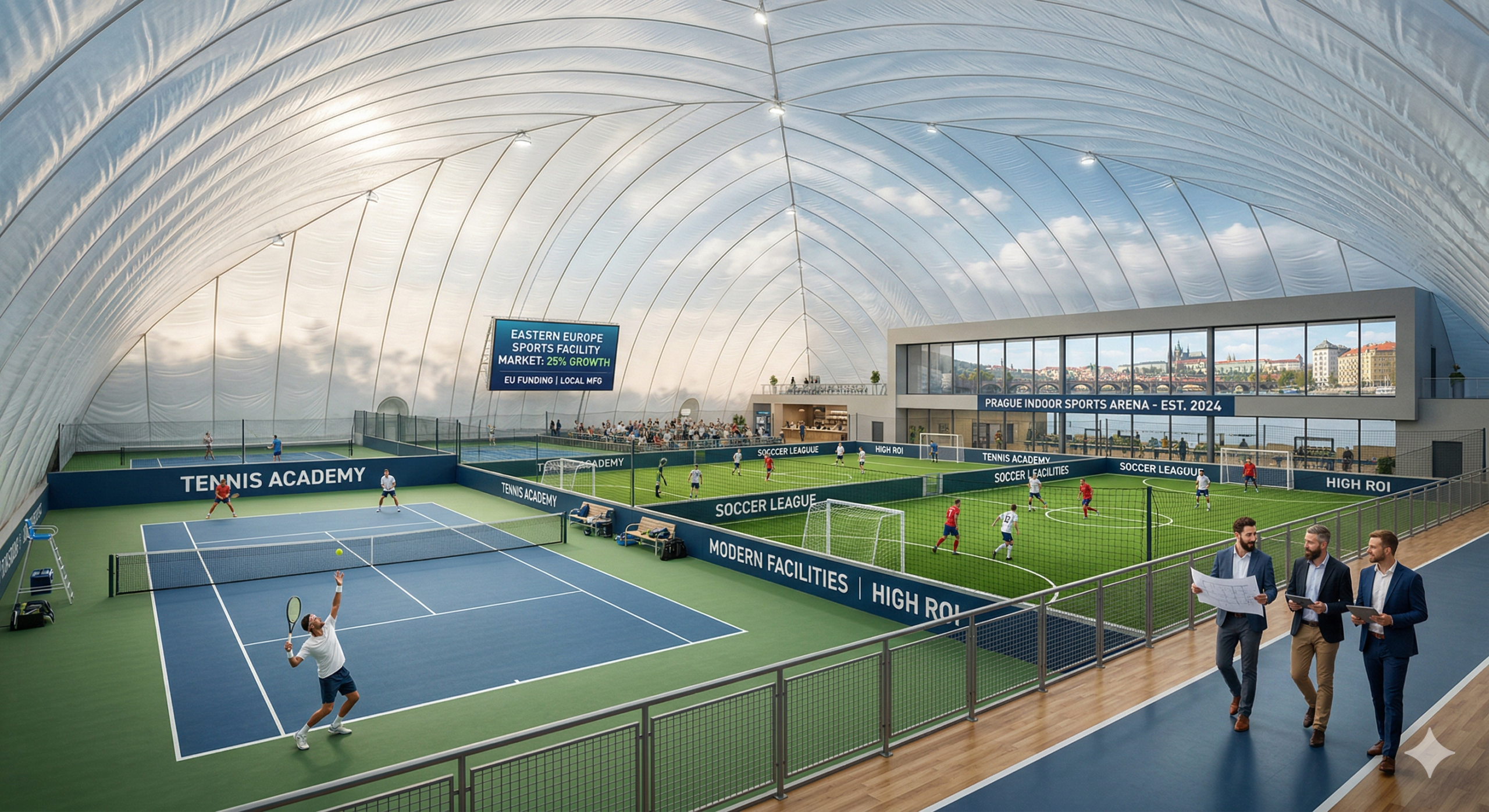
You’ll face construction costs ranging from $25-250 per square foot for metal buildings, $2-4 million for traditional structures, or $200,000-2 million for air dome systems when building indoor sports facilities in 2026. Extensive multi-court complexes can reach $27-33 million, while operational expenses average $133,000 monthly. Your location greatly impacts pricing—urban labor costs run $10-15 per square foot versus $5-8 in rural areas. Understanding these variables will help you make the most strategic investment decision.
Indoor Sports Facility Construction Costs: What To Expect In 2026
When evaluating sports building options cost, you’re looking at hard structure expenses around $170 per square foot for basic shells, while mezzanines and tracks cost $185 per square foot.
Your indoor facility pricing guide should account for soft costs representing 22.4% of total expenses, including permits at $0.15–$0.50 per square foot.
Equipment typically consumes 2.5%–10% of your budget, with regional variations greatly impacting final investment requirements. A comprehensive facility with 8 basketball and 16 volleyball courts requires construction costs ranging from $27 million to $33 million.
Building Types And Budgets: Metal Vs Traditional Vs Air Dome Structures
When planning your indoor sports facility, you’ll face three primary construction options that dramatically impact both your upfront investment and timeline.
Metal buildings offer the sweet spot between affordability and durability, ranging from $25–$250 per square foot depending on your finish level. These structures typically include free delivery and installation within service areas, which can be completed in just one to three days.
Traditional construction provides maximum customization at $500,000–$3,400,000+ for permanent structures, while air dome systems deliver quick installation starting around $200,000–$2,000,000 for climate-controlled environments.
Metal Building Cost Analysis
Metal buildings offer three distinct pricing tiers that’ll directly impact your 20,000 square foot (1,858 square meter) indoor sports facility budget.
Basic shell construction starts at $25–$35 per square foot ($269–$377 per square meter), totaling $500,000–$700,000 for structural components only.
Rigid frame systems cost $35–$55 per square foot ($377–$592 per square meter), providing enhanced load-bearing capacity essential for athletic spaces.
Pre-engineered athletic facilities represent the premium tier at $75–$130 per square foot ($807–$1,399 per square meter), reaching $1.5M–$2.6M for your project.
Sports complex construction cost increases considerably with customization—finished training centers demand $150–$250 per square foot ($1,615–$2,691 per square meter). Square or near-square dimensions maximize cost-effectiveness for your athletic facility design.
Geographic factors like wind and snow loads, plus steel market fluctuations, directly influence your final investment.
Traditional Construction Investment Ranges
Traditional construction delivers the highest investment requirements among indoor sports facility options, with your 20,000 square foot (1,858 square meter) project demanding $2M–$4M+ and 12-18 months completion time.
You’ll face $275–$336 per square foot for sports tourism-level facilities, while indoor baseball complexes cost $150–$250 per square foot.
Hard construction costs represent 54.5%–77.3% of your total project expenses.
You’re investing in concrete, brick, and steel-frame materials that provide maximum durability and 20+ year lifecycles. SBA loans commonly provide financing support for facility construction projects.
This option offers highly customizable layouts, multi-level designs, and complex mechanical systems.
You’ll benefit from long-term value through reduced per-year operational costs and consistent revenue generation.
Traditional construction suits high-end arenas, multi-purpose recreational centers, and professional sports venues requiring permanent structures.
Air Dome Structure Pricing
Air dome structures deliver the most economical entry point into indoor sports facilities, with your 20,000 square foot (1,858 square meter) project requiring just $700K–$1.2M and 2-6 weeks completion time.
You’ll pay approximately $12 per square foot for base dome packages, with lower rates available for larger structures. Your total investment includes double-layer fabric skin, cable harness, and complete inflation systems.
Installation costs remain minimal—a seven-day assembly totaled just $74,000 including labor and equipment rental. Small domes can be installed in as few as 4 days, while larger structures may require several weeks depending on complexity.
You’ll need engineering fees around $20,000 for structural stamps and permit drawings.
Foundation requirements vary greatly based on soil conditions, with costs ranging from basic concrete grade-beams to specialized anchor systems.
Long-term operational expenses run $0.60–$1.70 per square foot annually for maintenance and utilities combined.
Baseball, Basketball, And Soccer Facilities: Cost Comparison
You’ll find that baseball, basketball, and soccer facilities each carry distinct construction cost breakdowns based on their unique design requirements and space needs.
Baseball facilities typically demand specialized features like batting cages and artificial turf systems, while basketball courts require precise flooring and multiple court configurations that can push costs to $27-33 million for tournament-level complexes.
Soccer facilities focus heavily on turf installation and safety netting, where the playing surface alone represents 20-30% of your total construction budget, making operational expenses a critical factor in your long-term financial planning.
Construction Cost Breakdown Analysis
Understanding construction costs requires examining how different facility types impact your budget across various building structures and sports configurations. You’ll find significant variation in per-square-foot costs depending on your chosen sport and construction method.
| Facility Type | Cost Per Sq Ft |
|---|---|
| Baseball | $150-$250 |
| Basketball | $275-$336 |
| Soccer | $100-$200 |
| General Indoor Sports | $100-$300+ |
| Mid-Range Baseline | $200 |
Building structure choice dramatically affects your investment. Air domes for 20,000 sq ft (1,858 sq m) cost $700K-$1.2M with 2-6 week installation, while traditional construction ranges $2M-$4M+ requiring 12-18 months. You’ll allocate 30-40% of soccer budgets to playing surfaces, 15-25% to LED lighting, and 8-15% to drainage systems across all facility types.
Sport-Specific Design Requirements
Designing sport-specific facilities requires careful consideration of unique space requirements, surface materials, and specialized equipment that directly impact your construction budget.
Baseball facilities demand the largest footprint, requiring 90 ft (27 m) basepaths and outfield distances up to 330 ft (101 m), plus specialized synthetic turf or clay infields.
Basketball courts need precise 94 ft × 50 ft (29 m × 15 m) hardwood surfaces with specific shock absorption properties.
Soccer facilities require 200-300 ft (61-91 m) length fields with artificial turf systems designed for cleat traction.
Each sport’s unique demands affect your overall facility costs considerably.
Baseball’s expansive space requirements typically result in higher construction costs per square foot, while basketball’s smaller footprint allows for more cost-effective building solutions within your available budget.
Operational Expense Considerations
Beyond initial construction costs, your facility’s ongoing operational expenses will greatly impact your long-term profitability and cash flow management. You’ll face substantial monthly fixed costs totaling approximately $133,000, with facility rent representing your largest expense at $40,000 monthly for large sports complexes.
| Expense Category | Monthly Cost |
|---|---|
| Facility Rent | $40,000 |
| Staff Payroll | $41,667 |
| Utilities (Base) | $15,000 |
| Peak Season Utilities | $20,000+ |
| Total Fixed Overhead | $115,667 |
Your staffing expenses will consume nearly $42,000 monthly for core operations, while utilities fluctuate seasonally between $15,000-$20,000. You’ll need $120,000 in working capital reserves to weather cash flow challenges, particularly during slower periods when fixed costs continue regardless of revenue generation.
Location Impact: Urban Vs Rural Construction Pricing
When choosing between urban and rural locations for your indoor sports facility, you’ll face dramatically different cost structures that can impact your total investment by hundreds of thousands of dollars.
Rural locations consistently offer significant savings across multiple construction categories, while urban centers command premium pricing due to higher demand and regulatory complexity.
Key cost differentials you’ll encounter include:
- Labor rates: Urban areas charge $10-15 per sq ft (0.09-0.14 sq m) for court installation versus $5-8 per sq ft (0.05-0.07 sq m) in rural markets.
- Land acquisition: Rural acreage costs $50,000-500,000 compared to urban premiums often exceeding these ranges by multiples.
- Permitting fees: Urban jurisdictions charge $0.35-0.50 per sq ft (3.77-5.38 per sq m) versus rural rates of $0.15-0.25 per sq ft (1.61-2.69 per sq m).
- Material transportation: Rural locations incur 15-25% higher delivery costs despite lower base material prices.
Size, Permits, And Site Prep: The Full Cost Picture
Understanding location-based pricing variations represents just one piece of your facility’s financial puzzle.
Your project’s scale dramatically affects costs, with large multi-court complexes reaching $27-33 million, while single 10,000 sq ft (929 sq m) baseball facilities average $1.5-2.5 million.
You’ll face permitting expenses of $0.15-0.50 per sq ft ($1.61-5.38 per sq m), meaning that a 10,000 sq ft facility incurs $1,500-5,000 in regulatory costs.
Site preparation demands serious attention—earthworks and sub-base installation consume 20-30% of total construction costs.
Inadequate preparation can triple your maintenance expenses later.
Drainage systems require 5-15% of capital costs, while sub-base engineering typically accounts for 25-30% of your total expenditure breakdown.
Don’t underestimate these foundational elements.
Best ROI Sports Facilities For Your Investment
Five strategic facility types consistently deliver superior returns on your indoor sports investment, with functional fitness zones leading the pack at 600 square feet (56 sq m) for ideal ROI potential in 2026.
Revenue per square foot exceeds traditional cardio installations, while specialized fitness-focused spaces align with growing lifestyle trends driving industry expansion. You’ll maximize profitability through these proven approaches:
- Multi-sport diversified facilities generate 10-20% profit margins with $25,000-$50,000 profits on $250,000 revenue.
- Tier membership models provide financial predictability superior to single-transaction rentals.
- Dynamic pricing optimization achieves $100,000 to $1M+ annual revenue through peak-hour strategies.
- Long-term contracts with traveling teams offer the most lucrative revenue sources.
Youth sports participation increased 55% over the last decade, supporting sustained demand across facility types.
Frequently Asked Questions
How Much Does HVAC System Installation Cost for Indoor Sports Facilities?
You’ll pay $17 to $22 per square foot for HVAC installation in indoor sports facilities, considerably higher than standard commercial rates of $3 to $6 per square foot.
For a typical 5,000 square foot facility, you’re looking at $85,000 to $110,000 total.
Complete system installations range from $7,500 to $25,000 depending on your facility’s size and specifications, with sports buildings requiring more powerful cooling capacity than regular commercial spaces.
What Insurance Requirements Affect Indoor Sports Facility Construction Budgets?
You’ll need to budget 5-10% of your total operation costs for insurance requirements.
General liability coverage ($5,000-$15,000 annually) with $1-3 million limits is mandatory, plus commercial property insurance ($2,000-$10,000).
Workers’ compensation is required if you’re hiring staff.
Your landlord will demand certificates of insurance with additional insured status before construction begins, and specialized participant accident coverage protects against sports-related injuries.
Are There Tax Incentives Available for Building Community Sports Facilities?
Yes, you’ll find several tax incentives for community sports facilities.
New Jersey’s Sports and Entertainment Tax Credit Program offers up to 80% of project costs or $300 million maximum, requiring 150% economic benefit return.
You can access Local Recreation Improvement Grants ($10 million available) for community centers and athletic fields.
Opportunity Zone benefits provide capital gains deferral and enhanced rural incentives with reduced improvement requirements for sports facility development.
How Do Earthquake and Wind Load Requirements Impact Construction Costs?
You’ll face significant cost increases when earthquake and wind load requirements apply to your facility.
Seismic design can add 10-25% to structural costs, while high wind zones require reinforced framing that increases expenses by 15-30%.
These requirements heavily favor flexible structures like air domes ($700K-$1.2M for 20,000 sq ft/1,858 sq m) over rigid metal buildings ($1.5M-$2.5M) since they naturally accommodate movement without expensive engineering modifications.
What Ongoing Maintenance Costs Should Owners Budget for Different Building Types?
You’ll face different maintenance costs depending on your building type.
Air domes require $2,000-4,000/month for membrane repairs and re-inflation systems.
Tension fabric structures need $1,500-3,000/monthly for fabric maintenance and tensioning adjustments.
Metal buildings cost $1,000-2,500/month for roof/siding upkeep and rust prevention.
Traditional construction runs $800-2,000/monthly for standard building maintenance.
All types share common costs: utilities ($2,000-5,000/month), turf maintenance ($500-1,500/month), and cleaning services ($1,000-3,000/month).