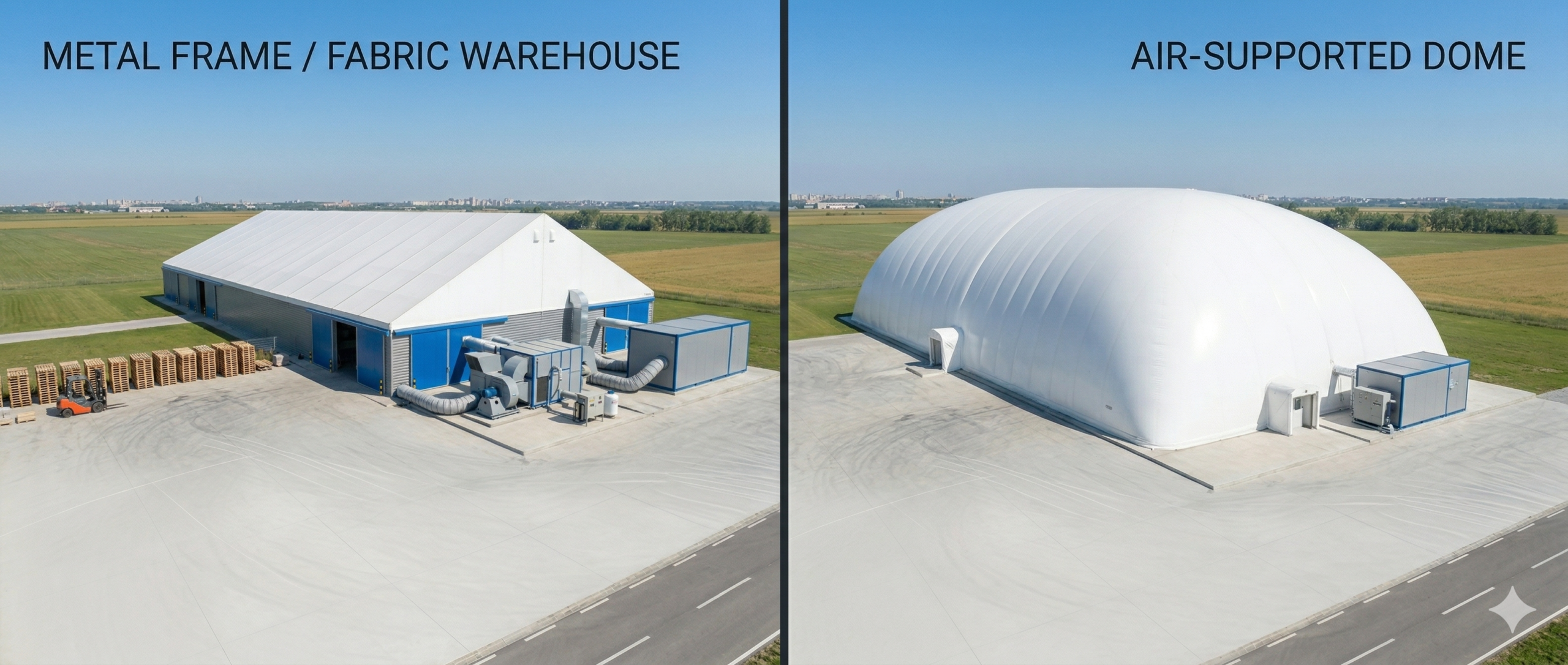
Tag: Tension Fabric

  • Tension Fabric vs Air Dome Detailed

    Tension Fabric vs Air Dome Detailed

    You’re facing a critical decision that’ll impact your facility’s budget for years to come. While air domes might seem like the obvious choice with their lower upfront costs, you’d be surprised how quickly those monthly operational expenses add up. The real story isn’t just about initial investment—it’s about understanding which structure type aligns with your long-term goals and operational reality. Here’s what the numbers actually reveal about your total cost of ownership.

    When Fabric Structures Beat Air Domes (And Vice Versa)

    When you’re weighing a 10+ year commitment, tension fabric structures offer clear advantages with their permanent frames, elimination of constant air pressure systems, and potential for operable walls that air domes simply can’t match.

    The tension fabric vs air dome decision hinges on your timeline and priorities.

    Choose fabric structures when you need year-round operation, want design flexibility, or require minimal ongoing maintenance. Their rigid frame vs inflatable design means no blower dependency and lower long-term operating costs.

    Air domes excel for seasonal use, temporary applications, or when upfront capital is limited. They’re faster to install and cost $500,000 less initially.

    However, this permanent vs seasonal comparison shifts dramatically after decade one, when fabric structures’ economic advantages become undeniable through reduced energy and maintenance expenses.

    Upfront Investment: Fabric vs Air Dome Costs

    Your upfront investment varies considerably between these two options, with air domes typically requiring $700K-$1.2M compared to fabric structures at $1.2M-$1.8M for a 20,000 square foot facility.

    You’ll also face different installation timelines – air domes can be deployed much faster than permanent fabric structures that require substantial foundation work and frame construction.

    These initial capital requirements and timeline differences directly impact your project’s cash flow and operational readiness.

    Initial Capital Requirements

    Two dramatically different price points separate tension fabric structures from air domes when you’re planning your initial investment.

    You’ll face $1.2M to $1.8M for a 20,000 square foot tension fabric building, while air domes cost considerably less at $700K to $1.2M for the same coverage.

    This fabric structure vs air supported cost difference stems from construction complexity.

    Tension fabric buildings require permanent steel frameworks, concrete foundations, and extensive engineering. You’re fundamentally building a permanent structure that’ll last decades without major renovations.

    Air domes offer immediate savings because they don’t need permanent foundations or complex structural systems.

    You’ll get faster installation and lower upfront capital requirements, making them attractive for organizations with limited budgets or seasonal needs.

    Installation Timeline Differences

    Since air domes don’t require permanent foundations or complex steel frameworks, they’ll have your facility operational in 2-4 weeks compared to 6-12 months for tension fabric structures.

    You’ll watch air dome installation unfold rapidly—site preparation, anchor system setup, and inflation happen consecutively with minimal delays.

    Tension fabric installations involve extensive planning phases, permit approvals, and coordinated construction sequences.

    You’re looking at foundation curing times, steel erection schedules, and fabric tensioning procedures that can’t be rushed.

    Consider these timeline realities:

    1. Air dome crews arrive with pre-manufactured components ready for immediate assembly.
    2. Weather delays impact tension fabric construction more greatly due to exposed structural work.
    3. Site disruption remains minimal with air domes versus months of heavy construction activity.

    If you need your facility operational quickly, air domes deliver faster occupancy.

    Monthly Operating Costs: $800-$3,500 Breakdown

    Monthly operating expenses between tension fabric structures and air domes vary dramatically, with fabric buildings running $800-$2,000 per month while air domes cost $1,500-$3,500 monthly.

    Your tension fabric structure’s lower costs stem from its permanent frame design. You won’t need continuous blower operation, eliminating the massive energy consumption that drives air dome expenses. Basic maintenance, lighting, and occasional heating represent your primary monthly outlays.

    Air domes require 24/7 blower systems to maintain structural integrity. You’ll face substantial electricity bills, often doubling or tripling fabric structure costs.

    Fan motor maintenance, backup system upkeep, and higher insurance premiums add further expenses.

    Over ten years, you’ll save $84,000-$252,000 in operating costs with tension fabric versus air domes, making the higher upfront investment financially advantageous long-term.

    Installation Timeline: Permanent vs Seasonal Setup

    When you’re planning your facility timeline, you’ll find dramatic differences between these two options.

    Tension fabric structures require several months for construction due to permanent foundation work and frame assembly, while air domes can be fully operational within days of delivery.

    Weather conditions will greatly impact fabric construction schedules, but they’ll barely affect your air dome’s quick inflation process.

    Fabric Frame Construction Time

    Although both structures serve the same functional purpose, their installation timelines differ dramatically due to fundamental design differences.

    When you choose a tension fabric structure, you’re committing to a thorough construction process that creates a permanent installation.

    Your fabric structure project typically requires 4-6 months from groundbreaking to completion. This extended timeline stems from the multi-phase construction approach:

    1. Foundation and structural work – Concrete footings, steel framework assembly, and anchor point installation
    2. Mechanical systems integration – HVAC, electrical, and lighting infrastructure permanently installed within the frame
    3. Fabric installation and tensioning – Precise membrane attachment and adjustment for ideal performance

    While this longer timeline requires patience, you’ll gain a permanent facility that doesn’t need seasonal reinstallation.

    The upfront time investment delivers decades of reliable service without recurring setup costs.

    Air Dome Setup Speed

    Air domes offer a dramatically different approach with their rapid deployment capability. You’ll find installation timelines greatly compressed compared to traditional construction methods. Most air dome systems can be fully operational within 2-4 weeks from groundbreaking to occupancy.

    The process begins with minimal site preparation – you’re fundamentally creating a level foundation pad rather than extensive excavation work. Once the concrete pad cures, technicians can inflate and secure the dome structure in just days. This speed comes from the pre-manufactured nature of air domes, where components arrive ready for assembly.

    However, you’ll need to take into account the seasonal limitations. Many air dome installations are temporary, requiring annual setup and takedown cycles. This impacts your long-term planning but provides flexibility for seasonal facilities or temporary expansions.

    Weather Impact Considerations

    Weather conditions greatly influence your installation timeline choices between permanent tension fabric structures and seasonal air domes.

    Your tension fabric structure withstands harsh conditions year-round, requiring careful weather planning during initial construction but offering long-term stability afterward.

    Air domes demand strategic seasonal timing since you’ll need ideal weather windows for installation and removal.

    Consider these weather-related factors:

    1. Spring storms can delay air dome setup by weeks, pushing your opening schedule into peak season.
    2. Winter snow loads require immediate air dome deflation, leaving you without coverage during unexpected weather events.
    3. High wind conditions make air dome installation dangerous and nearly impossible, while fabric structures handle sustained winds once erected.

    You’ll find tension fabric structures provide weather independence after installation, while air domes keep you constantly monitoring forecasts and adjusting operational schedules.

    10-Year Cost Analysis: Why Fabric Wins Long-Term

    When you’re evaluating these two options for a 20,000 sq ft facility, the numbers reveal a clear winner over time.

    Tension fabric structures require $1.2M-$1.8M upfront but cost only $800-$2K monthly to operate.

    Air domes start cheaper at $700K-$1.2M, yet they’ll drain $1.5K-$3.5K monthly from your budget.

    Here’s where it gets interesting: after 10-12 years, fabric structures become the more economical choice.

    You’re paying considerably less in ongoing operational expenses, primarily because there’s no need for continuous air blowers or the associated energy costs.

    The break-even point occurs when fabric’s lower operating costs offset its higher initial investment.

    Beyond that threshold, you’ll save thousands annually while enjoying a permanent, versatile structure that doesn’t require seasonal setup or takedown.

    Design Flexibility: Operable Walls vs Quick Setup

    Beyond the financial calculations lies another critical decision factor: how each structure adapts to your operational needs.

    Tension fabric structures offer unmatched design flexibility. You’ll get permanent frames that accommodate operable walls, allowing you to section off areas or open entire spaces as needed. This adaptability means you can host multiple events simultaneously or adjust layouts for different seasons without structural limitations.

    Air domes prioritize speed over customization. You’ll achieve rapid deployment—often within days rather than months. However, you’re locked into a fixed dome shape with limited modification options once inflated.

    Consider these operational scenarios:

    1. Winter training camps requiring sectioned practice areas
    2. Multi-sport facilities needing convertible spaces
    3. Event venues demanding quick seasonal setup

    Your choice depends on whether you prioritize long-term flexibility or immediate deployment speed.

    Fabric Structure vs Air Dome Decision Framework

    How do you determine which structure aligns with your specific project requirements? Start by evaluating your timeline and budget constraints.

    If you need immediate coverage and have limited upfront capital, air domes offer faster installation at $700K-$1.2M versus fabric structures at $1.2M-$1.8M. However, consider long-term operational costs – air domes require continuous power for blowers, costing $1.5K-$3.5K monthly compared to fabric’s $800-$2K.

    Assess your facility’s permanence needs. Fabric structures provide year-round stability with operable walls, while air domes work best for seasonal applications.

    Factor in your 10-year projection: fabric structures become more cost-effective after 10-12 years due to lower operating expenses.

    Choose air domes for temporary solutions or immediate needs, fabric structures for permanent installations requiring design flexibility.

  • Tension Fabric Structure Buying Guide

    Tension Fabric Structure Buying Guide

    You’re about to make a significant investment in a tension fabric structure, but the sheer number of variables can overwhelm even experienced buyers. From calculating your clear span requirements to maneuvering through local permitting hurdles, each decision impacts your project’s timeline, budget, and long-term performance. The wrong choice in framing or fabric material could cost you thousands in repairs or replacements down the road. Here’s what you need to know before you commit.

    Tension Fabric Building Basics: Spans, Applications, and Budget Planning

    Three fundamental factors shape every tension fabric building decision: the clear span width you need, your intended application, and your available budget. You can achieve clear spans up to 300 feet (91 meters) without interior columns, making these structures ideal for warehouses, aircraft hangars, sports facilities, and manufacturing plants.

    Your application determines critical specifications like wind loads, snow loads, and required door configurations. Athletic facilities need different engineering than storage buildings. Manufacturing operations require specific ventilation and lighting considerations.

    Budget planning involves upfront costs for frames, fabric, and installation, plus long-term expenses for maintenance and energy. This tension fabric structure buying guide helps you balance these three factors effectively.

    Consider operational costs early—insulation and HVAC requirements greatly impact your total investment over the building’s 25-year lifespan.

    Frame Options: I-Beam vs Truss Systems for Your Tension Fabric Structure

    When selecting your tension fabric structure’s foundation, you’ll choose between two primary frame systems: I-beam and truss configurations. Each system offers distinct advantages when buying fabric building solutions for your specific needs.

    Feature I-Beam System Truss System
    Clear Spans Up to 200 feet Up to 300 feet
    Construction Speed Faster installation Longer assembly time
    Cost Lower initial investment Higher upfront cost
    Structural Strength Suitable for most applications Maximum load capacity

    I-beam frames use solid steel beams that’re ideal for smaller to medium-sized structures, offering quick assembly and cost-effectiveness. Truss systems utilize triangulated steel frameworks that provide superior strength for larger spans and heavy snow loads, making them perfect for industrial applications requiring maximum structural integrity.

    Fabric Material Guide: PVC vs PTFE Performance and Costs

    After selecting your frame system, you’ll need to choose between two primary fabric materials that’ll determine your structure’s durability, performance, and long-term costs.

    PVC (Vinyl) Fabric offers excellent value for most applications. It’s UV-resistant, translucent, and costs considerably less than PTFE. You’ll get 15-20 years of reliable performance with proper maintenance.

    PTFE (Teflon-coated fiberglass) delivers premium longevity and fire resistance. While more expensive upfront, it lasts 25-30 years and handles extreme weather conditions better than PVC.

    Consider these performance scenarios when consulting your rigid frame purchase guide:

    1. Coastal environments: Salt air accelerates PVC degradation.
    2. High-temperature zones: PTFE withstands heat without compromising structural integrity.
    3. Heavy snow loads: PTFE’s superior tensile strength prevents fabric stretching.

    Your climate, budget, and intended lifespan should drive this critical material decision.

    Permits and Engineering: Local Code Requirements for Tension Fabric Buildings

    Before you finalize your fabric selection and frame specifications, you’ll need to navigate the engineering and permitting requirements that govern tension fabric structures in your area. Local building codes vary considerably, and your clear span building buying process must account for wind loads, snow loads, and seismic requirements specific to your location.

    Most jurisdictions require stamped engineering drawings from a licensed structural engineer. Your manufacturer should provide preliminary calculations, but you’ll need final approval from a local engineer familiar with regional codes.

    Common requirements include foundation design, anchor point specifications, and fire safety compliance.

    Start the permit application early, as approval can take 4-8 weeks. Some areas have streamlined processes for pre-engineered buildings, while others require extensive documentation for these specialized structures.

  • Tension Fabric Building Installation Cost

    Tension Fabric Building Installation Cost

    When you’re considering a tension fabric building, you’ll quickly discover that installation costs extend far beyond the initial structure price. Your 20,000 sq ft project could range from $235,000 to $570,000, but here’s what most contractors won’t tell you upfront: site conditions can double your foundation expenses, and labor availability in your area might push timelines from 8 weeks to 20. Understanding these hidden variables will determine whether your project stays on budget or spirals out of control.

    Total Tension Fabric Building Costs (20,000 Sq Ft Breakdown)

    Five major cost components determine your total investment for a 20,000 square foot tension fabric building.

    Site preparation ranges from $15,000-$40,000, covering excavation and ground leveling. Concrete foundations cost $30,000-$80,000, providing structural stability for your building.

    The steel frame represents your largest expense at $120,000-$300,000, forming the backbone of your structure. Your fabric membrane costs $60,000-$150,000, delivering weather protection and architectural appeal.

    Labor expenses add $40,000-$100,000 to complete installation. These tension fabric installation cost factors total $265,000-$670,000 for your project.

    The wide fabric building construction cost range reflects variables like soil conditions, local labor rates, and material specifications.

    Premium features and complex designs increase fabric structure build cost, while standard configurations keep expenses toward the lower end.

    Foundation And Site Prep: What You’ll Actually Pay

    Three critical factors drive your foundation and site preparation costs for tension fabric buildings.

    First, soil conditions determine excavation complexity and concrete requirements. Rocky terrain or poor drainage increases costs considerably, while stable soil keeps expenses manageable.

    Second, site accessibility affects equipment mobilization and material delivery. Remote locations or limited access roads add 15-30% to baseline costs.

    Third, utility connections and grading requirements vary by location. You’ll pay $15,000-$40,000 for complete site preparation, including excavation, grading, and utility rough-ins.

    Foundation work ranges $30,000-$80,000, covering concrete footings and anchor points essential for rigid frame installation pricing.

    Weather delays during excavation can extend timelines by 2-4 weeks. Smart planning during dry seasons minimizes these risks and keeps your project on budget.

    Steel Frame And Fabric Membrane Pricing Guide

    Two primary components determine your tension fabric building’s structural costs: the steel frame system and fabric membrane installation.

    For a 20,000 sq ft facility, you’ll pay $120,000-$300,000 for steel framing. This wide range reflects different structural requirements—basic warehouse frames cost less than complex multi-bay designs requiring engineered connections and wind load considerations.

    Frame complexity, local building codes, and seismic requirements directly impact pricing.

    Fabric membrane costs range from $60,000-$150,000 for the same size building. Premium architectural fabrics with enhanced UV resistance, fire retardants, and custom colors push costs higher.

    Standard PVC-coated polyester fabrics offer the most economical option.

    Combined, these two components represent 60-70% of your total project cost.

    Don’t skimp here—quality steel framing and properly engineered fabric membranes guarantee long-term structural integrity and weather resistance.

    Installation Timeline And Labor Cost Reality

    While steel and fabric costs grab attention, labor expenses and installation timelines often catch builders off guard.

    You’re looking at $40,000-$100,000 in labor costs for a 20,000 sq ft facility, representing 15-20% of your total project budget. The 8-20 week timeline depends heavily on weather conditions, site accessibility, and crew experience.

    Labor-intensive phases that’ll impact your schedule:

    • Foundation crews pouring concrete footings while surveying exact anchor points
    • Crane operators lifting massive steel frame sections into precise alignment
    • Specialized fabric installers stretching membrane panels with hydraulic tensioning systems
    • Electrical teams routing conduits through pre-engineered frame openings
    • Final inspection crews testing structural connections and weatherproofing seals

    Weather delays can extend timelines considerably.

    Rain halts fabric installation, while high winds prevent crane operations entirely.

    How Building Size Impacts Your Tension Fabric Investment

    Building size dramatically affects your per-square-foot costs, but not in the way you’d expect. Larger tension fabric buildings actually cost less per square foot due to economies of scale.

    While a 10,000 sq ft facility might run $16-25 per square foot, your 20,000 sq ft building drops to $13-34 per square foot, and 50,000+ sq ft structures can hit $10-15 per square foot.

    You’ll see the biggest savings in steel frame costs, which don’t double when you double the size. Fixed costs like site preparation and permits get spread across more square footage.

    However, complex shapes, multiple entrances, or unusual height requirements can eliminate these economies of scale. Simple rectangular designs maximize your cost benefits as you scale up.

  • Tension Fabric Structure vs Air Dome Cost

    Tension Fabric Structure vs Air Dome Cost

    You’ll pay 50-75% less upfront for an air dome ($80,000-$400,000) compared to a tension fabric structure ($150,000-$800,000), but the air dome’s annual operating costs of $300,000+ will quickly eliminate those initial savings. Air domes require constant blower operation costing $1,500-$3,500 monthly, while tension fabric structures need minimal maintenance with just standard inspections. Over ten years, you’re looking at potentially $2.85-$5.7 million in operational expenses for large air domes, making the total cost comparison more complex than initial pricing suggests.

    Initial Investment: Tension Fabric Vs Air Dome Construction Costs

    When comparing initial construction investments, tension fabric structures typically require $150,000-$800,000 upfront, while air domes cost considerably less at $80,000-$400,000.

    The tension fabric vs air dome cost difference stems from structural complexity and materials. Rigid frame vs inflatable cost variations reflect engineering requirements—tension systems need permanent steel frameworks, while air domes rely on continuous inflation systems.

    You’ll find tension fabric buildings range from $15-$35 per square foot installed, depending on features and complexity. Basic kits start around $10-$15 per square foot for materials only. These structures also save significantly on labor costs since fabric installation requires only 0.02-0.03 man-hours per square foot.

    Installation requires 8-20 weeks compared to air domes’ 2-6 weeks timeline.

    Permanent vs seasonal dome cost considerations affect your decision—tension structures offer long-term durability, while air domes provide cost-effective temporary solutions with lower upfront investment but higher operational dependencies.

    Why Air Domes Require $300K+ In Annual Operating Costs

    While the $300,000+ annual operating cost figure may seem intimidating, it’s important to understand this represents large-scale air dome facilities rather than a universal baseline. Your actual costs depend entirely on facility size, calculated at $3–$6 per square foot annually. A 100,000 square foot dome reaches this $300K+ threshold, but smaller facilities cost considerably less.

    In fabric structure vs bubble comparison, operating expenses differ dramatically. Air domes require continuous inflation ($0.10–$0.20 per square foot yearly) plus utilities ($0.50–$1.50 per square foot). Installation costs vary significantly, with small domes requiring as few as 4 days while larger structures may take several weeks.

    Meanwhile, tension fabric structures eliminate inflation costs entirely, reducing monthly operating expenses to $800–$2,000 versus air domes’ $1,500–$3,500.

    You’ll find smaller air dome projects, like three-court tennis facilities, typically incur $60,000–$80,000 annually when operating seasonally.

    Tension Fabric Maintenance Vs Air Dome Membrane Replacement

    Since tension fabric structures use permanent steel frameworks with replaceable membrane panels, you’ll face entirely different maintenance scenarios compared to air domes that rely on continuous pressurization and full membrane systems.

    Your tension fabric structure’s steel frame requires minimal maintenance beyond standard inspections and occasional hardware adjustments. When membrane panels need replacement, you can replace individual sections rather than entire coverings, keeping costs manageable.

    Air domes demand constant blower operation, creating $1,500-3,500 monthly operating costs versus tension fabric’s $800-2,000 range.

    You’ll face higher energy bills and mechanical system maintenance with air domes. Membrane replacement becomes more complex since the entire structure deflates during repairs. Fabric repair costs average $2 per square foot, making maintenance more predictable and affordable than traditional alternatives.

    Tension fabric structures offer superior long-term TCO through their permanent frameworks and selective panel replacement capabilities, eliminating continuous pressurization costs that plague air dome operations.

    When Air Domes Beat Tension Fabric (Size And Span Limits)

    Although tension fabric structures dominate most long-term comparisons, air domes excel in specific scenarios where maximum clear spans and rapid deployment matter more than permanent infrastructure.

    You’ll find air domes advantageous when you need immediate coverage for massive areas without structural constraints.

    Air-supported structures provide completely unobstructed interiors without internal columns or support beams, making them ideal for aircraft hangars, sports complexes, or temporary warehousing.

    You can scale height with minimal additional air supply, creating cost-effective volume expansion that’s harder to achieve with tension fabric.

    When you’re facing tight installation deadlines, air domes win with 2-6 week deployment versus 8-20 weeks for tension fabric.

    For projects requiring maximum open space with minimal structural interference, air domes deliver superior span capabilities despite higher operating costs. However, storm damage and maintenance expenses can significantly impact the total cost of ownership over time.

    Installation Speed: Why Tension Fabric Saves Months And Money

    You’ll cut your installation timeline dramatically when you choose tension fabric structures over air domes – we’re talking 8-20 weeks versus potentially longer timelines for more complex installations.

    The lightweight materials mean you won’t need heavy machinery or large crews, slashing your labor costs while crews can work efficiently in most weather conditions. Unlike air domes that require continuous inflation around the clock, tension fabric structures eliminate ongoing operational demands during construction.

    When you’re facing tight project deadlines, tension fabric’s pre-engineered components arrive ready for quick assembly, helping you open your facility months earlier than traditional construction methods.

    Lightweight Construction Advantages

    When comparing construction timelines, tension fabric structures deliver your facility in months rather than years, offering a compelling advantage over traditional building methods.

    You’ll benefit from dramatically reduced weight requirements that streamline every phase of construction.

    The lightweight design creates multiple cost-saving opportunities:

    1. Minimal foundation work – You’ll avoid extensive concrete pads and soil stabilization requirements.
    2. Reduced labor intensity – Installation requires only $0.02-$0.03 man-hours per square foot versus $0.04-$0.07 for steel sheeting.
    3. Simplified site preparation – Smaller construction footprints reduce overall site disruption and preparation costs.
    4. Faster equipment deployment – Pre-fabricated components arrive ready for assembly without heavy machinery needs.

    You’ll save thousands in equipment rental costs while meeting critical project deadlines through compressed schedules.

    Reduced Labor Requirements

    Since tension fabric structures require only $0.02 to $0.03 man-hours per square foot compared to steel sheeting’s $0.04 to $0.07 requirement, you’re looking at immediate labor cost reductions of 50-70%. This efficiency stems from prefabrication in controlled factory environments rather than extensive on-site assembly.

    Structure Type Installation Timeline Labor Requirements
    Tension Fabric 8-20 weeks Minimal on-site crew
    Air Domes 2-6 weeks 1-2 day installation
    Traditional Steel Months to years Extended skilled labor

    Air domes complete nearly all assembly off-site, requiring only days for final installation. You’ll eliminate extended construction crew management costs while generating revenue sooner. The Regis University Berce Athletic Center exemplifies this efficiency, completing construction in four months versus traditional facilities requiring years.

    Meeting Tight Deadlines

    Beyond labor savings, meeting aggressive project deadlines often determines whether your facility generates revenue this season or next year.

    While air domes appear faster with 2-6 week installation windows, you’re overlooking critical timeline factors that make tension fabric structures the smarter choice for deadline-driven projects.

    Here’s why fabric structures consistently deliver predictable completion dates:

    1. Weather resilience – No deflation cycles or storm-related reconstruction delays that plague air domes
    2. Permit efficiency – Streamlined approval process compared to air dome complications
    3. Year-round operation – Immediate revenue generation without seasonal weather closures
    4. Predictable scheduling – 6-8 month timeline includes design, manufacturing, and installation without weather interruptions

    You’ll generate revenue faster with a structure that operates continuously rather than one requiring expensive reconstruction after every major storm.

    Total 10-Year Ownership Costs For Both Structure Types

    When you’re evaluating fabric structures versus air domes, the initial price tag only tells part of the story.

    You’ll need to factor in a decade’s worth of operating expenses, maintenance costs, and potential storm damage repairs to understand the true financial impact.

    Your total cost of ownership analysis should compare upfront investments against long-term operational expenses to determine which structure delivers better value over ten years.

    Initial Investment Comparison

    While air domes present an attractive initial price point of $10-$25 per square foot compared to tension fabric structures at $25-$45 per square foot, this upfront advantage doesn’t tell the complete financial story.

    Your initial investment breakdown reveals significant differences:

    1. Air dome projects range from $100,000-$2,500,000, with basic facilities starting around $100,000-$200,000.
    2. Tension fabric structures span $250,000-$5,000,000+, with mid-range projects typically $250,000-$1,250,000.
    3. Air domes cost 50-75% less than permanent buildings initially, making them appear budget-friendly.
    4. Frame-supported fabric structures command premium pricing but offer superior long-term durability.

    You’ll find air domes cheaper upfront, but this initial savings creates a false economy when you factor in decade-long operational expenses and replacement cycles.

    Operational Cost Analysis

    The operational cost gap between these structures widens remarkably over time, turning air domes‘ initial savings into a financial liability. You’ll pay $3–$6 per square foot annually for air dome operations versus considerably lower expenses for tension fabric structures.

    Over ten years, this translates to $30–$60 per square foot in cumulative operational costs for air-supported buildings.

    Consider a 95,000-square-foot facility: you’re looking at $2.85–$5.7 million in total operational expenses over a decade for air domes. Continuous inflation requirements drive these costs through 24/7 blower electricity consumption and substantial energy losses during entry/exit cycles.

    Meanwhile, tension fabric structures offer superior thermal efficiency through custom insulation options and eliminate continuous pressurization costs, creating compound savings that increasingly favor frame-supported alternatives.

    Which Building Type Delivers Better Long-Term Value?

    Although air domes tempt buyers with their lower upfront costs of $100,000 to $2,500,000 compared to tension fabric structures at $250,000 to $5,000,000+, you’ll discover that initial savings quickly evaporate under the weight of relentless operational expenses.

    Over 10-20 year periods, tension fabric structures consistently deliver superior value through:

    1. Energy efficiency – Natural daylighting and superior insulation slash HVAC costs compared to single-skin air domes.
    2. Durability advantages – 25-year warranties versus frequent air dome replacements reduce lifecycle expenses.
    3. Operational stability – Fixed monthly costs of $800-$2,000 versus air domes’ escalating $1,500-$3,500 inflation expenses.
    4. Weather resistance – Hurricane-rated materials withstand extreme conditions without structural compromise.

    You’re investing in long-term financial performance when choosing tension fabric over short-term air dome savings.

    Frequently Asked Questions

    Can Tension Fabric Structures Withstand Extreme Weather Like Hurricanes and Heavy Snow?

    Yes, you can rely on tension fabric structures to withstand extreme weather when they’re properly engineered.

    You’ll find they handle Category III hurricane winds up to 150 mph with robust anchoring systems and tie-down cables.

    They’re designed to meet building codes for heavy snow loads through proper fabric tensioning and curvature distribution.

    You’ll need PTFE-coated materials and deep foundations, but they’ll provide reliable protection against hurricanes and snow when professionally installed.

    What Financing Options Are Available for Large-Scale Fabric Structure Projects?

    You’ll find several financing options for your large-scale fabric structure project.

    Traditional commercial real estate loans offer competitive rates with longer repayment terms.

    Lease-to-own programs provide tax-deductible payments with easier approval processes.

    You can access 100% financing coverage including installation costs with zero down payment options.

    SBA 7(a) loans deliver lower interest rates, while equipment financing uses your structure as collateral for faster approval and better terms.

    Do Building Codes Require Special Permits for Air Dome Installations?

    Yes, you’ll need special permits for air dome installations.

    Building codes classify air-supported structures under International Building Code Chapter 31 as Special Construction, requiring structural engineer approval and stamped drawings.

    You must demonstrate compliance with local wind, snow load, and seismic requirements.

    Additionally, you’ll need fire safety systems, emergency egress doors, mandatory airlocks with dual entry points, and smoke detection systems before permit approval.

    How Do Energy Costs Compare Between Fabric Structures and Air Domes?

    You’ll find fabric structures offer significant energy savings through natural daylighting that virtually eliminates artificial lighting during daytime hours.

    Air domes require continuous energy for maintaining inflation pressure, costing $3-6 per square foot annually.

    However, both structures provide superior insulation compared to metal buildings, reducing your HVAC costs year-round.

    Fabric structures don’t need ongoing structural energy expenses, while air domes require constant power for air supply systems throughout their operational lifespan.

    Can Existing Buildings Be Converted to Tension Fabric or Air Dome Systems?

    You can’t convert existing buildings to tension fabric systems since they require complete structural redesign from the ground up.

    However, you can retrofit air dome systems over existing structures like sports courts or pools, providing weather protection while preserving the original building.

    Air domes offer more conversion flexibility with their inflatable design, though you’ll still need structural assessments and proper anchoring systems to guarantee safety and code compliance.