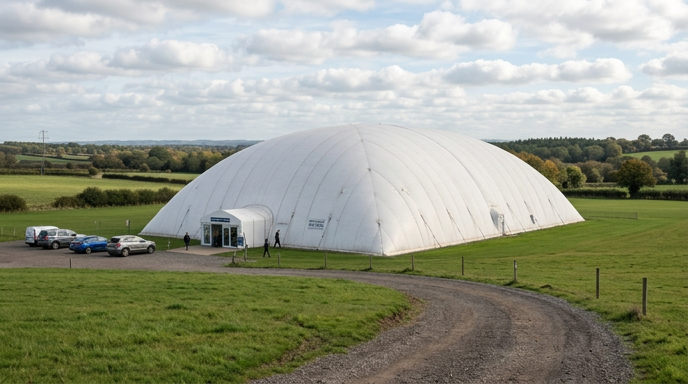
You can find excellent air dome options well within your $200K budget, starting as low as $27,600 for DIY aircrete domes or $30,000 for small air structures from Broadwell Air Domes. Pre-owned units offer the best value, with discounts of 50-75% off retail prices – large structures that originally cost $418,500 can be found for around $200,000. These domes cost 50-75% less than traditional buildings and install in just 1-2 days. There’s much more to explore about maximizing your investment.
Affordable Dome Options Under $50K
While traditional sports facilities require substantial capital investment, several affordable dome options can fit within a $50,000 budget and provide year-round protection for your activities.
You’ll find small air domes designed for personal use starting at $30,000 through companies like Broadwell Air Domes. These structures offer quality materials suitable for various applications at approximately $12 per square foot.
For an even more budget-friendly approach, you can construct air-crete domes yourself. A complete 1,000-square-foot studio costs around $27,600 including plumbing, electrical, and fixtures.
Basic materials alone run about $4,000 for the dome structure. This affordable sports dome solution uses lightweight air-crete that expands concrete five to seven times, dramatically reducing material costs while providing durable, insulated protection. These dome structures feature superior sound insulation that makes them ideal for containing noise from active sports and recreational activities.
Small Air Domes: 100-Foot Structures
Stepping up from personal-use domes brings you to 100-foot air dome structures that offer considerably more space for sports and recreational activities.
These budget air dome options cost between $10,000–$30,000 for the dome structure alone, covering approximately 7,854 square feet. You’ll pay $10–$25 per square foot for the basic structure, with complete packages starting at $12 per square foot minimum.
Installation takes just 1–2 days for small domes, making them highly cost-effective. Professional advice is recommended when determining the appropriate size and specifications for your specific project requirements.
Your total project costs include structural engineering ($20,000 approximately) and foundation work that varies by soil conditions.
Annual operating expenses remain reasonable at $0.50–$1.50 per square foot for utilities, plus basic maintenance costs of $0.10–$0.20 per square foot annually.
DIY Dome Kits vs Ready-Made Units
When choosing between DIY dome kits and professionally installed units, you’ll face a fundamental trade-off between cost savings and convenience.
DIY options like aircrete domes cost around $27,600 complete, while geodesic kits offer even cheaper alternatives. You’ll handle most construction yourself, requiring minimal experience but accepting potential timeline delays spanning weeks or months.
Ready-made units provide professional installation within one to two days, offering unlimited customization and reliable schedules. However, costs increase considerably with professional crews and equipment.
If you’re seeking a cheap tennis bubble alternative, DIY prefabricated panels deliver the best compromise – you’ll get standardized components with manageable assembly requirements while maintaining budget control. These larger formed panels enable easy on-site assembly compared to complex geodesic frameworks.
Professional services excel when you need complex designs or can’t afford construction delays.
Pre-Owned Domes: Best Value Finds
Beyond new installations, pre-owned air domes deliver exceptional value for budget-conscious buyers seeking proven structures at significant discounts.
You’ll find used domes marketed at 50-75% off original retail prices, with large-scale structures like 42m x 42m domes dropping from $418,500 to $200,000.
Pre-owned domes are graded on a 1-3 scale, with condition 1-2 indicating near-new status.
“Like new” units often feature minimal use—sometimes just single 10-day deployments—with full functionality and waterproofing intact. Buyers report cost savings of 30-60% compared to purchasing new air domes from manufacturers.
You can source these through Chinese manufacturers, certified resellers with warranty documentation, and marketplace aggregators listing 46,000+ products from 12,000+ suppliers.
Setup remains efficient at 4 hours to one day, while emergency systems and wind ratings guarantee operational reliability.
Air Dome Costs vs Traditional Buildings
While pre-owned domes offer substantial savings, you’ll discover even greater value when comparing air dome costs against traditional building construction. A low cost air dome structure costs 50–75% less than conventional buildings, with prices ranging $10–$25 per square foot versus traditional facilities requiring $5–$10 million investments.
| Factor | Air Dome | Traditional Building |
|---|---|---|
| Construction Cost | $1–$3 million | $5–$10 million |
| Installation Time | 1–2 days | Months/years |
| Annual Operations | $3–$6/sq ft | Considerably higher |
| Energy Consumption | 60% less | Standard rates |
You’ll benefit from faster installation timelines and lower operational expenses. Air domes require minimal on-site construction since manufacturing occurs off-site, while traditional buildings demand extensive planning and labor-intensive procedures that dramatically increase your total investment. The inflatable structure can be easily relocated or resized to accommodate different seasonal needs or venue requirements.
Frequently Asked Questions
What Permits and Zoning Approvals Are Required for Air Dome Installation?
You’ll need building permits in most U.S. jurisdictions before installing your air dome.
Submit detailed plans and specifications to your local building department for approval. Licensed engineers must stamp all project elements, costing around $20,000.
Check your local zoning laws since regulations vary considerably by municipality. Verify square footage thresholds and setback requirements with local authorities.
Rural areas typically have more relaxed regulations than urban zones.
How Long Does Typical Air Dome Installation Take From Start to Finish?
You’ll need 1-3 days for a single-court air dome installation.
Day one covers delivery, site prep, and positioning.
Day two includes electrical work and ductwork installation.
Day three involves testing and final inspection.
Expert teams can complete smaller domes in just 1-2 days.
However, if you’re adding custom features or dealing with complex site conditions, you might need additional time for proper setup and calibration.
What Ongoing Maintenance Costs Should I Budget for Annually?
You should budget 7-12% of your initial dome investment for annual maintenance costs. For a $130K installation, that’s roughly $9,000-$16,000 yearly. This covers routine inspections, repairs, and part replacements.
Additionally, expect $0.10-0.20 per square foot for inflation unit operation and $0.50-1.50 per square foot for utilities like heating and lighting.
Regular preventive maintenance will extend your dome’s lifespan and minimize costly emergency repairs.
Can Air Domes Withstand Severe Weather Like Hurricanes or Heavy Snow?
Yes, air domes can withstand severe weather. They’re engineered to handle hurricanes up to 67m/s (level 16 typhoons) and snow loads exceeding 250kg/sqm.
The structures increase interior air pressure during storms, making walls more rigid. Steel cable harness systems provide reinforcement against high winds, while membrane tops actively shed snow to prevent dangerous accumulation.
They’re designed to meet local building codes for your specific climate conditions.
What Happens if the Power Goes Out During Operation?
Your air dome’s equipped with emergency backup systems that automatically activate during power outages.
Generator-driven systems maintain dome inflation when primary power fails, operating without manual intervention.
However, you’ll need to evacuate everyone immediately upon power failure for safety.
Your emergency plan should include designated evacuation routes, assembly areas, and trained personnel with flashlights to guide occupants safely out from under the dome edges.
Leave a Reply