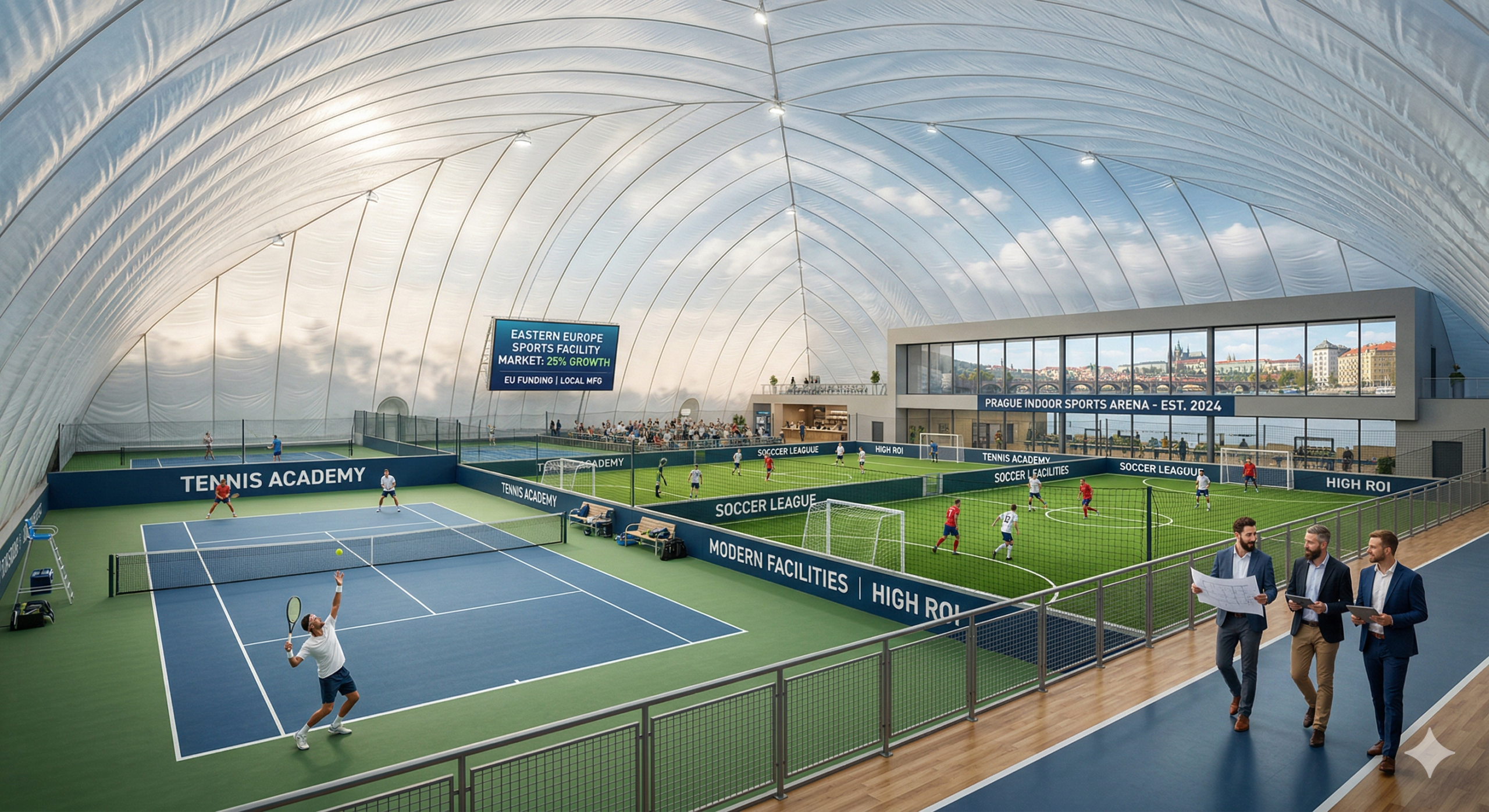
You’ll pay between $250,000 and $4.6 million for a multi-court air dome, with tennis facilities on the lower end and football domes commanding premium prices. Foundation and site preparation alone consume 20-40% of your total budget, while operating costs run $3-6 per square foot annually. Material quality, size, and installation complexity drive pricing, but larger structures offer better per-square-foot value. Understanding these cost factors will help you make informed decisions about your facility investment.
Total Air Dome Costs by Sport and Size
When planning your air dome investment, understanding sport-specific costs helps you make informed decisions about facility size and configuration.
Tennis facilities offer excellent multi court air dome cost efficiency, with four-court configurations ranging from $250K-$400K for basic structures, though premium installations reach $2.9 million. Your 4 court tennis bubble cost depends heavily on amenities and membrane quality.
Large sports dome pricing varies considerably by sport. Baseball domes cost $1.6-$4.2 million, while football facilities range $2.2-$4.6 million. Soccer domes fall between $2.1-$4.2 million. Specialty sports like lacrosse command $2.3-$4.2 million, and golf driving ranges cost $2-$3.4 million.
Per-square-foot costs range $10-$50 for membrane systems, plus $10 for site preparation. These durable materials result in fewer replacements and lower long-term operational costs.
Multi-sport configurations covering 120,000 square feet maximize your investment by accommodating multiple playing surfaces under one structure.
What Drives Air Dome Pricing (Materials, Labor, and Site Factors)?
Understanding air dome pricing requires examining five critical cost drivers that determine your final investment.
Material quality greatly impacts costs—durable vinyl and reinforced PVC command premium pricing but reduce long-term maintenance expenses compared to lower-quality alternatives.
Size affects pricing exponentially, though larger structures like a multiple tennis court dome achieve better per-square-foot rates starting at $12.
Installation complexity scales with dimensions, requiring specialized labor and extended timelines. Air domes offer faster installation compared to traditional permanent structures, reducing overall project costs.
Site-specific conditions dramatically influence foundation costs, with hybrid grade beam systems representing major expenses.
Additional features including LED lighting, HVAC systems, and specialized doors add substantial costs beyond base packages.
For a 6 court indoor facility cost, these factors combine to create considerable pricing variations depending on your specific requirements and location.
Foundation and Site Preparation Expenses
Foundation and site preparation represent the largest variables in your multi-court air dome budget, often accounting for 20-40% of total project costs.
Foundation expenses range dramatically from $3,795 for small projects to $350,000+ for large commercial installations. Your costs depend heavily on soil composition, frost line depth, and local wind codes—factors that can create $1,200-$3,200 variations between contractor quotes.
You’ll need grade-beam concrete foundations with angle iron anchoring for standard installations, though earth anchors work for temporary setups.
Geographic location greatly impacts pricing, as seen with Michigan’s 100,000 sq.ft. dome requiring a $350,000 hybrid foundation system. Professional installation teams will conduct an initial assessment of site conditions before beginning foundation work.
Flat terrain with minimal frost requirements reduces excavation expenses, while poor soil conditions demand deeper footings and specialized anchoring solutions.
Air Dome Engineering and Permit Costs
Professional engineering and permit costs will add approximately $20,000 to your multi-court air dome project, representing a fixed expense that doesn’t scale proportionally with dome size.
You’ll need licensed engineers to stamp structural and mechanical components, ensuring compliance with International Building Code (IBC) and ASCE 55-16 standards across all jurisdictions.
Your engineering team must maintain proper licensing across multiple states and countries, with requirements varying by location.
They’ll prepare essential permit drawings for local construction approval, with documentation standards determined by each permitting authority.
Additional costs may arise from supplementary services like civil engineering for site conditions, electrical work for HVAC systems, or architectural services.
These expenses depend on your specific site requirements and local code variations beyond standard structural and mechanical engineering work. The engineering process helps determine the complete dome package scope and final project cost through comprehensive analysis.
Interior Equipment and Flooring Investment
While engineering costs remain fixed regardless of dome size, your interior equipment and flooring investment scales directly with facility dimensions and intended sports applications.
Hard court surfaces integrate into your overall square footage pricing, while specialized options like clay courts and artificial turf systems require additional base layers and material considerations.
Your flooring selection greatly impacts total costs:
- Modular plastic tiles enable quick installation and replacement for tennis and pickleball facilities.
- Clay court installations vary in expense based on material quality and maintenance requirements.
- Artificial turf systems require base preparation, quality selection, and infill materials.
- Hard court surfaces offer durability for multi-sport use with integrated pricing.
Standard equipment additions include net systems, scoreboards, bleachers, and sport-specific goals within your extensive dome investment. All facilities include energy-efficient LED lighting systems that contribute to reduced operational costs over time.
HVAC, Lighting, and Climate Control Systems
Beyond structural and flooring investments, your HVAC, lighting, and climate control systems represent critical operational components that directly impact both upfront costs and long-term facility performance.
These systems are engineered based on your local weather conditions and designed to handle wind and snow loads specific to your region.
Your facility includes high-performance air blowers integrated into the dome structure, plus water heaters and air conditioning units.
Energy-efficient LED lighting systems are customizable for multi-court facilities, with ball-resistant options designed specifically for sports applications.
You’ll need professional HVAC technician hookup and a licensed electrician for proper installation.
Multiple HVAC configurations are available, including backup blower engines and gas heaters requiring natural gas hookup for supplemental heating operations.
Air Dome vs Permanent Building Cost Comparison
When evaluating facility options, you’ll find air domes offer substantial cost advantages over permanent structures.
Air-supported dome facilities typically cost $1–$3 million including all systems, while permanent sports buildings range from $5–$10 million for standard metal structures. This represents savings of 50–75% compared to traditional construction.
The cost differential becomes clear when examining key factors:
- Material costs – Air domes use $10–$25 per square foot versus expensive steel framing systems.
- Construction timeline – Installation takes days or weeks versus months or years for permanent buildings.
- Labor requirements – Minimal on-site assembly compared to complex traditional construction procedures.
- Foundation needs – Simplified anchoring systems versus extensive structural support requirements.
You’ll achieve faster deployment while notably reducing your overall project investment.
Operating Costs and Long-Term ROI Analysis
Understanding upfront costs represents only part of your financial planning equation.
You’ll face annual operating expenses of $3–$6 per square foot, with utilities consuming $0.50–$1.50 per square foot yearly.
A three-court tennis dome costs $60,000–$80,000 for four-month seasonal operation, while year-round facilities require approximately $100,000 annually including mortgage and utilities.
Your ROI improves considerably with continuous operation since year-round availability maximizes booking revenue and programming opportunities.
However, you’ll need continuous air pressure maintenance, increasing energy consumption compared to seasonal structures.
Factor in staffing expenses for coaching and facility management, plus mandatory insurance coverage.
Large multi-sport domes can reach $500,000 in annual operating costs, but their revenue potential justifies the investment through diverse programming and extended operational capacity.
Frequently Asked Questions
Can Air Domes Withstand Extreme Weather Conditions Like Hurricanes and Heavy Snow?
Yes, you’ll find air domes are engineered to handle extreme weather exceptionally well.
They’ll withstand hurricanes up to 67m/s and heavy snow loads exceeding 250kg/sqm. You’ll experience minimal displacement during high winds – less than 10cm compared to competitors’ 2m deflection.
The structures operate reliably from -55°C to +70°C, and you’re protected by triple redundancy inflation systems plus bias harness cable networks that distribute forces evenly.
What Financing Options Are Available for Multi-Court Air Dome Construction Projects?
You’ve got several financing options for multi-court air dome projects.
Commercial leasing through companies like Grenke Leasing and LED.Finance offers flexible payment terms.
Personal loans up to $100,000 are available through third-party lenders without collateral.
You can also pursue public grants like UPARR and Land Water Conservation Fund, or explore private funding through USA Track & Field Foundation.
Alternative strategies include sponsorship agreements, crowdfunding campaigns, and local fundraising efforts.
How Long Does It Typically Take to Construct a Multi-Court Air Dome?
You’ll typically complete a multi-court air dome construction in 12-16 weeks total.
Once your foundation’s ready, the dome installation and inflation happens incredibly fast—just 2-5 days for most projects.
However, you’ll need to account for the pre-construction phase including engineering, permits, and manufacturing, which takes 8-12 weeks.
Larger multi-court facilities may extend the timeline slightly, but you’ll still be operational months faster than traditional construction methods.
Are There Zoning Restrictions or Permits Needed Specifically for Air Dome Structures?
You’ll need operational permits for air domes exceeding 400 square feet, plus compliance with Type II-B building code classification.
Your application must include site plans, dimensions, fire safety assessments, and egress verification.
You’re limited to one-story structures with specific height restrictions.
Check local zoning since regulations vary by municipality – some areas have additional requirements if you’re within 540 feet of residential zones.
What Happens if the Air Dome Membrane Gets Damaged or Punctured?
You’ll face different repair options depending on damage size.
Small tears under 50mm can be patched with reinforcement, while larger damage over 300mm requires factory repair or replacement.
You can detect punctures using soapy water to spot bubbles or listening for escaping air.
Most repairs need specialized techniques like heat welding for PVC membranes and require 24-hour curing before you can reinflate the dome safely.
Leave a Reply