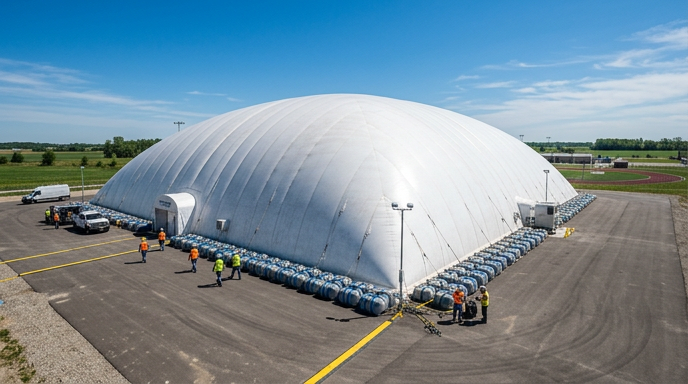
You’re looking at a market that’s quietly transforming Australia’s sports landscape. While traditional indoor facilities demand million-dollar investments and lengthy construction timelines, air dome technology has slashed those barriers by up to 70%. This shift isn’t just about cost savings—it’s creating opportunities in suburbs and regional areas that couldn’t previously support indoor sports complexes. However, what most operators don’t realize is how Australia’s unique regulatory environment could make or break their investment decisions.
Air Dome vs Traditional Indoor Sports Facility Costs in Australia
When you’re evaluating indoor sports facility options in Australia, air domes offer substantial cost advantages over traditional brick-and-mortar structures.
An air dome Australia installation typically costs AUD $120K-$350K for facilities ranging from 700-2,000 square meters. In contrast, traditional indoor sports buildings require considerably higher investments, often exceeding $1-2 million for comparable spaces when factoring in construction materials, labor, and extended building timelines.
Air domes eliminate expensive foundation work, structural steel, and roofing systems that traditional facilities demand.
You’ll also benefit from faster installation times, typically completing your project within weeks rather than months. Operating costs remain lower due to the dome’s insulation properties, which work effectively in Australia’s moderate climate.
The inflatable structure’s efficiency makes it particularly attractive for sports entrepreneurs seeking quick market entry.
Why Australia’s Climate Gives Indoor Sports Facilities a Cost Advantage
Australia’s moderate climate greatly reduces your operational expenses compared to indoor sports facilities in extreme weather regions.
You’ll spend considerably less on heating costs since temperatures typically range from 10-35°C (50-95°F), eliminating the need for expensive winter heating systems common in colder climates.
Your primary climate control focus shifts to heat and UV protection rather than battling freezing temperatures or extreme heat waves. This translates to lower energy bills and reduced HVAC maintenance costs throughout the year.
When you invest in an Australia air dome, you’re capitalizing on these natural advantages.
The moderate conditions mean your facility operates more efficiently, with less strain on climate control systems.
Your insurance costs may also decrease due to reduced weather-related risks, making Australia an ideal location for cost-effective indoor sports facility operations.
State-by-State Regulations for Australian Indoor Sports Facilities
While Australia’s favorable climate reduces your operational costs, you’ll need to navigate different regulatory requirements depending on which state you choose for your indoor sports facility.
Each state maintains distinct building codes, zoning laws, and safety standards that’ll impact your Australian sports facility development timeline and budget.
New South Wales requires thorough development applications for commercial sports facilities, while Queensland emphasizes cyclone-resistant construction in northern regions.
Victoria focuses heavily on fire safety compliance and accessibility standards.
Western Australia prioritizes energy efficiency requirements, and South Australia mandates specific ventilation standards for enclosed sports venues.
You’ll encounter varying permit processing times, from 6-16 weeks depending on your location.
Planning approval costs range from AUD $5,000-$25,000 across states.
Consider engaging local consultants who understand regional nuances to streamline your approval process and guarantee full compliance.
Australia’s Indoor Sports Facility Market Growth and Opportunities
Despite traditional outdoor sports dominance, Australia’s indoor sports facility market is experiencing unprecedented growth, creating lucrative opportunities for savvy investors and operators.
You’ll find the strongest expansion in Melbourne, Sydney, and Brisbane, where population density and year-round demand drive profitability.
The Australia indoor sports sector benefits from moderate climate conditions, reducing operational heating costs compared to colder regions.
You’re looking at investment ranges from AUD $120K-$350K for air dome facilities covering 700-2,000 square meters.
Key opportunities include multi-sport complexes, specialized training centers, and youth development facilities.
You can capitalize on growing participation rates in basketball, futsal, and racquet sports.
Urban densification creates space constraints, making indoor facilities increasingly valuable.
Smart operators focus on maximizing facility utilization through diverse programming and community partnerships.
Leave a Reply