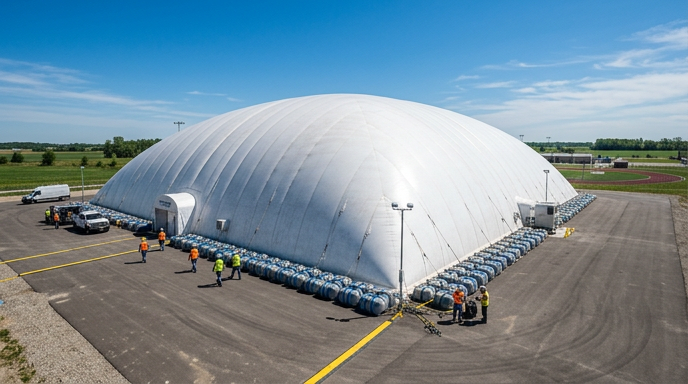
You’re looking at a European indoor sports facility market that’s fundamentally different from what you’ll find across the Atlantic. While the UK, Germany, and Scandinavian countries control nearly three-quarters of the market activity, you’ll face stricter regulations, higher upfront costs, and completely different design priorities than American buyers expect. What’s driving these regional differences—and more importantly, how they’ll impact your facility investment—requires understanding Europe’s unique approach to indoor sports infrastructure.
Top European Indoor Sports Facility Markets
When you’re considering expansion into European indoor sports facilities, you’ll find that the UK leads the market with its robust demand for year-round sports infrastructure.
Germany follows closely, driven by strong government support for community sports programs and athletic development initiatives.
Scandinavian countries represent premium markets where you’ll encounter sophisticated buyers willing to invest in high-quality indoor facilities. Norway, Sweden, and Denmark prioritize energy-efficient designs that withstand harsh winter conditions.
The Netherlands rounds out the top tier, offering consistent demand for versatile sports facilities solutions.
You’ll discover that Dutch buyers often prefer sports dome structures for football training and multi-sport applications.
These four regions account for approximately 70% of European market activity, presenting your best opportunities for sustainable growth and partnership development.
Leading Indoor Sports Facility Suppliers in Europe
Two major suppliers dominate Europe’s indoor sports facility landscape, each bringing distinct strengths to the market.
DUOL, based in Slovenia, has established itself as a leading force in the European air dome market, specializing in innovative membrane structures that serve diverse sporting applications.
Meanwhile, Broadwell from the UK offers extensive solutions with strong engineering expertise and local market knowledge.
You’ll find these suppliers understand Europe’s stringent regulatory environment, ensuring all facilities meet CE marking requirements and comply with EN standards.
Their experience maneuvering through these complex regulations gives them significant advantages over international competitors.
Both companies have adapted their offerings to European preferences, providing energy-efficient solutions that address the region’s sustainability concerns while delivering the robust performance standards European clients demand.
Indoor Sports Facility Costs and Budget Planning
Planning your indoor sports facility budget requires understanding that European costs typically run 10-20% higher than comparable US projects.
You’ll need to account for CE marking requirements and EN standards compliance, which add regulatory expenses but guarantee quality and safety.
For a standard 2,000 square meter (21,528 square foot) facility, expect costs between €400,000-€800,000.
This wide range depends on your chosen features, location, and complexity.
Northern European markets like Germany, UK, and Scandinavia command premium pricing due to stricter regulations and higher labor costs.
You should factor in additional expenses beyond basic construction: site preparation, utilities, permits, and ongoing maintenance.
Consider partnering with established suppliers like DUOL or Broadwell who understand European compliance requirements and can streamline your approval process.
European Indoor Sports Facility Standards and Regulations
Before you can break ground on your European indoor sports facility, you’ll need to maneuver through the continent’s extensive regulatory framework. CE marking stands as your primary compliance requirement, ensuring your structure meets essential health and safety standards across all EU member states.
You’ll must adhere to EN standards, which cover everything from structural integrity to fire safety protocols. These European Norms dictate specific requirements for load-bearing capacity, ventilation systems, and emergency egress routes.
Building codes vary by country, but most follow similar foundational principles established by the European Committee for Standardization.
Planning permission processes typically take 3-6 months longer than US equivalents. You’ll encounter stricter environmental impact assessments and noise regulations, particularly in densely populated areas.
Working with local regulatory consultants becomes essential for maneuvering through country-specific requirements efficiently.
Standard Indoor Sports Facility Sizes and Specifications
You’ll find that European indoor sports facilities typically range from 1,500 to 3,000 square meters, with the standard 2,000 sq m facility being most common across the region.
Your facility must meet specific technical requirements including minimum ceiling heights of 7-12 meters depending on the sport, proper ventilation systems, and adequate lighting levels measured in lux.
When planning your space, you’ll need to account for playing areas, spectator zones, changing rooms, and equipment storage while ensuring compliance with EN standards for each component.
Common Facility Dimensions
Since European sports facilities must accommodate multiple activities within standardized dimensions, understanding common facility sizes becomes essential for project planning. You’ll find that most European indoor facilities follow standardized measurements that guarantee multi-sport functionality while meeting EN standards compliance requirements.
| Facility Type | Dimensions (m) | Square Meters |
|---|---|---|
| Basketball/Volleyball Court | 28 x 15 | 420 |
| Tennis Court | 36 x 18 | 648 |
| Multi-Purpose Hall | 40 x 20 | 800 |
| Football Training Facility | 60 x 40 | 2,400 |
| Athletics Training Center | 80 x 40 | 3,200 |
You’ll notice that typical facilities range from 420 to 3,200 square meters, with the standard 2,000 square meter facility costing €400K-€800K. These dimensions accommodate CE marking requirements and allow for proper clearance zones essential in European markets.
Technical Specification Requirements
When designing indoor sports facilities across Europe, technical specifications must align with stringent EN standards that govern everything from structural integrity to environmental controls.
You’ll need CE marking compliance for all structural components, ensuring your facility meets European Conformity requirements.
Your building systems must incorporate proper ventilation rates, typically 6-8 air changes per hour for active sports areas, while maintaining temperature control between 16-20°C.
You’ll require specific lighting standards, with minimum 300 lux for recreational activities and up to 750 lux for competitive sports.
Acoustic performance standards demand noise reduction coefficients between 0.85-0.95 for ceiling materials.
Safety specifications include emergency exits every 30 meters maximum, fire-resistant materials rated Class A1 or A2, and impact-resistant glazing.
Floor specifications must meet EN 14904 standards for sports surfaces, ensuring proper shock absorption and ball rebound characteristics.
Space Planning Standards
Proper dimensioning forms the foundation of any successful indoor sports facility, with European standards dictating minimum court sizes that often exceed international norms.
You’ll need to allocate 40m x 20m for basketball courts, while volleyball requires 18m x 9m playing areas plus 3m safety zones. Tennis courts demand 36.57m x 18.29m including run-off space.
When planning multi-sport facilities, you should consider ceiling heights of 7-12 meters depending on activities.
Football pitches need 40m x 20m minimum for 5-a-side games. Your typical 2,000 square meter facility accommodates two basketball courts or four badminton courts simultaneously.
European facilities emphasize accessibility compliance, requiring wheelchair-accessible entrances, changing rooms, and spectator areas.
You’ll also need designated spaces for equipment storage, first aid stations, and administrative offices to meet EN standards certification requirements.
Key Indoor Sports Facility Cost Factors vs US Markets
Although European indoor sports facilities offer comparable quality to their American counterparts, you’ll find construction costs running 10-20% higher across most markets. This premium stems from stricter regulatory requirements, including mandatory CE marking and EN standards compliance that don’t exist in US construction.
Material costs contribute greatly to the price difference. European steel and specialized sports flooring typically cost more due to transportation expenses and local manufacturing limitations.
You’ll also encounter higher labor rates, particularly in Germany, Scandinavia, and the Netherlands where skilled construction workers command premium wages.
Regulatory complexity adds another cost layer. You must navigate country-specific building codes, environmental regulations, and safety standards that vary across EU markets.
Despite these factors, a typical 2,000 square meter facility ranges from €400K-€800K, representing solid value given Europe’s quality standards.
Leave a Reply