Blog

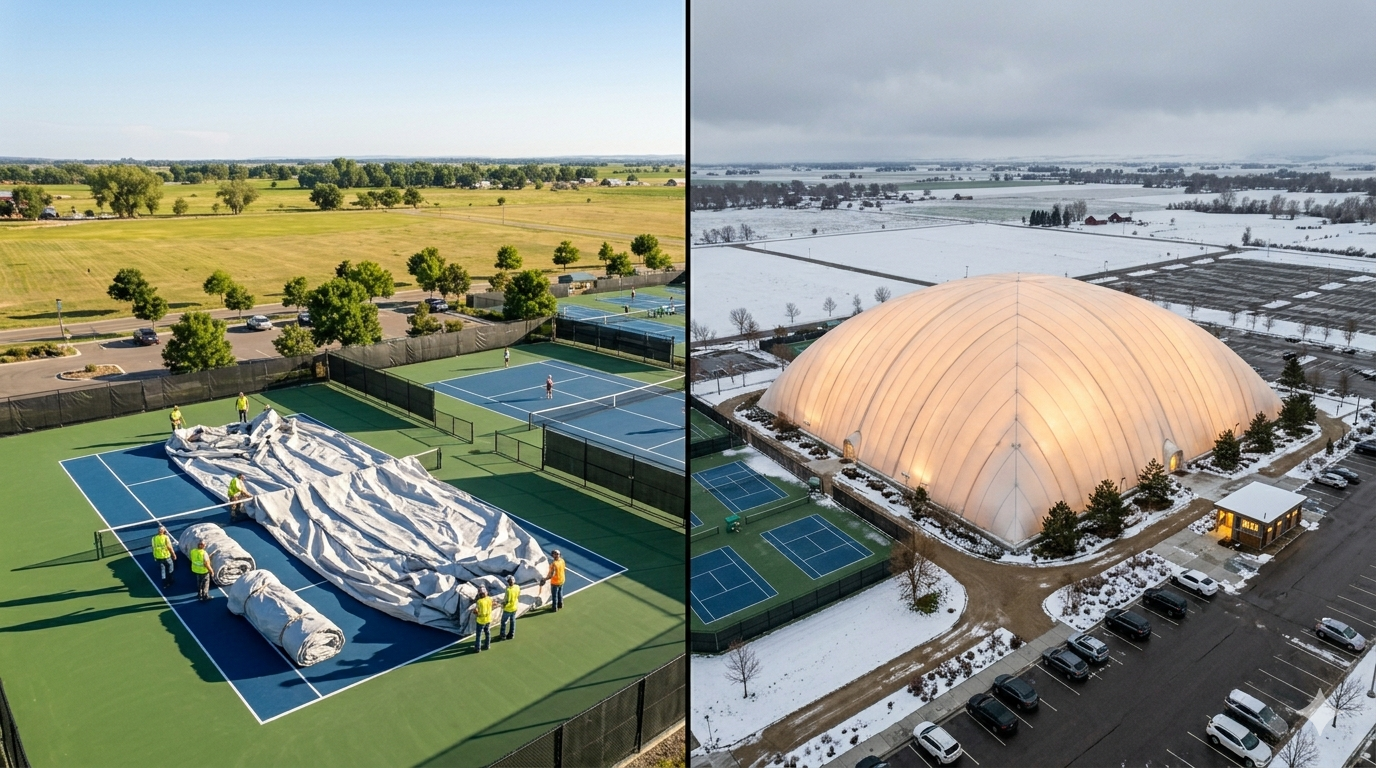
  • Seasonal vs Permanent Air Dome: Which Is Right for Your Facility?

    Seasonal vs Permanent Air Dome: Which Is Right for Your Facility?

    Choosing between a seasonal and a permanent air dome is one of the most consequential decisions in any sports facility project. Get it right and you match your capital and operating cost profile to your actual usage pattern. Get it wrong and you either overpay in capital, or lose revenue you could have captured.


    The core difference

    Seasonal dome: erected in autumn, deflated and removed in spring. The membrane and mechanical equipment are stored during the off-season.

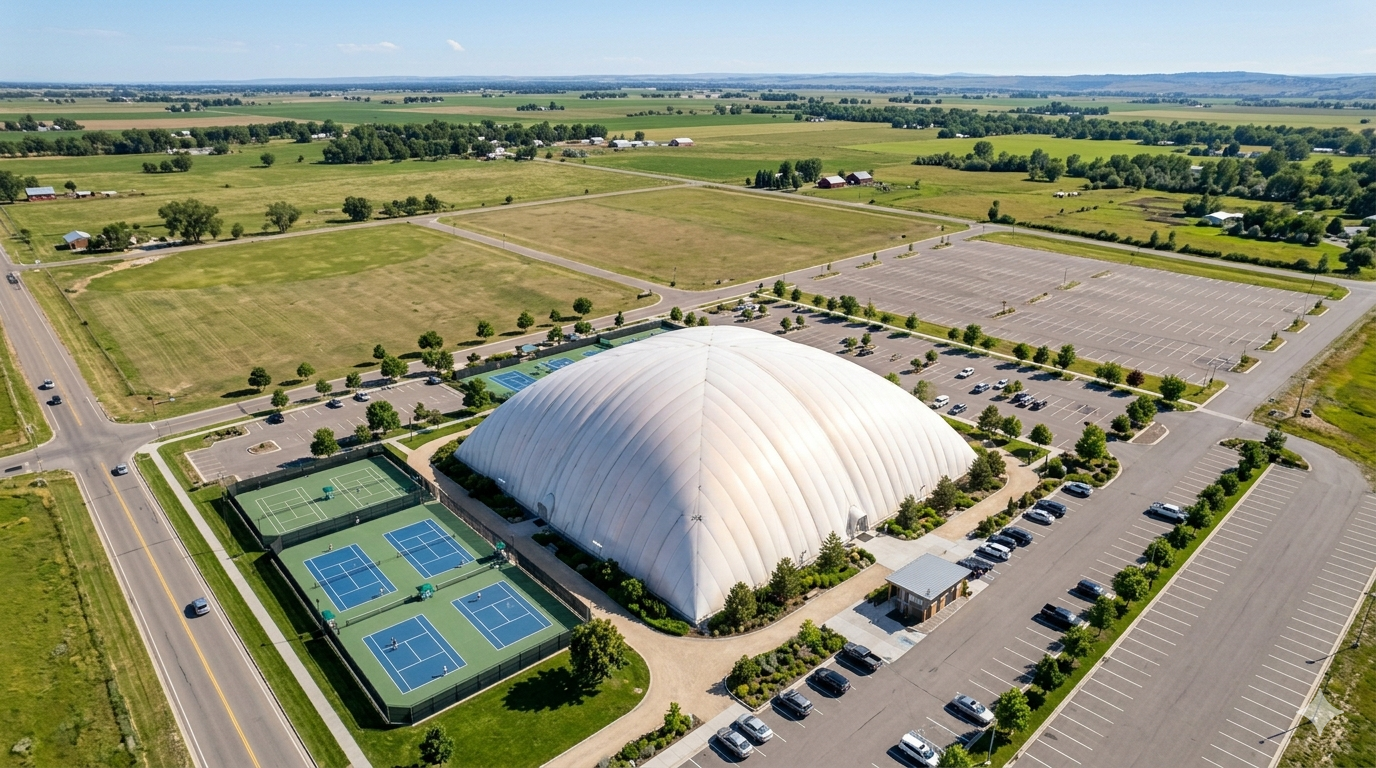
    Permanent dome: installed once and remains in place year-round. Provides 12-month indoor capacity.


    Head-to-head comparison

    FactorSeasonal domePermanent dome
    Capital cost60–75% of equivalent permanent100% baseline
    Annual installation/removal£10,000–£30,000 / $12,000–$38,000None
    FoundationGround anchors or ballastConcrete ring beam (typically)
    Summer incomeOutdoor courts generate revenueFull indoor revenue 12 months
    PlanningOften permitted as temporary structureUsually requires full planning permission
    Membrane lifespan15–25 years12–20 years (same material, more UV)
    Revenue potential5–7 months indoor / 5–7 months outdoor12 months indoor
    Break-even periodTypically 2–4 yearsTypically 4–7 years

    When a seasonal dome is the right choice

    1. You already have high-value outdoor courts or pitches in summer.
    2. Your market is in a temperate climate with defined playing seasons.
    3. Your capital budget is constrained.
    4. Planning permission for a permanent structure is difficult.

    Typical seasonal dome payback period:

    Dome sizeCapital costAnnual dome income (net)Payback
    2-court tennis bubble$150,000–$240,000$55,000–$90,0002–3 years
    4-court tennis / pickleball$320,000–$550,000$100,000–$200,0002–4 years
    Small soccer dome$480,000–$750,000$120,000–$250,0003–5 years

    When a permanent dome is the right choice

    1. Your climate is cold or wet for most of the year.
    2. You want to build a full indoor sports business.
    3. You are covering new courts rather than existing ones.
    4. You have a long lease or own the land outright.
    5. Energy cost management is a priority.

    Typical permanent dome payback period:

    Dome sizeCapital costAnnual dome income (net)Payback
    4-court tennis dome$500,000–$800,000$110,000–$220,0003–6 years
    Multi-sport (5-a-side + courts)$800,000–$1,500,000$180,000–$380,0004–6 years
    Large indoor sports centre$2,000,000–$4,000,000$350,000–$800,0005–8 years

    The total cost of ownership comparison (4-court dome, 20 years)

    Cost elementSeasonal domePermanent dome
    Year 0 capital cost$420,000$600,000
    Annual install/removal (20 years)$280,000 total$0
    Energy costs (20 years)$450,000 total$650,000 total
    Membrane replacement (year 15)$90,000$120,000
    Maintenance (20 years)$160,000 total$180,000 total
    Total 20-year cost$1,400,000$1,550,000
    Approximate revenue (20 yrs)$2,400,000$4,600,000
    Net 20-year position+$1,000,000+$3,050,000

    Decision framework

    QuestionLean seasonal if…Lean permanent if…
    What is your summer outdoor revenue?HighLow or zero
    How many months per year is outdoor sport impractical?4–6 months7+ months
    What is your lease length on the site?Under 15 years15+ years or freehold
    Do you need 12-month revenue certainty?NoYes
    Is planning permission for permanent structure viable?NoYes

    HeroX AirDomes has installed both seasonal and permanent air-supported structures across the US, UK, Europe, and UAE.

    Keywords: seasonal dome, permanent dome, seasonal vs permanent air dome, dome comparison, dome capital cost, dome payback period, dome total cost of ownership, dome planning permission, dome lease, dome revenue, dome winter operation, dome year-round, dome installation removal, dome ROI, dome decision framework, sports dome investment, dome break-even

  • Air Dome Cost Guide 2026: What You’ll Actually Pay

    Air Dome Cost Guide 2026: What You’ll Actually Pay

    Understanding what an air dome costs — and why — is one of the first things any serious buyer needs to nail down. The pricing ranges you find online vary wildly because air domes vary wildly in size, specification, climate requirements, and site conditions.

    This guide breaks down every cost component, gives you real price ranges by facility type, and explains what drives the biggest variances.


    The short answer: cost ranges by facility type

    These are complete turnkey project costs including membrane, foundations, airlocks, blowers, HVAC, LED lighting, and installation. They do not include the sports flooring, which is typically specified and quoted separately.

    United States (USD)

    FacilitySizeSeasonal domePermanent dome
    2-court tennis bubble~12,000 sq ft$120,000–$200,000$180,000–$320,000
    4-court tennis dome~22,000 sq ft$220,000–$400,000$350,000–$650,000
    4-court pickleball dome~18,000 sq ft$180,000–$320,000$280,000–$500,000
    Small multi-sport (soccer 5-a-side)~35,000 sq ft$350,000–$600,000$550,000–$950,000
    11-a-side soccer dome~100,000 sq ft$900,000–$1,800,000$1,500,000–$3,000,000
    Large multi-sport complex~150,000 sq ft$2,500,000–$5,000,000

    United Kingdom (GBP)

    FacilitySizeSeasonal domePermanent dome
    2-court tennis bubble~1,100 m²£95,000–£160,000£140,000–£260,000
    4-court tennis dome~2,000 m²£170,000–£320,000£280,000–£520,000
    Small multi-sport~3,200 m²£270,000–£480,000£440,000–£760,000
    Full 5-a-side soccer~3,800 m²£320,000–£560,000£520,000–£900,000
    11-a-side soccer dome~9,500 m²£750,000–£1,500,000£1,200,000–£2,500,000

    Europe (EUR)

    European pricing broadly tracks UK GBP on a 1:1 basis. Significant variation exists between western Europe (Germany, Netherlands, France — typically +10–20%) and eastern Europe (Poland, Romania, Czech Republic — typically −15–25%).


    Cost per square foot / square metre

    Dome specificationUSD per sq ftGBP per m²EUR per m²
    Basic single-skin seasonal$12–$18£80–£120€90–€140
    Standard double-skin insulated$25–$40£140–£240€160–€275
    High-performance triple-skin$40–$65£230–£380€265–€435

    A common rule of thumb: a well-specified permanent air dome costs roughly 25–35% of an equivalent permanent steel-and-concrete sports hall.


    What drives the cost?

    1. Membrane specification

    PE (polyethylene) membrane — lightest, lowest cost, lifespan 10–15 years. Suitable for seasonal structures in mild climates. Poor thermal performance.

    PVC-coated polyester — the industry standard. Weight typically 850–1,050 g/m². Lifespan 20–30 years. Good UV resistance, good structural performance, available in translucent grades.

    PVDF-coated / architectural PVC — premium specification with exceptional UV stability and self-cleaning properties. Lifespan 25–35 years.

    2. Skin count and insulation

    • Single-skin: U-value ~5.0 W/m²K. Suitable only for seasonal use or climates without cold winters.
    • Double-skin with air gap: ~U-value 1.5–2.5 W/m²K. Standard for year-round UK/northern Europe/northern US.
    • Double-skin with insulation layer: ~U-value 0.6–1.2 W/m²K. Recommended for facilities where heating cost is a major concern.
    • Triple-skin: ~U-value 0.3–0.6 W/m²K. Primarily specified for Scandinavia, Canada, and other severe-winter markets.

    3. Foundation and anchoring

    Anchoring methodRelative costBest for
    Continuous concrete ring beamHighest (adds 15–25% to total project cost)Permanent domes, high wind zones, large spans
    Helical ground anchorsMedium (adds 8–15%)Semi-permanent, good ground conditions
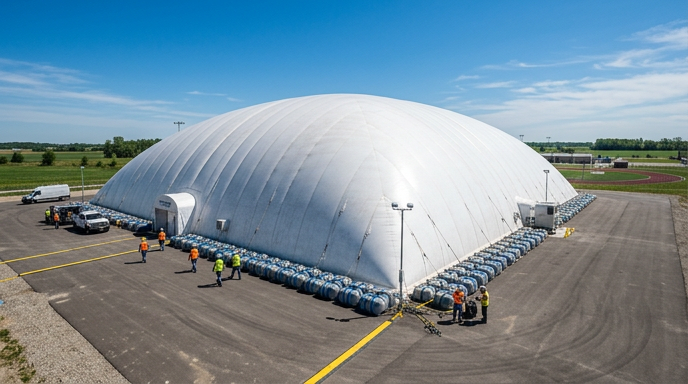
    Ballast / water-filled tubesLowest (adds 3–8%)Temporary/seasonal, low wind exposure

    4. HVAC and air management

    HVAC is typically 10–20% of total project cost. Options include warm-air units, underfloor heating, and heat pump systems.

    5. Airlock design

    • Revolving door airlock: ~£8,000–£20,000 / $10,000–$25,000 per unit.
    • Double-door vestibule: ~£4,000–£10,000 / $5,000–$12,000 per unit.

    6. Lighting

    LED lighting system cost: typically £15,000–£50,000 / $20,000–$65,000 depending on dome size and lux specification.


    Hidden costs buyers often underestimate

    • Planning / permits: allow 3–8% of project cost.
    • Site preparation: can add 10–20% for difficult sites.
    • Sports flooring: separate budget item. Artificial turf: £15–£80/m².
    • Project management and professional fees: allow 5–10% of total project.

    Annual operating costs

    Cost itemPer m² per yearPer sq ft per year
    Energy (blowers + heating + lighting)£15–£45 / €17–€52$3–$9
    Maintenance and inspections£2–£6 / €2–€7$0.40–$1.20
    Insurance£1.50–£5 / €1.75–€6$0.30–$1.00
    Seasonal labour (seasonal domes only)£4–£12 / €5–€14$0.80–$2.50
    Total operating (permanent dome)£18–£55 / €20–€63$3.50–$10.00

    What you should not cut to save money

    • Don’t skimp on membrane quality.
    • Don’t omit backup blower capacity.
    • Don’t undersize the foundation.

    HeroX AirDomes provides detailed itemised quotations for air-supported structures across the US, UK, Europe, and the UAE. Request a free feasibility assessment and indicative cost plan.

    Keywords: air dome cost, inflatable dome price, dome cost per square metre, dome cost per square foot, air dome pricing 2026, dome cost UK, dome cost USA, dome cost Europe, membrane specification cost, dome foundation cost, HVAC cost dome, airlock cost, LED lighting dome, dome running costs, dome operating costs, dome quote breakdown, air dome turnkey price, dome insulation cost, dome planning fees.

  • The Definitive Inflatable Dome Buying Guide (2026)

    The Definitive Inflatable Dome Buying Guide (2026)

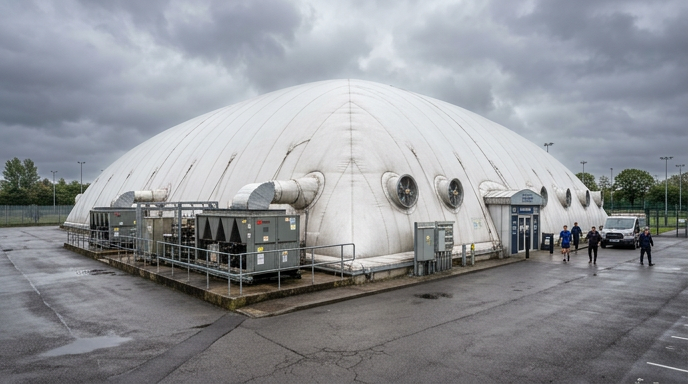
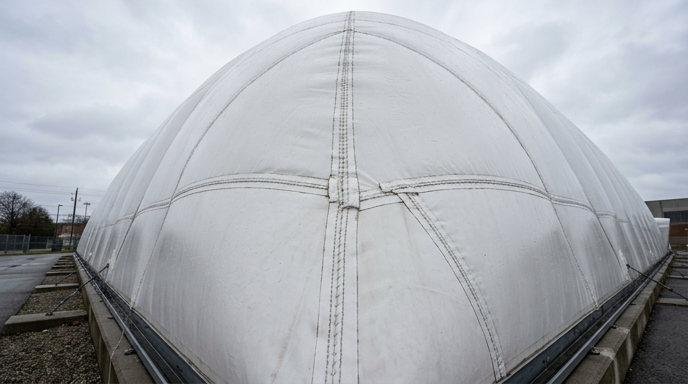
    Inflatable domes — also called air-supported structures, sports bubbles, or air domes — are large-span fabric enclosures held up entirely by slightly pressurised air. They are the fastest and most cost-effective way to create climate-controlled, column-free indoor space for sports, storage, events, or industry.

    This guide covers everything you need to know before buying: how they work, what they cost, what sports they suit, how long they last, and what the buying process actually looks like.


    What is an inflatable dome?

    An inflatable dome is a fabric membrane — typically PVC-coated polyester or polyethylene — anchored to a concrete ring beam or ground anchors. Industrial blowers maintain an internal air pressure of around 30–50 Pa (pascals) above ambient. That small pressure differential is enough to keep a membrane spanning 30–100+ metres with no interior columns.

    Entry is via an airlock vestibule or revolving door that maintains pressure while allowing people to pass through freely.

    They are not the bouncy-castle inflatables you see at fairs. Commercial air-supported domes are engineered to withstand snow loads of 50–100 kg/m², wind speeds above 100 km/h, and decades of continuous operation.


    Types of inflatable dome

    TypeDescriptionBest for
    Single-skinOne-layer membraneSeasonal use, warm climates, storage
    Double-skinTwo membranes with insulating air gapYear-round sports, cold climates
    Triple-skinThree layers with insulation pocketsArctic climates, premium facilities
    Seasonal domeInstalled in autumn, removed in springTennis clubs, soccer clubs covering existing courts
    Permanent domeYear-round, fully anchoredIndoor sports centres, 12-month revenue facilities

    What sports do inflatable domes cover?

    Inflatable domes are used across virtually every outdoor sport. The most common applications are:

    Tennis — The tennis bubble is the most established dome format globally. A standard seasonal bubble covering 2–4 courts is typically 25–30 m wide and 50–70 m long, allowing full ITF-compliant court dimensions plus run-off.

    Football / Soccer — Full-size 5-a-side, 7-a-side, and 11-a-side pitches. A regulation 11-a-side synthetic turf pitch requires a dome of approximately 80 × 120 m.

    Padel — One of the fastest-growing applications. A 4-court padel dome is typically 30 × 60 m.

    Pickleball — Surging in the US. Multiple pickleball courts can be covered in a relatively compact dome footprint.

    Golf — Driving range bays, short-game areas, and putting greens.

    Multi-sport — A single large dome can house several different court configurations simultaneously: basketball, volleyball, badminton, and futsal are commonly combined under one shell.

    Athletics — Throws cages, sprint tracks, and combined multi-event training facilities.

    Hockey — Field hockey and ice hockey (the latter requires a refrigeration system in the floor).


    How much does an inflatable dome cost?

    Costs vary based on size, skin type, insulation level, HVAC specification, and whether the dome is seasonal or permanent. The following ranges are indicative for a complete turnkey project including foundations, airlock, HVAC, and lighting.

    Facility typeApprox. sizeTypical cost range
    2-court tennis bubble (seasonal)1,000–1,500 m²£120,000–£220,000 / $150,000–$280,000
    4-court tennis / pickleball dome2,000–3,000 m²£280,000–£550,000 / $350,000–$700,000
    Small multi-sport dome2,500–4,000 m²£350,000–£700,000 / $450,000–$900,000
    Full soccer pitch dome9,000–12,000 m²£800,000–£2,000,000 / $1,000,000–$2,500,000
    Large multi-sport complex12,000–20,000 m²£1,500,000–£4,000,000 / $2,000,000–$5,000,000

    Cost per square metre / square foot:

    Dome specificationPer m²Per sq ft
    Basic single-skin seasonal£80–£120 / $15–$22
    Double-skin, insulated (standard)£140–£200 / $25–$38£13–£19 / $25–$38
    Triple-skin, high-performance£200–£350 / $38–$65£19–£33 / $38–$65

    These figures typically represent a 50–75% saving on equivalent permanent steel-and-concrete construction.


    Annual operating costs

    Running an inflatable dome is not free. The main ongoing expenses are:

    Energy — Blowers run 24 hours a day, 365 days a year (or seasonally). A 2,000 m² dome typically draws 7–12 kW for pressurisation. Heating in cold climates adds significantly: a well-insulated double-skin dome requires approximately 30–60 W/m² of heating capacity. Annual energy costs for a 2,000 m² dome range from £15,000–£45,000 / $20,000–$60,000 depending on climate and insulation specification.

    Maintenance — Annual inspection, blower servicing, anchor checks, minor fabric repairs: typically £3,000–£10,000 / $4,000–$12,000 per year.

    Insurance — Commercial inflatable structure insurance: typically £3,000–£12,000 / $4,000–$15,000 per year.

    Seasonal labour — For seasonal domes: installation and removal crew, typically £8,000–£25,000 / $10,000–$30,000 per year.

    Total operating cost benchmarks:

    Dome sizeAnnual operating cost range
    1,000–2,000 m²£25,000–£70,000 / $30,000–$90,000
    2,000–5,000 m²£50,000–£130,000 / $65,000–$160,000
    5,000–12,000 m²£100,000–£350,000 / $130,000–$450,000

    How long does an inflatable dome last?

    Membrane lifespan depends primarily on material quality and UV exposure:

    • Polyethylene (PE) membrane — 10–15 years. Lower cost, lighter weight, less durable.
    • PVC-coated polyester membrane — 20–30 years. Industry standard for commercial sports facilities.
    • PTFE / architectural fabric — 30–40 years. Premium specification, higher cost.

    Structural components (anchoring systems, airlocks, blowers) typically have serviceable lives of 15–25 years with regular maintenance.

    The blower system — typically 2–4 industrial fans with automated backup — should be serviced annually and replaced every 12–18 years.


    Installation timeline

    From contract signing to first use:

    PhaseTypical duration
    Engineering and drawings4–8 weeks
    Permitting (varies by jurisdiction)4–16 weeks
    Membrane manufacturing8–14 weeks
    Foundation and site preparation2–4 weeks
    Dome installation and inflation1–3 weeks
    HVAC, lighting, commissioning1–2 weeks
    Total from contract to first use5–9 months

    For seasonal domes on existing courts with simple ground anchors, the timeline can compress to 3–5 months. Planning permission is usually the longest variable.


    Key questions to ask before buying

    1. Permanent or seasonal? Permanent domes generate year-round revenue and have lower long-term labour costs; seasonal domes have lower capital costs and simpler planning routes.
    2. Single or double skin? In climates with winter temperatures below +5°C, a double-skin insulated dome pays for itself in energy savings within 3–5 years.
    3. What is the snow load rating? Ensure the structure is engineered for your local design snow load — this is a critical structural parameter, not a marketing claim.
    4. What blower redundancy is included? You need at least one backup blower on automatic failover. In cold climates, a diesel generator backup is also advisable.
    5. What anchorage system? A continuous concrete ring beam is the most secure and permanent anchor. Ground screws are faster and cheaper but have lower uplift resistance.
    6. Who installs? Ensure your supplier provides a supervised installation with a qualified structural engineer on site. Self-installation of large commercial domes is not advisable.
    7. What warranty covers what? Membrane, structure, blowers, and anchorage should each have clearly defined warranty periods. Industry standard is 5–10 years on membrane, 2–5 years on mechanical components.

    Inflatable dome vs traditional building: the key difference

    FactorInflatable domeTraditional building
    Capital cost25–50% of equivalent permanent structure100% baseline
    Build time6–12 weeks site time12–24 months
    Energy useModerate-high (continuous pressurisation)Lower (passive insulation)
    Lifespan20–30 years (membrane)40–60 years
    FlexibilityCan be relocated or removedFixed
    Column-free spanYes, up to 100+ mEngineering-dependent
    Planning classificationOften temporary structurePermanent building

    Is an inflatable dome right for your project?

    An inflatable dome is likely a strong fit if: – You need indoor space within 12 months – Budget constraints rule out permanent steel construction – You already own the land or courts to cover – Your market has demonstrable year-round demand – You operate in a climate where outdoor sports are interrupted for 3+ months per year

    It may not be the best option if: – You plan to operate for 30+ years and want the lowest possible lifetime cost – Your climate involves extreme sustained winds or ice loading beyond standard design parameters – Local planning authority requires permanent-structure classification – Your occupants expect a luxury, hotel-standard interior environment


    HeroX AirDomes designs, engineers, and installs air-supported structures across the US, UK, Europe, and the UAE. Contact us for a free feasibility assessment for your project.

    Keywords: inflatable dome, air dome buying guide, air-supported structure, sports bubble, dome types, single-skin dome, double-skin dome, triple-skin dome, seasonal dome, permanent dome, dome cost, dome lifespan, PVC membrane, dome installation timeline, dome vs traditional building, indoor sports facility, dome planning permission, dome warranty, dome HVAC, dome blower system

  • How a Transatlantic Friendship is Changing the Future of Energy

    How a Transatlantic Friendship is Changing the Future of Energy

    Have you ever looked out your window on a completely still, gray day and thought about the wind turbines sitting motionless on a distant hill? Or maybe you’ve watched a sudden rainstorm roll in and wondered what happens to the solar panels on your neighbor’s roof?

    I think about it a lot. Actually, our whole team thinks about it constantly.

    We are living in an incredible moment in human history. We’re finally transitioning away from the dirty energy of the past and embracing the clean, boundless power of the sun and the wind. It’s exciting, it’s necessary, and frankly, it’s about time. But behind the closed doors of our industry, we all talk about the same giant elephant in the room: the intermittency problem. The sun sets. The wind dies down. And yet, we still need to turn on our lights, heat our homes, and run our hospitals.

    For a long time, the energy storage puzzle has kept a lot of us awake at night. But today, I want to share a story with you. It’s a story about a wild idea, an unlikely transatlantic friendship, and a secret project we’ve been brewing that might just change how the world stores its power.

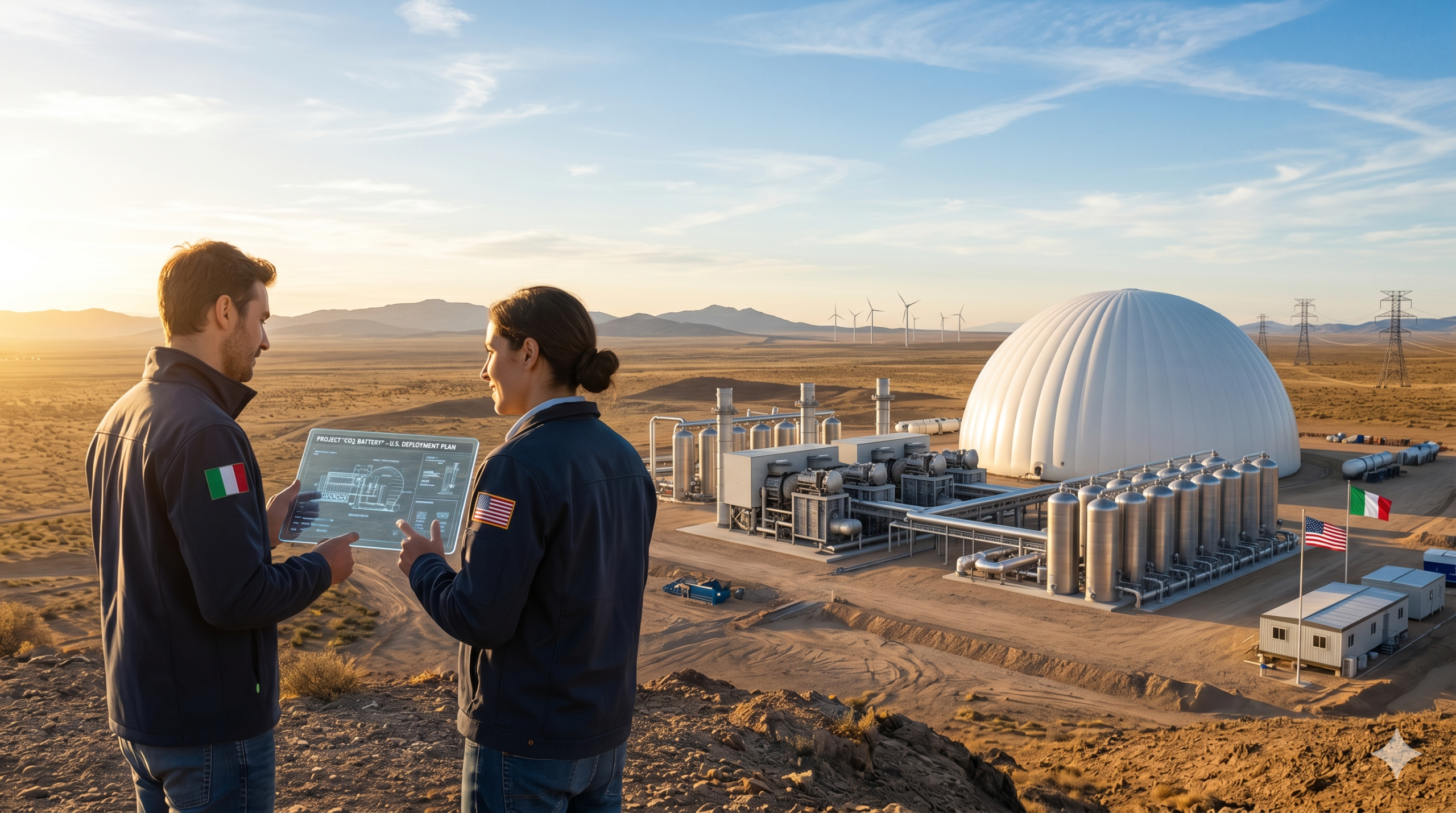
    We’re taking a massive leap into the world of Long-Duration Energy Storage (LDES). We are teaming up with a brilliant group of innovators in Italy and an absolute powerhouse of a company right here in the United States to bring a revolutionary concept to life.

    I can’t give you all the juicy details just yet—my legal team would probably have a heart attack—but I can tell you how this technology works, why we’re so passionate about it, and why this collaboration gives me so much hope for our planet’s future.

    The Smartphone Problem, but for Cities

    To understand why we’re so thrilled about this, think about your smartphone.

    We’ve all experienced that mild panic when we see the battery icon drop into the red. Now, imagine that anxiety scaled up to an entire city. For the past decade, the hero of the renewable energy revolution has been the lithium-ion battery. They are amazing pieces of technology. But they are essentially sprinters. They are fantastic for giving the grid a quick jolt of energy to smooth out a momentary hiccup.

    But what happens when a winter freeze blankets a region for four days, and the solar panels are covered in snow? A lithium-ion battery simply cannot run a marathon. Trying to build enough of them to power a city for days on end is practically impossible, incredibly expensive, and requires mining a massive amount of rare earth minerals.

    We realized we couldn’t just keep building bigger smartphone batteries to solve a civilization-level problem. We needed something robust, scalable, and built from the stuff we already have lying around. We needed a true marathon runner.

    The Irony of CO2: From Villain to Hero

    This is where our story takes a beautifully ironic twist.

    If I say “carbon dioxide,” you probably immediately think of climate change, smokestacks, and the very crisis we are trying to solve. For years, CO2 has been the ultimate villain in our environmental story.

    But what if we could flip the script? What if we could take the villain and turn it into the hero?

    That is the genius behind the “CO2 Battery” concept we are working with. Invented by some of the most creative engineering minds I’ve ever had the pleasure of meeting, this technology uses carbon dioxide to store massive amounts of energy. And no, we aren’t burning anything, and we aren’t releasing anything into the atmosphere. It’s a completely closed loop.

    I like to think of the system as a giant, mechanical lung. Here’s how it breathes:

    1. The Inhale (Charging): Picture a breezy Sunday afternoon. The wind turbines are spinning like crazy, and there’s more electricity on the grid than anyone knows what to do with. Instead of letting that clean energy go to waste, our system wakes up. It uses that surplus electricity to take CO2 gas out of a massive, flexible balloon-like structure we call the “Dome.” A compressor squeezes the gas, turning it into a liquid. During this squeezing, a lot of heat is generated, which we capture and save in special thermal bricks.

    2. Holding the Breath (Storage): Now, the energy is trapped. The CO2 is sitting comfortably as a liquid in standard steel tanks at regular, everyday temperatures. It doesn’t need massive, energy-hogging freezers to stay cold. It can just sit there, patiently holding onto all that potential energy for hours, days, or even weeks without losing an ounce of power.

    3. The Exhale (Discharging): Fast forward to a Tuesday evening. People are coming home, turning on their ovens, and blasting their heaters. The sun is down, and the grid is stressing out. Our system exhales. We take that liquid CO2, warm it back up using the heat we stored earlier, and it rapidly expands back into a gas. This forceful expansion spins a turbine, pushing clean, reliable electricity right back into the homes that need it. The CO2 flows safely back into the Dome, ready to take another breath.

    It’s elegant. It relies on standard steel pipes, tanks, and turbines that the industrial world has been making for a century. There are no toxic chemicals, no rare earth mining, and the machinery lasts for decades. It’s just simple, beautiful thermodynamics.

    Espresso, Engineering, and the Italian Connection

    You don’t get to a breakthrough like this without a bit of passion, and let me tell you, our technology partners in Italy have passion in spades.

    When we first started exploring this concept, we spent hours on video calls with their engineering team. I remember flying out to meet them, stepping into a room filled with blueprints, the smell of strong espresso, and an infectious, buzzing energy. Italy has an incredible, deeply rooted history of mechanical engineering, and you can feel it in the way these folks talk about turbines and fluid dynamics.

    They looked at the climate crisis not just as a tragedy, but as the ultimate engineering puzzle. They had the audacity to look at CO2 and say, “We can build a machine out of this.” Partnering with them hasn’t just been a business transaction; it’s been an exchange of shared values. We are learning from their technical mastery and their unwavering belief that human ingenuity can fix the messes we’ve made.

    The American Muscle: Our Secret Partner

    But having a brilliant invention in Europe is only half the battle. If you want to change the world, you have to build at a staggering scale. You need massive infrastructure, deep resources, and a footprint that spans continents.

    That’s where the second half of our transatlantic partnership comes in.

    We are incredibly proud to announce that we are teaming up with a major company right here in the United States to bring this concept to the American grid.

    I know, I know—I can almost hear you shouting at the screen: “Just tell us who it is!” Trust me, it is taking every ounce of my willpower not to shout their name from the rooftops. This is a company with a massive industrial legacy in the U.S. They know how to build big things, they know how the American energy market works, and most importantly, they share our vision that the future of power has to be clean, reliable, and accessible to everyone.

    By bringing our Italian partner’s technological artistry together with our American partner’s incredible industrial muscle, we are creating a dream team.

    So, Why All the Secrecy?

    I know it can be frustrating to read an announcement that feels a bit like a movie teaser. Why the mystery?

    The honest truth is that overhauling the grid is messy, complicated human work. We aren’t just launching an app; we are dealing with physical steel, gigawatts of electricity, land permits, utility regulations, and the coordination of hundreds of people across multiple time zones.

    Right now, we are in the “rolling up our sleeves” phase. We are hashing out the intricate details of how this deployment will work. We are mapping out the logistics, dotting our i’s, and crossing our t’s. We decided to share this concept with you now because we simply couldn’t contain our excitement, but we are keeping the names and exact dates quiet until the concrete is ready to pour.

    When we do a full reveal, we don’t just want to hand you a press release. We want to show you exactly where the shovels are hitting the dirt.

    A Brighter Horizon

    We spend a lot of time reading headlines about the climate, and it’s easy to feel overwhelmed. It’s easy to feel like the problem is too big for us to solve.

    But when I look at what we are building right now—when I see American and Italian engineers laughing over a Zoom call, figuring out how to turn carbon dioxide into a battery that could power thousands of homes—I don’t feel overwhelmed. I feel incredibly optimistic.

    We are moving away from an energy system that takes from the earth, and moving toward one that works with it. We are building a grid that can take a deep breath on a windy day, and keep your lights on through the darkest night.

    We can’t wait to introduce you to our partners and show you what we are building together. Thank you for being on this journey with us. Stay tuned—the best is yet to come.

  • Future of Sports Domes Technology Trends

    Future of Sports Domes Technology Trends

    You’re witnessing a revolution in sports dome technology that’ll reshape how facilities operate. Solar-powered fabrics now generate substantial energy while smart pressure systems automatically maintain ideal conditions. Advanced insulation materials are slashing heating costs, and AI climate control adapts to usage patterns like never before. These aren’t distant concepts—they’re emerging realities that could cut your operating expenses by 30%. The question isn’t whether these innovations will arrive, but how quickly you’ll adopt them.

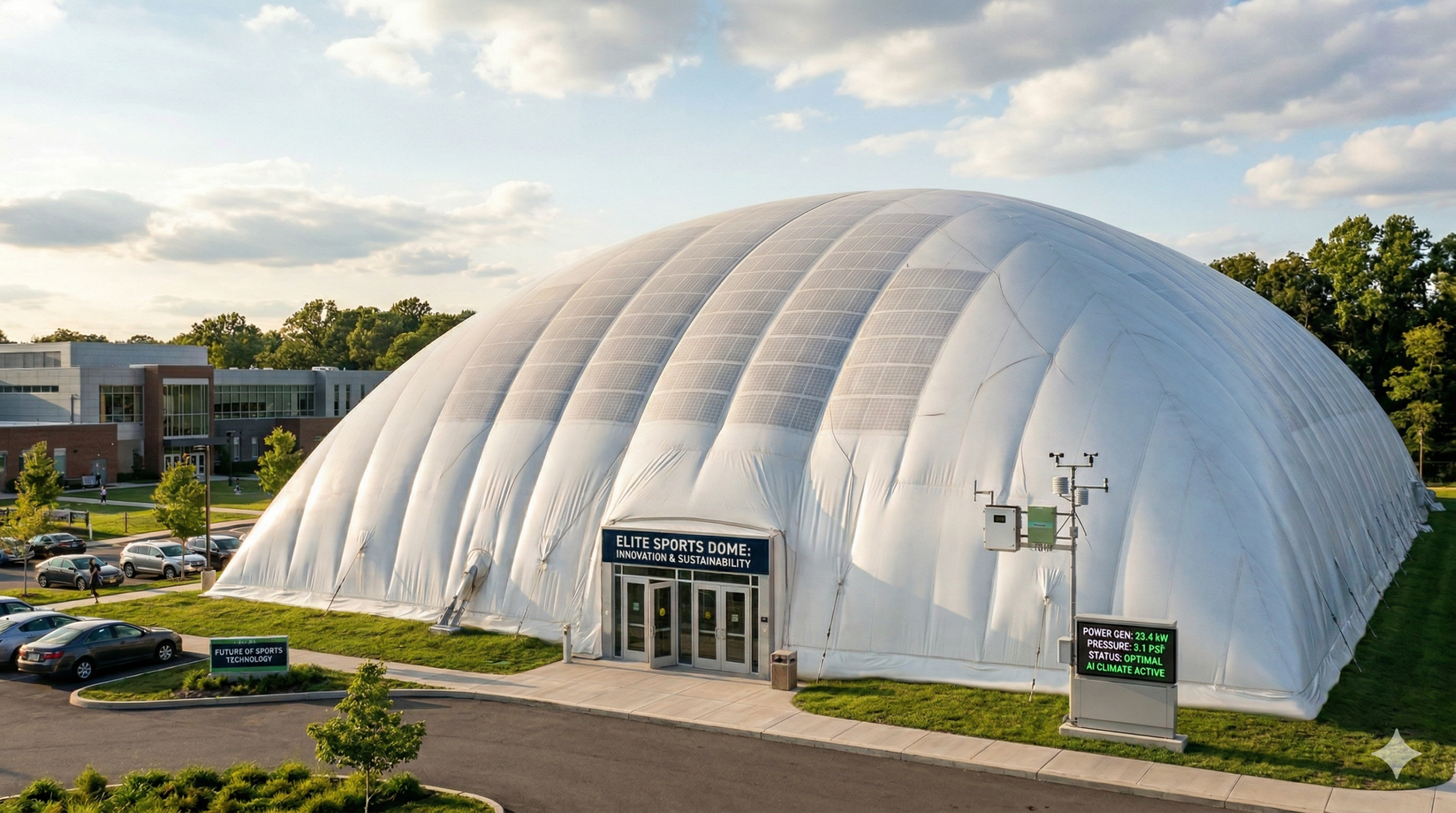
    Solar-Powered Air Dome Fabrics Generate 15-30 kW Energy

    Revolutionary solar fabric technology transforms traditional air dome surfaces into powerful energy generators, producing between 15-30 kilowatts of electricity for a standard 20,000 square foot sports facility.

    You’ll discover these solar-powered air dome fabrics integrate photovoltaic cells directly into the membrane material, creating dual-purpose structures that maintain structural integrity while harvesting sunlight.

    These innovative dome features eliminate your dependence on external power sources for lighting and climate control systems.

    You’re looking at significant operational cost reductions as the integrated solar technology powers essential dome functions throughout daylight hours. The flexible photovoltaic materials bend and flex with the dome’s natural movement patterns.

    Sustainable sports domes equipped with this technology represent the future of eco-friendly athletic facilities, offering you energy independence while reducing your facility’s carbon footprint substantially.

    Smart Air Dome Pressure Systems Monitor 2-5 PSF Automatically

    Advanced IoT sensors continuously monitor your air dome’s pressure levels between 2-5 PSF (0.1-0.24 kPa), automatically detecting fluctuations before they compromise structural integrity.

    These smart air dome systems send instant alerts to your smartphone when pressure drops below safe thresholds, preventing costly emergencies and downtime.

    The future of air domes relies on predictive maintenance rather than reactive repairs. Your monitoring system learns weather patterns and adjusts pressure proactively during storms or temperature changes.

    Real-time data analytics help you enhance energy consumption while maintaining peak structural support.

    Sports dome technology now includes redundant pressure sensors that cross-reference readings for maximum accuracy.

    You’ll receive maintenance schedules based on actual usage patterns rather than arbitrary timelines, extending your dome’s lifespan while reducing operational costs through intelligent automation.

    R-30+ Insulation Materials Slash Air Dome Heating Costs

    You’ll discover revolutionary insulation materials with R-30+ values that dramatically cut your air dome’s heating costs through advanced aerogel composites and multi-layer thermal barriers.

    These high-performance materials can slash your energy bills by up to 40% compared to traditional insulation, though you’ll face higher upfront installation costs.

    You’re looking at a significant long-term investment that pays dividends through reduced operational expenses and enhanced climate control efficiency.

    Revolutionary Insulation Material Types

    When heating costs consume up to 60% of your air dome’s operational budget, the new generation of R-30+ insulation materials offers a game-changing solution.

    These revolutionary materials dramatically outperform traditional options, delivering unprecedented thermal efficiency for your 20,000 sq ft facility.

    Three breakthrough insulation technologies are transforming air dome performance:

    • Aerogel-infused membranes – Ultra-lightweight materials with superior thermal resistance
    • Phase-change material (PCM) integration – Automatically regulates temperature by storing and releasing thermal energy
    • Multi-layer reflective barriers – Advanced metallic coatings that redirect heat back into your dome

    You’ll see immediate results with these innovations.

    Energy consumption drops by 30-40% compared to conventional insulation, while maintaining ideal playing conditions year-round.

    The investment pays for itself through reduced heating bills within two seasons.

    Energy Savings Analysis

    The numbers tell a compelling story about R-30+ insulation’s financial impact on your air dome operations.

    You’ll see heating costs drop by 40-60% compared to traditional R-10 materials, translating to $8,000-$15,000 annual savings for a 20,000 sq ft facility.

    When you combine advanced insulation with solar fabric integration generating 15-30 kW, you’re looking at near energy-neutral operations during peak sunlight hours.

    Your ROI timeline shrinks dramatically—typically 3-4 years versus 7-8 years with standard insulation.

    AI climate optimization learns your usage patterns, automatically adjusting temperature zones and reducing unnecessary heating cycles.

    You’ll extend your dome’s operational season while maintaining consistent internal temperatures.

    These efficiency gains compound over time, with projected 30% total energy reduction becoming achievable within five years of implementation.

    Installation Cost Considerations

    Initial R-30+ insulation installation carries a premium of $12-18 per square foot compared to standard materials, but smart procurement strategies can reduce these upfront costs considerably.

    You’ll recover this investment through dramatically lower heating bills, typically within 3-4 years for cold climate installations. The advanced insulation reduces energy consumption by 40-60% compared to traditional dome materials.

    Consider these cost-reduction approaches:

    • Bulk purchasing – Order materials for multiple projects or coordinate with other facilities
    • Off-season installation – Schedule during contractors’ slower periods for better rates
    • Manufacturer partnerships – Negotiate direct deals with insulation producers for volume discounts

    Your total project cost includes membrane fabrication, foundation preparation, and blower system upgrades.

    While initial expenses run higher, the long-term savings and improved comfort justify the investment.

    AI Climate Control Learns Air Dome Usage Patterns

    As artificial intelligence transforms facility management, air dome operators gain unprecedented control over their environment through systems that adapt to real usage patterns. You’ll benefit from AI that learns when your facility experiences peak activity, automatically adjusting temperature and humidity before events begin. The system recognizes seasonal trends, weather impacts, and occupancy levels to optimize energy consumption.

    Usage Pattern AI Response Energy Savings
    Morning practice Pre-heating 30 min early 15-20%
    Evening games Gradual cooling during events 25-30%
    Weekend tournaments Extended comfort periods 20-25%
    Off-season periods Minimal climate maintenance 40-50%
    Weather changes Proactive adjustments 10-15%

    You’ll see 30% energy reduction as AI eliminates guesswork, creating comfortable conditions while minimizing waste through predictive climate management.

    Recyclable Air Dome Membranes Last 50% Longer

    Beyond optimizing energy through smart climate systems, modern air dome operators now benefit from revolutionary membrane materials that extend facility lifecycles while supporting environmental sustainability.

    You’ll discover these advanced recyclable membranes deliver 50% longer operational lifespans compared to traditional materials, greatly reducing replacement costs and environmental waste.

    These innovative materials transform how you’ll manage your facility:

    • Enhanced durability – Advanced polymer compounds resist UV degradation, extreme temperatures, and mechanical stress
    • Full recyclability – End-of-life membranes become raw materials for new installations instead of landfill waste
    • Cost efficiency – Extended lifespans reduce total ownership costs while maintaining structural integrity

    You’ll find these membranes maintain superior performance throughout their extended service life, offering consistent air retention and weather resistance that traditional materials can’t match.

    Future Air Dome Technologies Cut Operating Costs 30%

    You’ll see dramatic cost reductions with three breakthrough technologies transforming air dome operations.

    Solar fabric integration generates 15-30 kW of power directly from your dome’s surface, while IoT pressure monitoring systems automatically alert you when pressure drops below ideal 2-5 PSF levels.

    AI climate control learns your facility’s usage patterns and optimizes energy consumption, delivering the promised 30% operating cost reduction within five years.

    Solar Fabric Energy Generation

    Revolutionary solar fabric technology transforms traditional air dome membranes into power-generating surfaces that’ll slash your energy bills by thousands of dollars annually.

    This breakthrough integration converts your entire 20,000 square foot dome into a massive solar collector, generating 15-30 kW of clean electricity while maintaining structural integrity.

    You’ll benefit from multiple advantages with solar fabric technology:

    • Dual functionality – Your membrane provides weather protection and generates power simultaneously
    • Grid independence – Reduce reliance on utility companies during peak demand hours
    • Revenue potential – Sell excess energy back to the grid through net metering programs

    The photovoltaic cells are seamlessly woven into the fabric without compromising air retention or durability.

    You’ll see immediate returns on investment while future-proofing your facility against rising energy costs.

    Smart Pressure Monitoring Systems

    Advanced IoT pressure monitoring systems continuously track your dome’s structural integrity at precise 2-5 PSF intervals, automatically detecting dangerous pressure drops before costly failures occur.

    You’ll receive instant mobile alerts when pressure fluctuations exceed safe parameters, preventing expensive emergency repairs and potential safety hazards.

    These intelligent sensors operate 24/7, learning your facility’s unique pressure patterns while compensating for weather changes, occupancy loads, and seasonal variations.

    You can monitor multiple zones simultaneously through cloud-based dashboards, accessing real-time data from anywhere.

    Smart systems integrate with existing HVAC controls, automatically adjusting blower speeds to maintain ideal pressure levels.

    This proactive approach reduces energy consumption by 15-20% while extending membrane lifespan considerably.

    You’ll eliminate manual pressure checks and minimize unexpected downtime through predictive maintenance scheduling.

    AI Climate Control Optimization

    As AI climate control systems learn your dome’s unique usage patterns, they automatically enhance heating, cooling, and ventilation cycles to slash operating costs by up to 30% within the first year.

    These intelligent systems continuously analyze occupancy data, weather forecasts, and energy pricing to make real-time adjustments that maximize efficiency.

    Your AI-powered dome will deliver:

    • Predictive scheduling – Pre-conditions spaces before peak usage while avoiding energy waste during idle periods
    • Dynamic load balancing – Automatically shifts heating and cooling zones based on actual occupancy patterns rather than fixed schedules
    • Weather integration – Adjusts internal climate controls by anticipating external temperature changes and storm systems

    This machine learning approach eliminates the guesswork from climate management, ensuring peak comfort while dramatically reducing your facility’s energy consumption and operational expenses.
  • Sports Dome Lead Generation Strategies

    Sports Dome Lead Generation Strategies

    You’re probably watching potential customers drive past your sports dome daily without knowing what you offer inside. Most facility owners make the mistake of assuming their location alone will generate steady bookings, but today’s athletes and teams research options online before making decisions. The difference between struggling with 30% capacity and maintaining a waiting list comes down to implementing the right lead generation system that connects with your local sports community.

    Launch Your Sports Dome’s Digital Marketing Foundation

    Before you can attract your first members to your 20,000 square foot sports dome, you’ll need to establish a strong digital presence that makes your facility discoverable online.

    Start with Google My Business optimization – this free tool becomes your digital storefront for local searches. Upload high-quality photos of your courts, equipment, and facility amenities. Confirm your business hours, contact information, and services are accurate and complete.

    Your sports dome marketing foundation requires a professional website showcasing your facility’s unique features. Include detailed information about court availability, rental rates, and membership options.

    Integrate online booking capabilities to streamline reservations. Develop social media profiles on Facebook, Instagram, and TikTok to showcase action shots, highlight events, and engage with your community before your grand opening.

    Partner With Schools and Leagues for Guaranteed Bookings

    Once your digital foundation is set, you’ll want to secure consistent revenue streams through strategic partnerships. Schools and local sports leagues represent your most reliable booking sources, offering predictable income that drives sports dome business growth.

    Start by contacting athletic directors at nearby high schools and middle schools. They’re constantly seeking quality practice facilities, especially during harsh weather months. Offer competitive rates for regular weekly bookings rather than one-time rentals.

    Local sports leagues with 50-100 members each provide excellent opportunities. Youth soccer, football, and baseball leagues need consistent training spaces. Present package deals that include multiple booking dates at discounted rates.

    Tournament hosting becomes your premium revenue generator, commanding $500-$2,000 daily facility fees. These events also showcase your facility to hundreds of potential new customers simultaneously.

    Optimize Tournament Hosting for $2,000 Daily Revenue

    Tournament hosting transforms your sports dome into a premium revenue generator, potentially earning you $2,000 per day while showcasing your facility to hundreds of prospective customers.

    Start by reaching out to regional sports organizations and league coordinators who regularly need venues. Create tournament packages that include field rental, equipment, and basic concessions. Price competitively within the $500-$2,000 range based on tournament size and duration.

    Market your facility’s unique advantages: climate-controlled environment, professional lighting, and ample parking.

    Tournament hosting creates natural lead generation as parents and players experience your facility firsthand. Capture contact information during registration and follow up with special membership offers.

    Many attendees will convert to regular customers after seeing your dome’s quality. Document events through photos and videos for future marketing materials that demonstrate your hosting capabilities.

    Convert Local Sports Communities Into Monthly Members

    Building relationships with tournament participants sets the foundation for your most valuable revenue stream: converting these one-time visitors into loyal monthly members.

    Your air dome lead generation strategy should capture contact information during tournaments through registration forms and follow-up surveys. Offer exclusive membership trials to participants immediately after events when they’re most engaged with your facility.

    Create targeted membership packages for different sports communities. Youth leagues need family plans while adult recreational teams prefer flexible scheduling options.

    Partner with local league organizers to offer group discounts that incentivize entire teams to join. Use social proof by showcasing current members’ success stories and hosting member-only events that create exclusivity.

    Track conversion rates from each tournament to refine your approach and maximize long-term revenue potential.

    Track Member Growth From 200 to 400 in Year One

    Since your air dome facility’s success hinges on reaching that crucial 400-member milestone, you’ll need systematic tracking methods to monitor progress throughout your first year.

    Start by implementing monthly membership audits, categorizing new sign-ups by source—whether from tennis dome advertising, local league partnerships, or tournament participation.

    Create a simple dashboard tracking retention rates, seasonal fluctuations, and member engagement levels.

    Monitor key performance indicators like cost per acquisition from different marketing channels. Your Google My Business metrics, social media conversion rates, and tournament attendance numbers reveal which strategies drive actual memberships versus mere interest.

    Set quarterly targets of 100 new members, adjusting your marketing spend based on what’s working.

    Track member feedback through surveys to identify improvement areas that boost retention and word-of-mouth referrals.

  • Air Dome Ventilation Systems Guide

    Air Dome Ventilation Systems Guide

    When you’re managing an air dome facility, you’ll quickly discover that proper ventilation isn’t just about comfort—it’s about preventing structural damage, controlling humidity, and maintaining safe air quality. You’ve got three main ventilation approaches to contemplate, each with distinct advantages and price points. The system you choose will determine whether you’re constantly battling condensation issues or enjoying effortless climate management. But here’s what most facility managers don’t realize about making this critical decision.

    How to Choose the Right Air Dome Ventilation System?

    When selecting an air dome ventilation system for your 20,000 square foot facility, you’ll need to evaluate three key factors: your budget constraints, climate control requirements, and operational complexity preferences.

    If you’re working with limited funds, sidewall vent panels offer passive air dome ventilation starting at $2,000-$5,000. They’re simple but provide basic airflow without temperature control.

    For moderate budgets requiring active airflow, powered exhaust fans deliver 5,000-10,000 CFM capacity at $3,000-$8,000. They’ll maintain air circulation while keeping costs reasonable.

    When precise climate control matters most, invest in full HVAC integration costing $15,000-$40,000. This premium air dome ventilation option maintains your facility’s temperature between 55-85°F year-round, ensuring ideal comfort and air quality for all activities.

    Sidewall Vent Panels: Budget-Friendly Passive Airflow

    Feature Standard Panels Insulated Panels Weather-Resistant
    Cost Range $2,000-$3,500 $3,000-$4,500 $4,000-$5,000
    Airflow Rate 2,000-4,000 CFM 1,800-3,500 CFM 2,500-4,500 CFM
    Weather Protection Basic Enhanced Superior
    Installation Time 4-6 hours 6-8 hours 8-10 hours
    Maintenance Minimal Low Very Low

    Powered Exhaust Fans: Active Air Dome Climate Control

    While sidewall vent panels offer passive airflow, powered exhaust fans deliver active climate control that transforms your air dome’s environmental management.

    These mechanical systems actively pull stale air out while drawing fresh air in, maintaining ideal temperature ranges between 55-85°F regardless of external conditions.

    You’ll find powered exhaust fans particularly effective for larger 20,000 sq ft facilities where passive ventilation can’t adequately circulate air.

    With capacities ranging from 5,000-10,000 CFM, these systems guarantee consistent air quality throughout your dome.

    • Consistent Performance: Unlike passive systems, powered exhaust fans work independently of wind conditions
    • Temperature Control: Active air circulation prevents hot spots and maintains even climate distribution
    • Scalable Options: Choose from various fan sizes and configurations to match your dome’s specific requirements

    Investment ranges from $3K-$8K depending on system complexity.

    HVAC Systems: Complete Air Dome Environmental Management

    Though powered exhaust fans provide excellent active ventilation, HVAC systems represent the pinnacle of air dome climate control, delivering thorough environmental management that goes far beyond basic air circulation.

    HVAC integration transforms your air dome into a precisely controlled environment. You’ll maintain consistent temperatures year-round while managing humidity levels and air quality. These systems offer heating, cooling, filtration, and circulation through a unified network.

    Feature Capability Investment Range
    Temperature Control Precise heating/cooling $15K-$25K
    Air Quality Management Advanced filtration $8K-$15K
    Humidity Regulation Dehumidification systems $12K-$20K

    Professional HVAC integration requires substantial investment ($15K-$40K total) but delivers unmatched performance. You’ll achieve ideal conditions for any activity while reducing energy costs through efficient operation. This all-encompassing approach guarantees your 20,000 sq ft space maintains perfect environmental conditions regardless of external weather.

  • Dome Fabric Types PVC vs PTFE vs ETFE

    Dome Fabric Types PVC vs PTFE vs ETFE

    When you’re selecting fabric for your air dome project, you’ll face a critical decision that impacts both your budget and long-term satisfaction. While PVC dominates most installations due to its affordability, PTFE and ETFE offer compelling advantages that might justify their higher costs. The key isn’t simply choosing the cheapest option—it’s understanding which material aligns with your specific performance requirements, climate conditions, and project timeline. Your choice today determines whether you’ll thank yourself in twenty years.

    Air Dome Fabric Showdown: Cost vs Performance Analysis

    When you’re evaluating air dome fabrics, you’ll face a classic trade-off between upfront costs and long-term performance.

    PVC coated polyester represents the budget-friendly option at $25-$40 per square foot, offering 15-25 years of reliable service. It’s why 90% of installations choose this material for their dome membrane materials selection.

    PTFE Teflon-coated fabric doubles your initial investment at $50-$80 per square foot, but you’ll get 30-40 years of superior durability and weather resistance. This premium option often proves more economical over time when you factor in replacement costs.

    ETFE film sits at the expensive end, offering unique transparency but requiring specialized engineering.

    Your choice ultimately depends on budget constraints, expected lifespan, and specific performance requirements for your application.

    What Really Matters When Choosing Air Dome Fabric?

    Four critical factors determine whether your air dome fabric choice will succeed or fail in real-world conditions.

    Budget constraints typically drive initial decisions. You’ll pay $25-$40/sq ft for PVC versus $50-$80/sq ft for PTFE, making budget a primary filter for most projects.

    Climate exposure matters enormously. PTFE handles extreme temperatures, UV radiation, and chemical exposure better than PVC, explaining why airports and industrial facilities choose premium materials despite higher costs.

    Project lifespan affects total ownership costs. PVC’s 15-25 year life versus PTFE’s 30-40 years changes the math considerably for permanent installations.

    Performance requirements include fire resistance, light transmission, and structural loads. Among air dome fabric types, PVC dominates 90% of applications because it balances performance with affordability for most recreational and temporary uses.

    PVC Dominates 90% Of Projects: Here’s Why

    Nine out of ten air dome projects choose PVC coated polyester fabric, and the reasons go beyond simple cost considerations.

    You’ll find PVC offers the perfect balance of affordability, durability, and proven performance that makes it the industry standard.

    When comparing PVC vs PTFE dome options, PVC delivers 15-25 years of reliable service at $25-$40 per square foot—significantly less than PTFE’s $50-$80 range.

    You’re getting established manufacturing processes, widespread availability, and decades of field-tested results. Most contractors understand PVC installation, reducing labor complexities and potential errors.

    PVC’s dominance stems from its practical advantages: easier repairs, lower replacement costs, and sufficient longevity for most applications.

    Unless you need PTFE’s premium 30-40 year lifespan, PVC provides everything you require.

    PTFE And ETFE Alternatives: When To Pay More

    While PVC handles most air dome needs, certain projects justify the premium cost of PTFE or ETFE alternatives. You’ll want PTFE Teflon-coated fabric when longevity matters most—its 30-40 year lifespan doubles PVC’s durability. Despite costing $50-$80 per square foot, PTFE’s superior weather resistance and minimal maintenance make it cost-effective long-term for permanent installations.

    ETFE film offers unique transparency benefits but remains rare due to extreme costs. Consider these sports dome fabric options when:

    Fabric Type Best Use Cases
    PTFE Permanent facilities, harsh climates
    PTFE High-traffic commercial venues
    ETFE Natural lighting requirements
    ETFE Architectural showcase projects
    Both 20+ year operational plans

    You’re investing in reduced replacement frequency and enhanced performance characteristics that justify the higher upfront investment.

  • Portable vs Fixed Air Dome Systems

    Portable vs Fixed Air Dome Systems

    You’re facing a critical decision that’ll impact your project’s success for years to come. While portable air domes promise quick deployment and lower upfront costs, fixed installations offer unmatched stability and weather resistance. The choice isn’t just about money—it’s about understanding how wind ratings, foundation requirements, and long-term durability will affect your specific application. Before you commit to either system, there’s essential cost and performance data you can’t afford to overlook.

    How Much Do Portable vs Fixed Air Domes Really Cost?

    When you’re evaluating air dome systems for your 20,000 square foot facility, the upfront cost difference between portable and fixed installations can greatly impact your budget.

    A portable air dome typically requires an additional $5,000 to $15,000 for ballast weights like water or sand bags, making it ideal for rental applications where you’ll relocate the structure within days. Your relocatable sports dome won’t need expensive concrete footings, reducing initial construction costs markedly.

    However, when comparing temporary vs fixed dome options, permanent installations offer better long-term value.

    Fixed systems require concrete foundations and higher upfront investment, but they’re built to withstand winds exceeding 100 mph compared to portable systems rated under 80 mph.

    Consider your timeline and budget carefully.

    Portable Air Dome Setup: Ballast Systems and Installation Speed

    The ballast system you choose directly affects how quickly your portable air dome goes operational. Water bags offer the fastest setup, filling in hours and allowing your movable air dome to be ready within days.

    Sand bags take longer to fill but provide superior stability in windy conditions.

    You’ll need ballast weights strategically placed around your dome’s perimeter to secure it without permanent foundations. This eliminates concrete work and permits relocating your structure when needs change.

    Most portable systems achieve operational status in 2-3 days compared to weeks for fixed installations.

    However, your wind rating stays below 80 mph with ballast systems. You’re trading permanent stability for speed and flexibility, making portable domes ideal for temporary projects, seasonal use, or rental applications where quick deployment matters most.

    Fixed Air Dome Foundations: Concrete Requirements and Permanence

    While portable domes prioritize speed, fixed air dome foundations demand concrete footings that create permanent installations designed for decades of use.

    You’ll need engineered concrete foundations that anchor your dome securely to the ground, eliminating the flexibility of relocation but dramatically improving structural integrity.

    Fixed foundations require substantial upfront planning and construction time, often taking weeks to complete properly.

    However, you’re investing in superior wind resistance ratings exceeding 100+ mph, compared to portable systems’ limitations under 80 mph.

    This permanence makes fixed domes ideal for long-term facilities where you won’t need relocation.

    You’ll save the $5K-$15K in additional ballast costs associated with portable systems, but you’re committing to a permanent structure.

    For facilities planning decades of operation, fixed foundations offer unmatched stability and weather resistance.

    Weather Performance: Wind Ratings and Long-Term Durability Compared

    Wind resistance capabilities reveal the most significant performance gap between portable and fixed air dome systems for your 20,000 sq ft facility.

    Your portable system’s ballast weights and flexible anchoring limit wind ratings to under 80 mph, making them vulnerable during severe weather events. You’ll face potential deflation risks and structural damage in high-wind zones.

    Fixed systems deliver superior weather performance with concrete footings that achieve 100+ mph wind ratings. You’re investing in a structure that withstands hurricanes, tornadoes, and extreme weather conditions that would compromise portable alternatives.

    The permanent foundation distributes loads effectively, ensuring your facility remains operational year-round.

    Long-term durability favors fixed installations through reduced maintenance costs and extended operational life, while portable systems require frequent inspections and anchor point reinforcement.

    Rental vs Purchase: Which Air Dome Investment Makes Sense?

    How do you determine whether renting or purchasing an air dome system delivers better value for your 20,000 sq ft project? Your timeline and long-term plans are the deciding factors.

    Portable systems excel in rental applications where you need temporary coverage for events, seasonal sports, or short-term projects.

    You’ll pay $5K-$15K additional for portable features like ballast weights and quick setup capabilities, but you can relocate the structure within days when your needs change.

    Fixed installations make sense when you’re planning permanent use.

    The concrete footings and permanent foundation require higher upfront investment, but you’ll get superior wind ratings exceeding 100 mph and better long-term value.

    Consider purchasing if you’ll use the dome for multiple years at the same location.

  • Seasonal vs Year-Round Dome Use

    Seasonal vs Year-Round Dome Use

    You’re facing a critical decision that’ll impact your facility’s profitability for years to come. While seasonal domes might seem like the budget-friendly choice with their lower upfront costs, you could be missing out on significant revenue opportunities during off-peak months. The math behind seasonal versus year-round installations isn’t as straightforward as it appears, and the wrong choice could cost you hundreds of thousands in lost income. Here’s what the numbers actually reveal.

    Seasonal Vs Year-Round Domes: Complete Cost Breakdown for 20,000 Sq Ft Facilities

    When choosing between seasonal and year-round dome installations for a 20,000 square foot facility, you’ll face a significant cost difference that impacts your long-term financial planning.

    A seasonal vs year-round dome comparison reveals temporary installations cost $700K-$1M upfront, while permanent structures require $800K-$1.2M initially.

    However, temporary vs permanent dome analysis shows ongoing expenses favor year-round facilities. You’ll spend $16K-$30K annually on seasonal setup and removal, plus require 10′ x 20′ storage space during off-season months.

    Your seasonal inflation vs fixed installation costs break even after 3-4 years.

    Seasonal domes provide 6-8 months of use annually, while year-round installations offer continuous 12-month programming capabilities.

    Consider your facility’s usage patterns and budget constraints when making this decision.

    When Year-Round Domes Pay Off: Break-Even Analysis and ROI Timeline

    Year-round dome installations become financially advantageous once you hit the 3-4 year mark, transforming what initially appears as a $100K-$200K premium into substantial long-term savings.

    Your break-even calculation is straightforward: divide the upfront cost difference by annual operational savings. With seasonal domes requiring $16K-$30K yearly for setup, removal, and storage, you’ll recover your additional investment quickly.

    Investment Period Your Total Savings
    Year 3-4 Break-even point reached
    Year 5-10 $80K-$150K saved
    Year 10+ $160K-$300K+ saved

    Beyond financial benefits, you’ll gain programming flexibility, consistent revenue streams, and enhanced facility utilization. Year-round domes eliminate weather-related setup delays and provide reliable indoor space for events, training, and rentals throughout winter months when seasonal structures sit dormant.

    Seasonal Dome Operations: Installation, Storage, and Annual Maintenance Requirements

    Although seasonal domes require more hands-on management, they offer significant upfront savings that make them attractive for facilities with limited winter programming needs. You’ll save $100K-$200K on initial installation compared to permanent structures, but you’ll need to budget $16K-$30K annually for professional setup and takedown services.

    Storage becomes a critical consideration – you’ll need approximately 200 square feet (10′ x 20′) of dedicated space to house the dome fabric, frame components, and inflation equipment during off-season months. This storage area must remain dry and temperature-controlled to prevent material degradation.

    Your maintenance schedule revolves around bi-annual shifts.

    Spring installation requires foundation inspection, fabric examination for tears or wear, and system testing.

    Fall removal involves thorough cleaning, proper folding techniques, and organized storage to guarantee next season’s successful deployment.

    Year-Round Programming Revenue: Maximizing Your 12-Month Facility Potential

    Maximize your investment potential by operating a permanent dome that generates revenue across all twelve months of the year.

    Your year-round facility transforms from a simple sports venue into a versatile revenue generator that adapts to seasonal demands and community needs.

    During peak winter months, you’ll capture traditional indoor sports like soccer, baseball training, and field hockey.

    Spring and fall shoulder seasons offer opportunities for tournaments, camps, and leagues that seasonal facilities can’t accommodate.

    Summer programming diversifies your income through fitness classes, corporate events, birthday parties, and specialized training programs.

    You’ll eliminate the $16K-$30K annual setup costs while maximizing your higher upfront investment.

    The consistent revenue stream from 12-month operations typically recovers the additional $100K-$200K initial cost within 3-4 years, creating long-term profitability advantages over seasonal alternatives.

    Making the Decision: Seasonal vs Permanent Dome Selection Criteria

    When deciding between seasonal and permanent dome structures, you’ll need to evaluate several key factors that directly impact your facility’s long-term success and profitability.

    Consider your climate first—if you’re in regions with harsh winters or limited outdoor sports seasons, seasonal installation makes sense.

    Analyze your programming needs: year-round facilities support 12-month revenue streams but require higher upfront investment ($800K-$1.2M vs $700K-$1M).

    Factor in operational costs—seasonal domes need annual setup/removal ($16K-$30K) plus storage space requirements.

    Evaluate your break-even timeline: permanent structures typically pay for themselves within 3-4 years through consistent programming.

    Consider local demand patterns, competition, and your organization’s long-term growth plans when making this critical infrastructure decision.