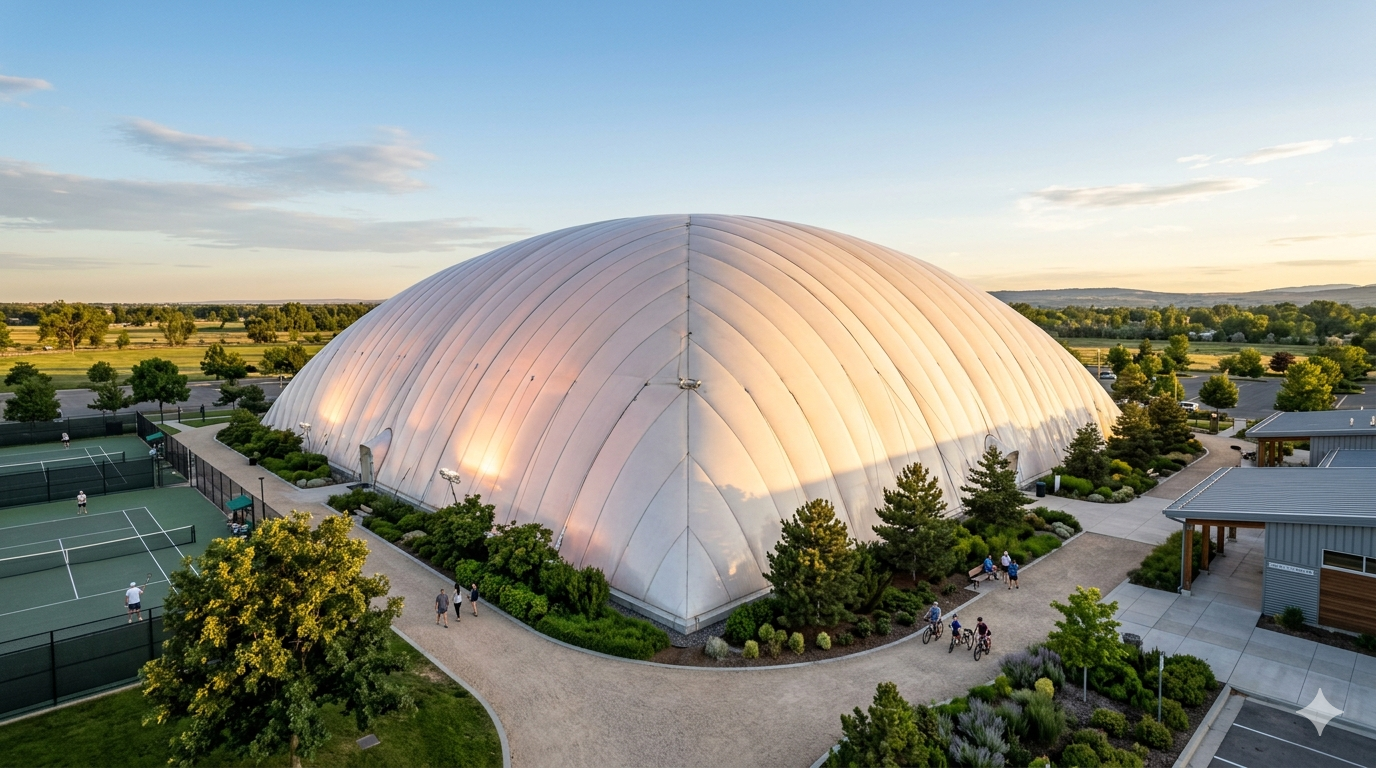
Inflatable domes — also called air-supported structures, sports bubbles, or air domes — are large-span fabric enclosures held up entirely by slightly pressurised air. They are the fastest and most cost-effective way to create climate-controlled, column-free indoor space for sports, storage, events, or industry.
This guide covers everything you need to know before buying: how they work, what they cost, what sports they suit, how long they last, and what the buying process actually looks like.
What is an inflatable dome?
An inflatable dome is a fabric membrane — typically PVC-coated polyester or polyethylene — anchored to a concrete ring beam or ground anchors. Industrial blowers maintain an internal air pressure of around 30–50 Pa (pascals) above ambient. That small pressure differential is enough to keep a membrane spanning 30–100+ metres with no interior columns.
Entry is via an airlock vestibule or revolving door that maintains pressure while allowing people to pass through freely.
They are not the bouncy-castle inflatables you see at fairs. Commercial air-supported domes are engineered to withstand snow loads of 50–100 kg/m², wind speeds above 100 km/h, and decades of continuous operation.
Types of inflatable dome
| Type | Description | Best for |
|---|---|---|
| Single-skin | One-layer membrane | Seasonal use, warm climates, storage |
| Double-skin | Two membranes with insulating air gap | Year-round sports, cold climates |
| Triple-skin | Three layers with insulation pockets | Arctic climates, premium facilities |
| Seasonal dome | Installed in autumn, removed in spring | Tennis clubs, soccer clubs covering existing courts |
| Permanent dome | Year-round, fully anchored | Indoor sports centres, 12-month revenue facilities |
What sports do inflatable domes cover?
Inflatable domes are used across virtually every outdoor sport. The most common applications are:
Tennis — The tennis bubble is the most established dome format globally. A standard seasonal bubble covering 2–4 courts is typically 25–30 m wide and 50–70 m long, allowing full ITF-compliant court dimensions plus run-off.
Football / Soccer — Full-size 5-a-side, 7-a-side, and 11-a-side pitches. A regulation 11-a-side synthetic turf pitch requires a dome of approximately 80 × 120 m.
Padel — One of the fastest-growing applications. A 4-court padel dome is typically 30 × 60 m.
Pickleball — Surging in the US. Multiple pickleball courts can be covered in a relatively compact dome footprint.
Golf — Driving range bays, short-game areas, and putting greens.
Multi-sport — A single large dome can house several different court configurations simultaneously: basketball, volleyball, badminton, and futsal are commonly combined under one shell.
Athletics — Throws cages, sprint tracks, and combined multi-event training facilities.
Hockey — Field hockey and ice hockey (the latter requires a refrigeration system in the floor).
How much does an inflatable dome cost?
Costs vary based on size, skin type, insulation level, HVAC specification, and whether the dome is seasonal or permanent. The following ranges are indicative for a complete turnkey project including foundations, airlock, HVAC, and lighting.
| Facility type | Approx. size | Typical cost range |
|---|---|---|
| 2-court tennis bubble (seasonal) | 1,000–1,500 m² | £120,000–£220,000 / $150,000–$280,000 |
| 4-court tennis / pickleball dome | 2,000–3,000 m² | £280,000–£550,000 / $350,000–$700,000 |
| Small multi-sport dome | 2,500–4,000 m² | £350,000–£700,000 / $450,000–$900,000 |
| Full soccer pitch dome | 9,000–12,000 m² | £800,000–£2,000,000 / $1,000,000–$2,500,000 |
| Large multi-sport complex | 12,000–20,000 m² | £1,500,000–£4,000,000 / $2,000,000–$5,000,000 |
Cost per square metre / square foot:
| Dome specification | Per m² | Per sq ft |
|---|---|---|
| Basic single-skin seasonal | £80–£120 / $15–$22 | — |
| Double-skin, insulated (standard) | £140–£200 / $25–$38 | £13–£19 / $25–$38 |
| Triple-skin, high-performance | £200–£350 / $38–$65 | £19–£33 / $38–$65 |
These figures typically represent a 50–75% saving on equivalent permanent steel-and-concrete construction.
Annual operating costs
Running an inflatable dome is not free. The main ongoing expenses are:
Energy — Blowers run 24 hours a day, 365 days a year (or seasonally). A 2,000 m² dome typically draws 7–12 kW for pressurisation. Heating in cold climates adds significantly: a well-insulated double-skin dome requires approximately 30–60 W/m² of heating capacity. Annual energy costs for a 2,000 m² dome range from £15,000–£45,000 / $20,000–$60,000 depending on climate and insulation specification.
Maintenance — Annual inspection, blower servicing, anchor checks, minor fabric repairs: typically £3,000–£10,000 / $4,000–$12,000 per year.
Insurance — Commercial inflatable structure insurance: typically £3,000–£12,000 / $4,000–$15,000 per year.
Seasonal labour — For seasonal domes: installation and removal crew, typically £8,000–£25,000 / $10,000–$30,000 per year.
Total operating cost benchmarks:
| Dome size | Annual operating cost range |
|---|---|
| 1,000–2,000 m² | £25,000–£70,000 / $30,000–$90,000 |
| 2,000–5,000 m² | £50,000–£130,000 / $65,000–$160,000 |
| 5,000–12,000 m² | £100,000–£350,000 / $130,000–$450,000 |
How long does an inflatable dome last?
Membrane lifespan depends primarily on material quality and UV exposure:
- Polyethylene (PE) membrane — 10–15 years. Lower cost, lighter weight, less durable.
- PVC-coated polyester membrane — 20–30 years. Industry standard for commercial sports facilities.
- PTFE / architectural fabric — 30–40 years. Premium specification, higher cost.
Structural components (anchoring systems, airlocks, blowers) typically have serviceable lives of 15–25 years with regular maintenance.
The blower system — typically 2–4 industrial fans with automated backup — should be serviced annually and replaced every 12–18 years.
Installation timeline
From contract signing to first use:
| Phase | Typical duration |
|---|---|
| Engineering and drawings | 4–8 weeks |
| Permitting (varies by jurisdiction) | 4–16 weeks |
| Membrane manufacturing | 8–14 weeks |
| Foundation and site preparation | 2–4 weeks |
| Dome installation and inflation | 1–3 weeks |
| HVAC, lighting, commissioning | 1–2 weeks |
| Total from contract to first use | 5–9 months |
For seasonal domes on existing courts with simple ground anchors, the timeline can compress to 3–5 months. Planning permission is usually the longest variable.
Key questions to ask before buying
- Permanent or seasonal? Permanent domes generate year-round revenue and have lower long-term labour costs; seasonal domes have lower capital costs and simpler planning routes.
- Single or double skin? In climates with winter temperatures below +5°C, a double-skin insulated dome pays for itself in energy savings within 3–5 years.
- What is the snow load rating? Ensure the structure is engineered for your local design snow load — this is a critical structural parameter, not a marketing claim.
- What blower redundancy is included? You need at least one backup blower on automatic failover. In cold climates, a diesel generator backup is also advisable.
- What anchorage system? A continuous concrete ring beam is the most secure and permanent anchor. Ground screws are faster and cheaper but have lower uplift resistance.
- Who installs? Ensure your supplier provides a supervised installation with a qualified structural engineer on site. Self-installation of large commercial domes is not advisable.
- What warranty covers what? Membrane, structure, blowers, and anchorage should each have clearly defined warranty periods. Industry standard is 5–10 years on membrane, 2–5 years on mechanical components.
Inflatable dome vs traditional building: the key difference
| Factor | Inflatable dome | Traditional building |
|---|---|---|
| Capital cost | 25–50% of equivalent permanent structure | 100% baseline |
| Build time | 6–12 weeks site time | 12–24 months |
| Energy use | Moderate-high (continuous pressurisation) | Lower (passive insulation) |
| Lifespan | 20–30 years (membrane) | 40–60 years |
| Flexibility | Can be relocated or removed | Fixed |
| Column-free span | Yes, up to 100+ m | Engineering-dependent |
| Planning classification | Often temporary structure | Permanent building |
Is an inflatable dome right for your project?
An inflatable dome is likely a strong fit if: – You need indoor space within 12 months – Budget constraints rule out permanent steel construction – You already own the land or courts to cover – Your market has demonstrable year-round demand – You operate in a climate where outdoor sports are interrupted for 3+ months per year
It may not be the best option if: – You plan to operate for 30+ years and want the lowest possible lifetime cost – Your climate involves extreme sustained winds or ice loading beyond standard design parameters – Local planning authority requires permanent-structure classification – Your occupants expect a luxury, hotel-standard interior environment
HeroX AirDomes designs, engineers, and installs air-supported structures across the US, UK, Europe, and the UAE. Contact us for a free feasibility assessment for your project.
Keywords: inflatable dome, air dome buying guide, air-supported structure, sports bubble, dome types, single-skin dome, double-skin dome, triple-skin dome, seasonal dome, permanent dome, dome cost, dome lifespan, PVC membrane, dome installation timeline, dome vs traditional building, indoor sports facility, dome planning permission, dome warranty, dome HVAC, dome blower system
Leave a Reply