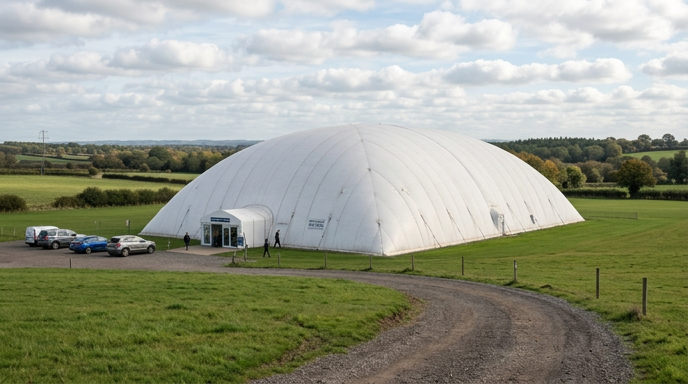
You’re witnessing a transformation in South Africa’s athletic infrastructure as sports domes reshape how athletes train year-round. These climate-controlled facilities aren’t just solving weather challenges—they’re addressing critical gaps in urban sports development with investments that’ll surprise you. Whether you’re considering tennis, soccer, or netball applications, the financial and regulatory landscape presents both opportunities and complexities that could determine your facility’s success. The numbers behind these structures reveal more than you’d expect.
South African Sports Dome Benefits: Heat Protection and Year-Round Training
These structures enable year-round athletic development across tennis, netball, and soccer facilities.
You won’t need to cancel training sessions due to extreme heat, thunderstorms, or seasonal weather changes that typically disrupt outdoor activities.
Your athletes can maintain consistent training schedules, improving performance outcomes and reducing weather-related injuries.
The controlled environment eliminates UV exposure concerns while providing ideal ventilation systems.
You’ll maximize facility utilization throughout South Africa’s diverse climate patterns, from Johannesburg’s highveld conditions to Cape Town’s Mediterranean weather and Durban’s humid subtropical climate.
Sports Dome Costs and Sizing: ZAR 1.5M-5M Investment Guide
Sports dome investments in South Africa typically range from ZAR 1.5 million to ZAR 5 million, depending on your facility’s size and specifications.
You’ll find smaller domes covering 700 square meters (7,535 sq ft) at the lower end, while larger facilities reaching 2,000 square meters (21,528 sq ft) command premium pricing.
Your investment covers the complete air-supported structure, ventilation systems, and installation.
For South African indoor sports facilities, you’re looking at approximately ZAR 2,100-2,500 per square meter for standard specifications.
Premium features like advanced climate control or specialized flooring increase costs considerably.
Consider your target sports when sizing your dome.
Tennis courts need 600-800 sq m minimum, while soccer facilities require 1,500+ sq m.
Netball courts fit comfortably in 500-700 sq m spaces, making them cost-effective options for smaller budgets.
Tennis, Soccer, and Netball Applications in South African Domes
Tennis facilities dominate South Africa’s sports dome market, requiring precise court dimensions of 36.6m x 18.3m with additional safety margins that bring your total space needs to approximately 40m x 22m per court.
You’ll find most South African sports facility owners prioritize tennis domes due to consistent year-round demand and premium pricing potential.
Soccer applications need larger spaces, typically 50m x 30m for five-a-side or 70m x 40m for seven-a-side formats.
You’re looking at considerably higher construction costs but can accommodate more players simultaneously.
Netball courts require 30.5m x 15.25m playing areas with safety margins bringing total needs to 34m x 19m.
These domes offer excellent ROI in South Africa’s competitive netball market, especially near schools and clubs in Johannesburg, Cape Town, and Durban.
SANS Building Standards and Installation Requirements
Before you can install any sports dome in South Africa, you’ll need to comply with SANS (South African National Standards) building codes that govern structural integrity, ventilation, and safety requirements.
These standards guarantee your sports dome south africa installation meets wind load specifications, fire safety protocols, and emergency exit provisions.
You must submit detailed engineering drawings showing foundation designs, anchoring systems, and membrane specifications.
SANS 10160 covers structural loading requirements, while SANS 10400 addresses building regulations including accessibility compliance.
Your installer should provide certified calculations for wind resistance up to 120 km/h.
Municipal approval processes vary between Johannesburg, Cape Town, and Durban, typically requiring 6-12 weeks.
You’ll also need environmental impact assessments for larger installations exceeding 1,500 square meters, ensuring proper drainage and utilities integration.
Leave a Reply