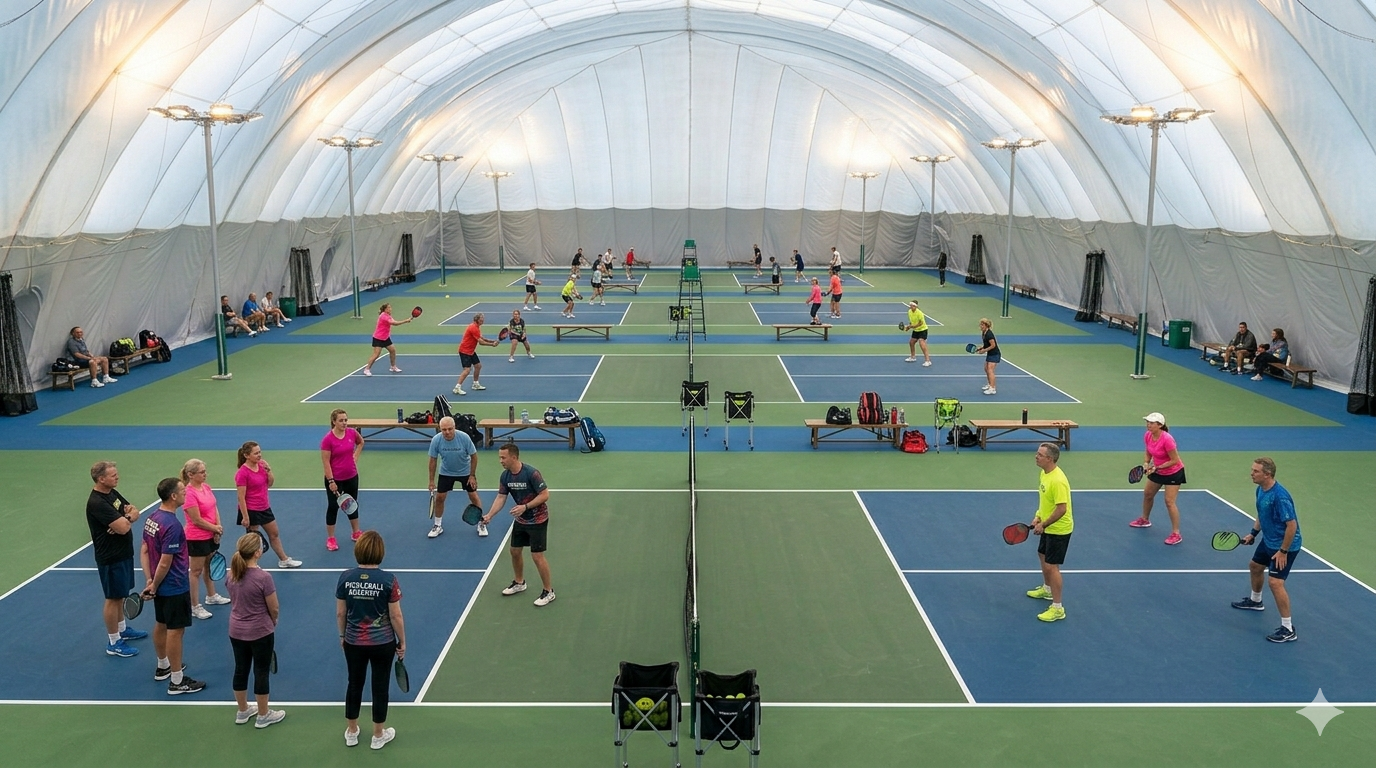
The facilities that generate the best returns are rarely the ones with the biggest domes or the lowest construction costs. They are the ones with the most disciplined approach to programming, pricing, and revenue diversification.
The fundamental economics
An indoor sports dome has a fixed cost base regardless of usage. Every unsold peak hour is revenue that cannot be recovered.
Revenue stream 1: Court and pitch hire
Rate benchmarks:
| Sport | Peak rate (US) | Off-peak rate (US) | Peak rate (UK) | Off-peak (UK) |
|---|---|---|---|---|
| Tennis (per court/hr) | $35–$120 | $20–$60 | £18–£100 | £10–£50 |
| Pickleball (per court/hr) | $25–$90 | $15–$50 | £20–£50 | £12–£30 |
| Football 5-a-side (per pitch/hr) | — | — | £55–£120 | £30–£70 |
| Padel (per court/hr) | $30–$80 | $18–$45 | £30–£65 | £18–£40 |
Key tactics: dynamic pricing (yield management), block bookings (offer 10–15% discounts for 10-week commitments), and booking software (CourtReserve, PlaySight, Club Automation).
Revenue stream 2: Leagues and competitions
Leagues are the highest ROI revenue stream for most operators.
Tournament revenue (4-court tennis open, 64 players):
| Income item | Amount |
|---|---|
| Entry fees | $4,800 |
| Food and drink | $500–$1,500 |
| Sponsor logos | $500–$2,000 |
| Total | $6,000–$9,100 |
vs standard weekend hire: $1,440. Tournament revenue is 4–6× standard hire for the same hours.
Revenue stream 3: Coaching and academy programmes
Staff coaching model: charge market rates ($60–$150/hr tennis US; £40–£100/hr UK). Margin per session: 40–65%.
Franchise / licence model: external coaches pay slightly below rack rate (80–90%). Zero management overhead.
A 20-week junior tennis academy on 2 courts: – 24 students × $350 = $8,400 total – Net contribution after court costs: $5,400
Revenue stream 4: Memberships
| Membership type | Monthly fee | Value proposition |
|---|---|---|
| Open access (off-peak only) | $80–$150 | Unlimited weekday daytime play |
| Priority booking | $140–$250 | 7-day advance peak access |
| Family membership | $200–$350 | 2 adults + children |
| Corporate membership | $500–$1,500 | 4 named users, invoiced monthly |
Revenue stream 5: Schools and education partnerships
Block contract with 3 local schools (2 × 2-hour sessions/week): – £28,800 guaranteed income over a 32-week academic year – Uses off-peak slots that would otherwise be empty
Revenue stream 6: Corporate and events
A 2-hour corporate pickleball/tennis event for 12 people: – Court hire + equipment + food/drink = $680 total – vs $330 standard hire (50–100% premium for exclusive use)
Revenue stream 7: Fitness and non-sport programming
Bootcamp (6am–8am), yoga (mid-morning), HIIT, children’s multi-activity — block-hire to external fitness operators is the simplest model.
Revenue stream 8: Sponsorship and naming rights
Perimeter LED panels: £2,000–£10,000/year. Court naming: £5,000–£25,000/year. A mid-size dome can generate £15,000–£50,000/year in sponsorship at maturity.
Programming sequence: how to build a full facility
- Months 1–3: Court hire only. Fill peak slots.
- Months 3–6: Launch leagues. Convert hirers to weekly returners.
- Months 6–12: Introduce membership.
- Year 2: Schools, corporate, academies.
- Year 3+: Dynamic pricing, sponsorship, secondary revenue.
HeroX AirDomes works with clients throughout the feasibility, design, and post-installation phases to model revenue potential.
Keywords: dome revenue maximisation, indoor sports dome revenue, dome operator playbook, dome court hire, dome leagues, dome tournaments, dome academy programme, dome membership, dome school partnership, dome corporate bookings, dome sponsorship, dome dynamic pricing, dome yield management, dome programming strategy, dome off-peak revenue, dome fitness classes, dome naming rights, dome block bookings, dome revenue diversification
Leave a Reply