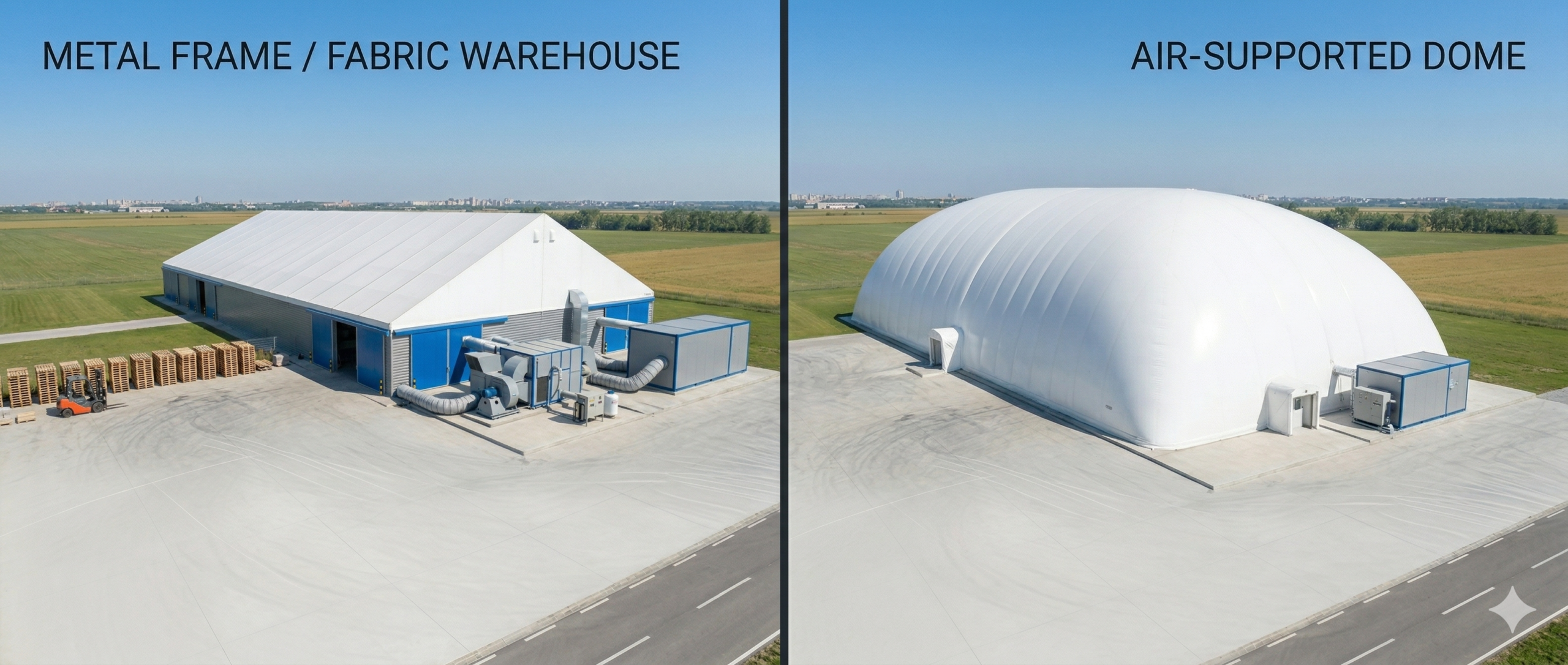
You’ll save 50-75% on upfront costs choosing a sports dome over a permanent building—a 20,000 sq ft air dome costs around $200,000 versus $800,000 for traditional construction. However, permanent buildings last 35+ years compared to domes’ 15-20 year lifespan. Annual operating costs are similar at $3-6 per square foot, though domes install in just 2-6 weeks versus 12-18 months for permanent structures. Understanding these trade-offs will help you make the smartest investment decision.
Sports Dome vs Permanent Building: Upfront Investment Breakdown
When you’re weighing the financial commitment between sports domes and permanent buildings, the upfront investment difference is striking.
Air dome vs building cost analysis shows you’ll spend $10-$25 per square foot for dome structures, while permanent buildings require two to three times more capital expenditure. For a 20,000 square foot (1,858 square meter) facility, you’re looking at $200,000 for an air dome versus $800,000 for a traditional building—that’s 50-75% in savings.
Temporary vs permanent facility cost comparisons reveal dome packages starting as low as $12 per square foot, with costs decreasing as size increases. Sports domes also offer faster installation times compared to permanent structures, reducing labor costs and allowing you to start generating revenue sooner.
The inflatable vs traditional building price gap widens further when you factor in material requirements, as air domes use economical synthetic textiles while permanent structures demand substantial investments in concrete, steel, and glass.
Operating Costs: What You’ll Pay Each Year
Beyond the initial investment, your annual operating expenses will determine the true cost of facility ownership. For a 20,000 sq ft (1,858 sq m) facility, you’ll face several key expense categories that impact the sports dome vs permanent structure decision.
Maintenance costs range from $3–$6 per square foot annually, with inflation systems adding $0.10–$0.20 per square foot yearly for air domes.
Utility expenses typically run $0.50–$1.50 per square foot, though permanent buildings often achieve better energy efficiency long-term.
Staffing represents your largest expense at approximately $500,000 annually for full operations.
Insurance averages $36,000 yearly, while security costs around $30,000.
Total operating budgets range from $336,000 for basic facilities to $1.6 million for extensive complexes. Rental hours constitute over 57% of most facilities’ total revenue, making scheduling optimization critical for covering these substantial operating expenses.
How Long Does Each Structure Actually Last?
While upfront costs grab immediate attention, the lifespan of your facility determines its true long-term value. You’ll typically get 15-20 years from a well-constructed air dome, though high-end models can reach 30 years under ideal conditions.
PVC fabric offers superior durability with 25-year warranties, while lighter PE materials last 15-20 years.
Permanent buildings greatly outlast air domes. You’re looking at 35+ years for standard stadiums, with historic concrete structures operating for over 100 years.
The Cinerama Dome has functioned for 61+ years, while Wrigley Field hit its 100-year milestone.
Your maintenance commitment directly impacts longevity. Proper installation, regular inspections, and following manufacturer guidelines can maximize your structure’s operational life, regardless of the type you choose. Modern air pressure technology continuously maintains inflation to minimize structural stress and preserve dome integrity.
Construction Speed: Sports Domes vs Traditional Buildings
Your facility’s construction timeline can make or break your project’s success, especially when you’re working with tight deadlines or seasonal demands. Sports domes offer dramatically faster installation compared to traditional buildings, allowing you to start operations in weeks rather than months.
| Aspect | Sports Domes | Traditional Buildings |
|---|---|---|
| Installation Time | 2-6 weeks | 12-18 months |
| Setup Process | Inflation in days | Multiple construction phases |
| Labor Requirements | 20-30 workers | Extensive workforce teams |
You’ll find that dome construction eliminates complex foundation work and structural framing that permanent buildings require. While traditional facilities need site preparation, governmental permits, and extensive planning phases, air-supported structures use simplified air pressure systems for rapid assembly. This speed advantage means you can capture revenue opportunities immediately rather than waiting through lengthy construction delays.
The flexible usage capabilities of sports domes also allow for quick adaptation to different sports and events without the extensive renovations that traditional structures would require.
Which Option Delivers Better ROI?
When comparing return on investment, the numbers tell a compelling story that favors air domes for most scenarios.
You’ll save $600,000 upfront with a $200K air dome versus an $800K permanent building for the same 20,000 sq ft (1,858 sq m) space. That’s 50-75% less initial capital investment.
Your operational costs remain competitive at $3-6 per square foot annually, while permanent buildings carry higher year-round expenses.
If you’re operating seasonally for 5-6 months, you’ll reduce costs further compared to 12-month traditional facility operations. Air domes offer additional savings through direct-cooling ice systems that can reduce energy consumption by 60%.
The faster 2-6 week installation versus 12-18 months means you’ll generate revenue sooner.
With proper maintenance, your air dome can last 15-50 years, delivering strong returns on that lower initial investment.
Frequently Asked Questions
Can Air Domes Withstand Extreme Weather Like Hurricanes and Heavy Snow Loads?
Yes, you’ll find air domes exceptionally resilient against extreme weather.
They’ll withstand hurricane-force winds up to 252 km/h (157 mph) and even meet Nuclear Regulatory Commission standards for 482+ kph winds. You can rely on them supporting snow loads exceeding 250 kg/m² without failure.
Their curved design actually reduces wind resistance compared to traditional buildings, while the reinforced membrane maintains structural integrity from -30°C to +70°C temperatures.
What Permits and Zoning Approvals Are Needed for Sports Dome Installation?
You’ll need local government permits before construction begins, with requirements varying by jurisdiction.
Your site must comply with zoning classifications, building codes like IBC and ASCE 55-16, plus setback and height restrictions.
Licensed engineers must create stamped permit drawings (costing around $20,000).
Multiple city departments review applications including Planning, Building Code Enforcement, and Fire Department.
Plan approval typically takes 2-6 weeks, followed by final inspections before receiving your Certificate of Occupancy.
How Much Does It Cost to Relocate an Air Dome Facility?
Relocation costs depend on your dome’s size.
You’ll pay $10,000-$30,000 for small domes under 100 feet (30.5 meters) in diameter, $30,000-$100,000 for medium domes 100-300 feet (30.5-91.4 meters), and over $1 million for large domes exceeding 300 feet (91.4 meters).
These costs include disassembly, transport, and reinstallation.
You can reduce expenses by having your staff help with construction and maintenance during the relocation process.
Are There Financing Options Available Specifically for Sports Dome Construction Projects?
Yes, you’ll find several financing options specifically for sports dome construction.
You can access public funding through UPARR programs, Land and Water Conservation Fund, and EPA Brown/Greenfield grants.
You’ll also benefit from leasing agreements that spread costs over time with lower upfront requirements.
Additionally, you can pursue bank loans, private investors, bonds financing, and community fundraising through sponsorships and donations to fund your project.
What Happens if the Air Pressure System Fails During Events?
If your air pressure system fails during events, you’ll need to evacuate everyone immediately as the dome deflates like a flag.
The fabric develops wave-like movements and whip-like motions, but you won’t face structural collapse onto occupants – cables maintain 30+ feet (9+ meters) clearance above.
However, you’ll lose complete facility protection and face significant re-inflation costs, making your 20,000 sq ft (1,858 sq m) space unusable until pressure’s restored.
Leave a Reply